
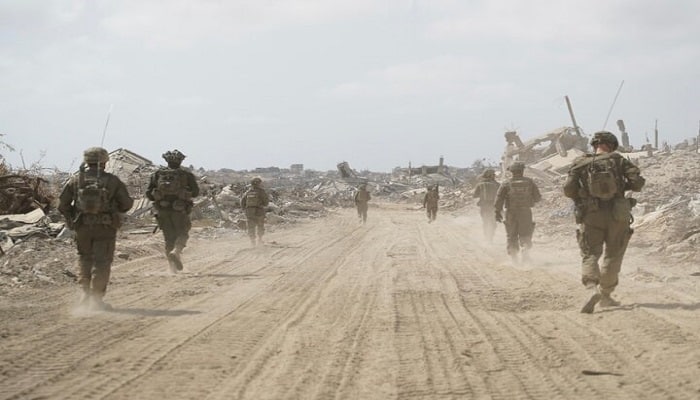
PNN – The Israeli regime’s army, which once claimed to be the most powerful military in the region, is now facing serious threats such as the departure of experienced personnel, declining motivation, and youth emigration.
The Israeli army, which once tried to present itself as the strongest military in the region through media propaganda, is now facing an unprecedented human resources crisis; a crisis that threatens its operational capability and has even shaken the regime’s social and political structure. Recently leaked internal army reports show a shortage of over 1,600 officers at mid and senior levels, and it is predicted that up to 30 percent of senior commanders will leave service in the coming years. Only 37 percent of officers are willing to extend their contracts, and the reserve forces, long the backbone of the army, are shrinking. These figures are not just numbers; they signal the end of a legend built over more than seven decades with Palestinian blood.
Roots of the Crisis: Prolonged War and Social Divide
The main reason for this collapse is the prolonged and exhausting two-year war in Gaza and the northern fronts. Soldiers who were supposed to fight Hamas within weeks are now still trapped in the devastated streets of Gaza after more than two years. Witnessing the deaths of comrades, seeing images of dead children and civilians, and severe psychological fatigue have led many professional officers and non-commissioned officers to conclude that continuing this path is meaningless. A reserve officer admitted to Hebrew Channel 12: “We no longer know what we are fighting for. There is no clear objective.”
However, war is not the only problem. The internal social divide within the Israeli regime has also fueled the crisis. Secular youth and middle-class citizens are required to serve three years or more, then repeatedly called as reservists, while the Haredi community (ultra-Orthodox Jews), comprising over 13 percent of the population, is almost completely exempt from military service and also receives government financial support. When a 22-year-old in Tel Aviv sees peers only studying the Torah and receiving financial aid, there is no incentive to risk their life. This sense of inequality has sparked strong reactions on Hebrew social media: “We are fools fighting, the Haredim study, and Netanyahu gives them concessions to stay in power.”
Read more:
Deep rift between the cabinet and the Israeli army; Tel Aviv in the Gaza quagmire.
The third factor is the declining trust of troops in political and military leadership. The intelligence and operational failures of October 7 remain unaddressed, yet senior commanders neither take responsibility nor provide a clear strategy. When professional soldiers and officers see their commanders unaccountable and lacking a plan, they lose motivation to continue serving and abandon their duties.
Officer Departures and Army Depletion
The consequences of this crisis are no longer in the future; they are evident now. The Israeli army faces a shortage of 1,300 officers from lieutenant to captain and 300 officers at the rank of major and above. To fill these gaps, commanders are forced to promote inexperienced officers quickly—those who would normally reach these ranks in ten years are now occupying sensitive positions. The result is weaker decision-making, more operational mistakes, and higher troop casualties.
The reserve forces, long the army’s backbone, are now declining. The army predicts that in the next year, up to 30 percent of reserve and active personnel will not return. This means that if a new front opens in the north with Hezbollah or resistance groups, the army will lack sufficient forces to fight on two fronts simultaneously. Analysts warn that the combination of experienced officer shortages and reserve attrition has turned the army into a hollow force that is large only on paper.
Economic Pressure and Youth Emigration
The crisis is not limited to the battlefield; the economy is also under pressure. Reservists, away from work for months or years, now face debt and financial problems. Internal surveys show that 70 percent of reservist families are experiencing financial and psychological crises. This situation has led many educated youth who could become future officers to choose leaving Israel. In 2024 alone, more than 50,000 people left Israel, and asylum requests from Jews in European countries reached the highest level since World War II. Young people who could have been the future backbone of the army are now moving to Europe and the U.S.
The End of the Myth of the Israeli Army
The Israeli army, long advertised as a “people’s army,” has now lost its foundation. Netanyahu’s extreme cabinet faces two options: either forcibly conscripts the Haredi community, which could lead to widespread internal conflict, or hire foreign mercenaries and sharply increase the military budget. Both options put severe pressure on Israel’s fragile economy and permanently end the propagandized myth of the “invincible army.” The army that once claimed victory now struggles to find even a few hundred skilled officers.