
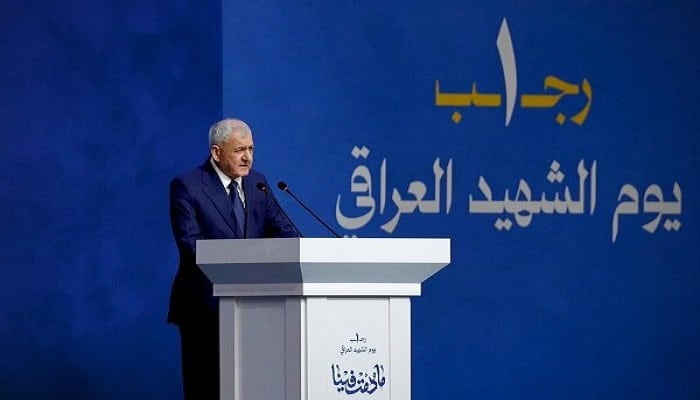
PNN – The President of Iraq said during a ceremony marking Iraqi Martyrs’ Day that Iraq has passed through the turbulence of difficult times and has now reached the shore of security and stability.
According to the report of Pakistan News Network, citing the information office of the Iraqi National Wisdom Movement, Iraqi President Abdul Latif Jamal Rashid said in a speech at the official ceremony held on the occasion of the first of Rajab, the anniversary of the martyrdom of Grand Ayatollah Sayyed Mohammad Baqir al-Hakim and Iraqi Martyrs’ Day, which took place at the headquarters of the National Wisdom Movement in Baghdad, that Iraq has gone through very difficult circumstances. He said that they have gathered today to commemorate Iraqi Martyrs’ Day, an occasion aimed at immortalizing the sacrifices made by the Iraqi people for freedom, democracy, and the struggle against dictatorship.
Referring to the many hardships Iraq has endured, Abdul Latif Rashid said that they proudly commemorate the anniversary of the martyrdom of Sayyed Mohammad Baqir al-Hakim, a great religious and national figure who devoted his life to fighting dictatorship.
He added that Grand Ayatollah Sayyed Mohammad Baqir al-Hakim was one of the pillars of national political activity after 2003 and played an important role in forming the state, consolidating and institutionalizing the democratic process, and defending Iraq’s unity and sovereignty. He brought Iraqis together and, in the most difficult circumstances, gave priority to wisdom, prudence, reason, and dialogue above all else.
The Iraqi president, pointing to the capabilities of the Iraqi state and people, stressed that Iraq has passed through the turbulence of a difficult era and has now reached the shore of security and stability; therefore, strengthening the foundations of democracy is a national mission and a patriotic duty.
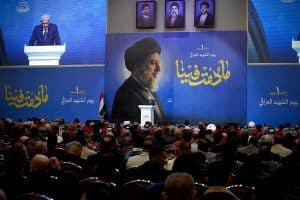
He went on to say that keeping alive the memory of religious scholars, major national figures, and their sacrifices for future generations, as part of the country’s history and identity, is a national duty.
Referring to the difficult conditions Iraq has endured over past decades, Abdul Latif Rashid said that the sons of the Iraqi nation, including all security forces in the army, police, Popular Mobilization Forces, and Peshmerga, have made many sacrifices along this path.
In another part of his speech, emphasizing that the country has achieved stability and consolidation, he noted that everyone should work to preserve this situation. This requires intensifying efforts, resolving outstanding issues, and continuing the path of progress and prosperity.
The Iraqi president added that the sons of the nation achieved a major accomplishment by holding successful elections for the Council of Representatives. Through this, they demonstrated their commitment to the foundations and principles of democracy and pursued their rights to form the executive and legislative authorities, thereby showcasing the will and sincerity of the Iraqi people. Through this step, they sought to realize their aspirations and demands for a dignified and honorable life.
Abdul Latif Rashid stressed in conclusion that consolidating the democratic process is a national duty that will be achieved through adherence to the constitution and its implementation within the prescribed timelines. Therefore, he called for unity and the convergence of efforts toward forming a government that represents all Iraqis, a government capable of realizing their aspirations for a prosperous, developed, and advanced Iraq, institutionalizing security and stability, combating corruption, and improving living standards and service delivery in various sectors, including health and education.
Speaker of the Iraqi Parliament: Political differences must be set aside
Mahmoud al-Mashhadani, Speaker of the Iraqi Parliament, also said at the ceremony that the martyrdom of Sayyed Mohammad Baqir al-Hakim was a turning point in the history of the new Iraq.
Emphasizing the national stature of Martyr al-Hakim, he said that Sayyed Mohammad Baqir al-Hakim was not only a religious and political leader, but also a national symbol who fought for the dignity of the Iraqi people. Martyr al-Hakim played an effective role in consolidating the values of justice, peaceful coexistence, and the formation of a state governed by the rule of law in Iraq. It is necessary to safeguard the achievements gained through the blood of the martyrs and to accelerate the process of government formation within the framework of respecting constitutional timelines.
He added that the blood of the martyrs is a light that illuminates the path toward building a strong Iraq. Political differences must be set aside, and Iraq must transform from a country made up of diverse segments into a state based on equal citizenship rights. We seek stability and international respect for Iraq. Adherence to the constitution is the guarantor of Iraq’s stability and future.
Head of Iraq’s Supreme Judicial Council: Sayyed al-Hakim was the voice of truth during tyranny and the banner of resistance against despotism
Faiq Zaidan, head of Iraq’s Supreme Judicial Council, also said at the ceremony that today marks the anniversary of the martyrdom of Ayatollah Sayyed Mohammad Baqir al-Hakim, a national leader who defended Iraq, its people, and its identity. Sayyed al-Hakim was the voice of truth during the era of tyranny and the banner of resistance against despotism, and even during the years of exile he carried Iraq’s concerns on his shoulders. Sayyed Mohammad Baqir al-Hakim made national unity and building the country on the basis of justice his guiding principles.
Honoring the memory of Iraq’s martyrs, Zaidan said that we proudly remember the martyrs of Iraq, whose blood defined the dignity of the country. Remembering the martyrs is a renewal of our pledge to them and an affirmation that we are committed to the values for which they sacrificed their lives. Our responsibility toward the martyrs is not limited to speaking about them; it also includes caring for the families of the martyrs, honoring their sacrifices, and immortalizing their memory in the minds of future generations. We are also duty-bound to safeguard our homeland, build the country, and protect its sovereignty.