
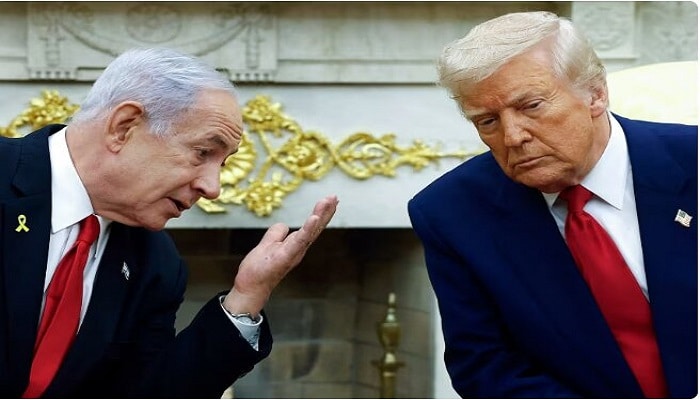
PNN – A careful examination of the content of the meeting between the leaders of the Zionist regime and the United States in Florida reveals that this meeting is more an effort to manage the current situation than a new turning point.
Benjamin Netanyahu, the Prime Minister of the Zionist regime, traveled to the United States and met with US President Donald Trump at a time when regional and international developments are in a state of tension and instability. At first glance, this meeting could be seen as carrying messages about the future of West Asia’s equations, but a closer examination shows it lies more within the continuation of previous patterns of political cooperation and coordination between the US and the Zionist regime, rather than signaling the start of a new path. From this perspective, the Florida visit should be analyzed within the framework of managing the current situation and controlling simultaneous internal and external pressures.
Objectives of Netanyahu’s Visit; Consolidating Political Position and Redefining Priorities
Netanyahu’s objectives can be examined at three levels: domestic, regional, and international—levels that mutually influence each other.
On the domestic level, the Prime Minister of the Zionist regime traveled to the US while facing increasing political and judicial pressures. Internal cabinet divisions, social protests, and legal cases have severely strained the internal political atmosphere of the occupied territories. In such an environment, displaying close relations with the US President can have a symbolic function and serve as a tool to strengthen his political position domestically. This display does not necessarily signify a change in on-the-ground realities but can help manage public opinion in the short term.
Read more:
Hamas: The Zionist regime is the most dangerous enemy of the media and journalists
On the regional level, the focus remained on Iran and the Gaza dossier. Netanyahu’s emphasis on Iran’s missile and nuclear programs is a continuation of the same analytical framework the Zionist regime has pursued in recent years. The main goal of this approach is to maintain Western political consensus around Iran and prevent any moderation in pressure policies. These positions, more than reflecting a new development in regional policy, represent a repetition of a known agenda whose primary function is to manage diplomatic and media discourse.
Regarding the Gaza dossier, the renewed proposal for Hamas’s disarmament and emphasis on security conditions indicate the Zionist regime’s effort to maintain political leverage. However, the experience of recent years’ developments has shown that achieving such goals faces serious political, social, and operational obstacles. Therefore, many analysts evaluate these positions more within the framework of political and diplomatic consumption.
On the international level, Netanyahu’s visit can be seen as an effort to preserve the Zionist regime’s place in the priorities of US foreign policy. In a situation where Washington faces multiple global challenges, Tel Aviv is concerned about a decrease in US focus on the Middle East and a diversion of resources and attention to other regions. This meeting sends an implicit message about the importance of continuing this relationship.
What Happened in Florida?
An examination of the statements and positions raised during the Florida meeting shows that a major part of the discussions focused on topics that have been repeatedly expressed by both sides before. US political support for the Zionist regime, emphasis on concerns regarding Iran, and the presentation of stringent conditions regarding Gaza—all fall within the established framework of US foreign policy discourse.
On the issue of Iran, the statements made are more indicative of political messaging and deterrence rather than a sign of change in practical policy. These positions are often raised with the aim of sending signals to regional and domestic actors, rather than announcing a specific decision for action. The experience of recent years has shown that there is a significant gap between such verbal positions and practical action, and decision-making in this area is influenced by a complex set of political, military, and economic factors.
In reality, US policy toward Iran has been a combination of pressure, tension management, and avoidance of large-scale direct conflict. Sharp or warning statements in such meetings do not necessarily signify a readiness for military action; they are often interpretable within the framework of managing deterrence and controlling the behavior of the opposing party.
Regarding Gaza, the focus on disarmament and phased crisis management indicates an approach that concentrates more on controlling the current situation than on seeking a fundamental solution to the problem. Given the political and humanitarian complexities of the Gaza crisis, this approach faces serious limitations and makes the prospect of achieving a sustainable solution ambiguous.