
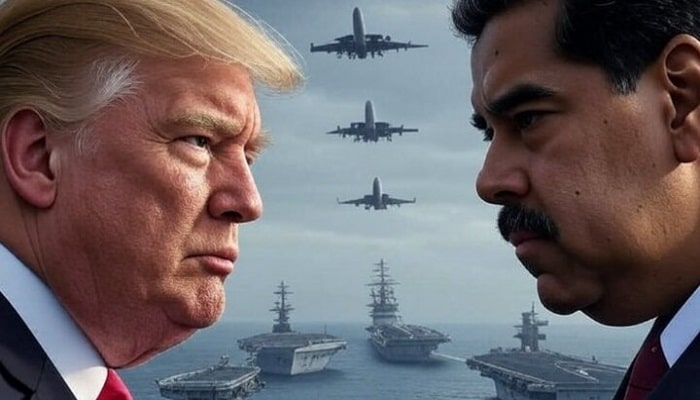
PNN – Trump’s order to close Venezuelan skies has heightened speculation about a possible military attack on Caracas—an action that could carry heavy costs for the region and Washington.
According to the report of Pakistan News Network, Donald Trump’s recent warning on his social media platform Truth Social, urging all flights to avoid Venezuelan airspace, has sparked a new wave of tension in U.S.–Latin America relations. This message, addressed directly to airlines, pilots, and even drug traffickers, has reminded many of the Cold War era and Washington’s unilateral military interventions in the Western Hemisphere.
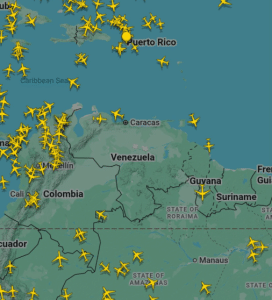
What set this warning apart from a typical security alert is its decisive tone and its timing alongside U.S. Federal Aviation Administration warnings about increased military activity and GPS system disruptions over Venezuelan airspace. While some view this move as part of psychological warfare and diplomatic pressure against Nicolás Maduro, others interpret it as a sign of readiness for a large-scale military operation.
Strategic Contexts and Trump’s Motivations for Military Adventurism
Relations between Washington and Caracas have been highly tense over the past two decades. Since Hugo Chávez came to power in 1999, and later his succession by Maduro, Venezuela has become one of the staunchest opponents of aggressive and confrontational U.S. policies in the Western Hemisphere. During his first term, the Trump administration pursued a “maximum pressure” policy against Maduro and supported Juan Guaidó, who, backed by the White House, claimed the presidency in Venezuela. However, this strategy did not lead to the overthrow of the Caracas government. Some now believe that Trump’s primary goal is the removal of Maduro from power.
Observers note that Trump’s objectives in issuing this warning are multi-layered and complex:
First level: This move can be part of a strategy of political and psychological pressure; a show of force to compel Maduro to retreat or negotiate. Trump has consistently presented himself as a tough president against regimes opposed to the U.S., and he believes that such a hardline stance can help strengthen his domestic support base.
Second level: Domestic U.S. issues play a key role. The wave of migration from Venezuela in recent years has placed enormous pressure on the U.S. southern border. According to statistics, more than seven million Venezuelans have left their country, with a significant portion seeking entry into the U.S. Trump, who has made border control a central pillar of his electoral campaign, may believe that the only way to stop this migration wave is to change the regime in Caracas.
Third level: Trump emphasizes the U.S. government’s concern over drug trafficking into its territory, viewing it as a major security challenge. According to U.S. officials, some trafficking routes pass through Venezuelan territory, making this a focal point of dispute between Washington and Caracas. Trump’s direct reference to traffickers in his message reflects his administration’s focus on this security dimension.
Fourth level: From a geopolitical perspective, Venezuela is an important actor in U.S. strategic calculations. Its vast oil reserves and expanding relations with Russia and China in recent years have made it part of the great power competition in Latin America. Military cooperation between Caracas and Moscow has also drawn Washington’s attention and concern, further highlighting Venezuela’s role in regional security dynamics.
Possible Scenarios and Assessment of the Seriousness of the Military Threat
To evaluate the likelihood of a U.S. military attack on Venezuela, various indicators must be considered. The history of U.S. military interventions in Latin America shows that Washington has not hesitated to use force when it perceives its vital interests to be at risk. The invasion of Panama in 1989 to capture Manuel Noriega, the intervention in Grenada in 1983, and repeated involvement in Central American affairs during the 1950s–1980s all demonstrate that the U.S. has, under certain circumstances, been willing to take unilateral military action.
However, Venezuela is different from Panama or Grenada. With a population of over 28 million, a relatively strong and moderately modernized military, and complex geography—including dense Amazonian jungles and the Andes mountains—Venezuela represents a difficult military target. Moreover, Maduro enjoys the support of a significant portion of the military and security forces, and pro-government militias are ready to defend the regime.
Many experts argue that while the military balance favors the U.S., this does not guarantee a quick or low-cost resolution of any crisis. Analysts note that past U.S. interventions indicate that entering a military conflict, even with superior weaponry, can have long-term and unpredictable consequences.
Another serious obstacle to a military attack is the potential international reaction. Latin American countries, even those opposed to Maduro’s government, are likely to condemn any unilateral U.S. military action. Brazil, Mexico, Argentina, and Colombia have all previously stated that Venezuela’s crisis should be resolved politically and diplomatically rather than militarily. A U.S. attack could revive anti-American sentiment across the region and provide an opportunity for leftist regimes to strengthen their positions.
Russia and China would also respond. Moscow has invested billions of dollars in Venezuela’s oil and military sectors in recent years, and Beijing is one of Caracas’s largest creditors. Although it is unlikely that these powers would directly intervene militarily, they could increase the cost of U.S. intervention through the UN Security Council, economic sanctions, and political or military support for Venezuela.
Some analysts, however, believe that Trump’s warning may be part of a “coercive diplomacy” strategy. In this scenario, the goal is to create psychological pressure on Maduro and his inner circle so that changes in the regime’s behavior—or even its collapse—occur without actual military force. The official announcement of airspace closure could act as a deterrent and send a clear message to regional and international actors about Washington’s seriousness in altering the status quo.
Analyzing the Potential Costs of War for the U.S
If the U.S. decides to launch a military attack on Venezuela, it must be prepared for heavy costs. Even a limited air operation could cost several billion dollars. Should the operation require deployment of ground forces, expenses would increase exponentially. The experiences in Iraq and Afghanistan have shown that post-war reconstruction and stabilization costs often far exceed the initial military expenditure.
From a humanitarian perspective, any military attack would inevitably cause civilian casualties. Venezuela is a heavily urbanized country, and major cities such as Caracas, Maracaibo, and Valencia are densely populated. Military operations in these areas carry a high risk of damaging civilian infrastructure and harming ordinary citizens. Such casualties could escalate into a major humanitarian disaster, further tarnishing the global image of the United States.
Politically, a military strike could mobilize both domestic and international public opinion against the U.S. Within the United States, opposition Democrats and even some Republicans are likely to oppose a unilateral intervention. After two decades of war in the Middle East, the American public is fatigued by conflict and is generally reluctant to support a new military adventure in Latin America.
On the international stage, an attack without UN authorization or support from the Organization of American States (OAS) would be strongly condemned and could lead to diplomatic isolation of Washington. Even U.S. European allies would likely oppose such an operation unless there were compelling evidence of an immediate Venezuelan threat to regional security, which to date does not exist.
Economically, the consequences of military action could be significant. Despite years of economic crisis, Venezuela remains a global oil producer. Any instability in the country could trigger fluctuations in global oil prices, which in turn could negatively affect the world economy and, in particular, the U.S. economy, still struggling with inflationary pressures.
Another potential cost is a surge in migration. Military intervention would likely worsen Venezuela’s humanitarian situation, forcing millions more to flee. This could exacerbate the migration crisis that Trump claims to want to address, placing unprecedented pressure on the borders of Colombia, Brazil, and ultimately the U.S. southern border.
Finally, military action could lead to long-term instability across the Latin American region. Neighboring countries, particularly Colombia—which already faces internal security challenges—could become entangled in conflict. Rebel groups, drug cartels, and militias may exploit the chaos caused by an intervention to expand their activities.
Conclusion
While Trump’s recent warning and airspace closure may signal a serious posture toward Venezuela, a full-scale military intervention carries enormous humanitarian, political, and economic risks. Historical precedent, regional dynamics, and potential international backlash suggest that the costs of such a military adventure could far outweigh its immediate strategic gains. Thus, the threat may be more accurately interpreted as a tool of coercive diplomacy aimed at pressuring the Maduro regime rather than an inevitable prelude to war.