
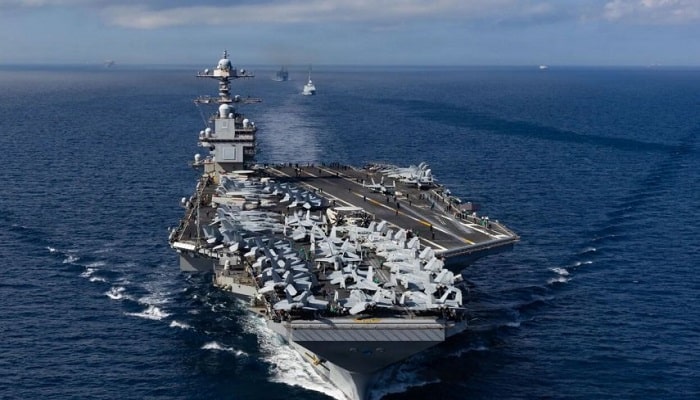
PNN – What is currently happening in the waters of the region is not just the movement of one or two ships, but this situation has enough potential to divert the fragile path of dialogue between Iran and the United States towards a desired or even unwanted confrontation.
On Wednesday, February 11, before meeting with Israeli Prime Minister Benjamin Netanyahu in Washington, US President Donald Trump announced in an interview with the Axios news site that he was considering sending another aircraft carrier to the region.
Trump, while indicating that he is seeking an agreement with Iran, emphasized: We have a fleet headed toward the region, and another fleet may join it.
Trump’s threat to strengthen American forces in the Persian Gulf region came after he described the talks between Tehran and Washington in Oman last Friday as very good.
While indirect talks between Tehran and Washington over Iran’s nuclear program have only just been revived after the 12-day war and the two sides are trying to hold a second round, US military movements in the West Asian region have entered a new phase.
What did the media say about the deployment of the world’s largest aircraft carrier to the region?
The Associated Press reported on February 13, citing a source familiar with the matter, that the aircraft carrier USS Gerald R. Ford will depart the Caribbean Sea for the Middle East. While announcing this brief news, the American media emphasized that this decision was made at a time when the US President is considering the option of possible military action against Iran.
According to the report, with the arrival of the Ford in the region, the number of US aircraft carriers will increase to two. The USS Abraham Lincoln, along with three guided-missile destroyers, had arrived in the region more than two weeks ago.
The White House is strengthening its military presence in the region while pursuing the path of diplomacy. This action, which was ordered by Donald Trump, contains multi-layered messages for Tehran, America’s regional allies, and even the country’s domestic public opinion. The Associated Press, noting that Trump’s action was described as part of Washington’s increased pressure on Tehran to reach a new agreement on Iran’s nuclear program, wrote: This decision was made despite Trump’s national security strategy emphasizing a greater focus on the Western Hemisphere, an issue that indicates that developments related to Iran are an immediate priority for the White House.
Al Jazeera also reported on February 13 that the Pentagon had ordered the preparation of a second aircraft carrier strike group to deploy to the Middle East, citing a report in the Wall Street Journal. Donald Trump retweeted the report on his social media account without further explanation, a move that was seen as a tacit endorsement of the Pentagon’s decision.
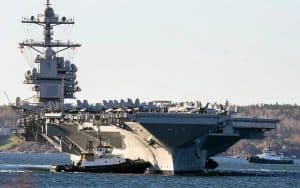
CBS News reported on February 12 that the USS Gerald R. Ford, the most advanced aircraft carrier in the US Navy, has been on a mission since June 2025 and is now scheduled to be transferred to the area under the supervision of US Central Command (CENTCOM) after being deployed in the Caribbean.
The network also noted that the Ford had previously been used in the context of US pressure on Venezuela, and some of its aircraft participated in the January operation in Caracas. The redeployment of the ship to West Asia would mean a longer mission for its crew.
In its report on February 13, Fox News quoted an American official as confirming that the deployment of the second carrier is taking place at the same time as the option of military action against Iran is being considered.
What does Iran say? / Intensification of military movements questions America’s seriousness in negotiations
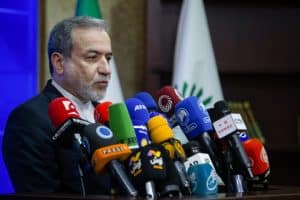
In a press conference on the sidelines of the first “National Congress on Foreign Policy and the History of Foreign Relations” at the Center for Political and International Studies of the Ministry of Foreign Affairs, Foreign Minister Seyyed Abbas Araqchi said, referring to the dual approach of America in resorting to diplomacy and simultaneously shaping a vast military formation around Iran: There are signs that indicate America’s seriousness in the negotiations, and at the same time, there are also signs that diminish this seriousness. The continuation of some sanctions and some movements in the military sphere naturally raise doubts about the seriousness and readiness of the other side. We will monitor and evaluate all these signs together and, based on this conclusion, we will decide on the continuation of the negotiations.
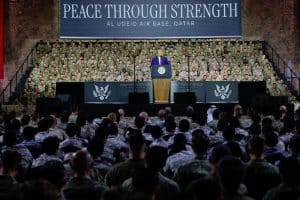
Negotiations in the Shadow of the Ships and Its Connection to Donald Trump’s Idea of ”Peace through Strength”
The idea of ”Peace through Strength,” which Trump often repeats, has its roots in the literature of American conservatives, especially during the Ronald Reagan era. The logic behind this idea is simple: If you are strong enough that the other side fears the cost of conflict, the likelihood of war becomes less and you have more leverage in negotiations. This concept in classical deterrence theory also means displaying power to prevent its actual use.
The precise question is what is the connection between this popular idea ofthe US President and moving along two parallel paths of negotiation and maintaining a military threat around Iran?
When the US simultaneously sends diplomatic messages but also keeps aircraft carriers and bombers in the region, it is repeating a specific message loudly: We negotiate, but if it doesn’t work, we have other tools at our disposal. In the logic of the Trump team at this juncture of the contentious case between Iran and the United States, military power is used not as a substitute for diplomacy but as a support for it.
The next question is: What goals does Trump pursue with this policy? The answer ranges from increasing bargaining leverage in negotiations to domestic consumption.
- Increasing bargaining leverage: In Trump’s logic, negotiation works when the other side feels the cost of failure. Military presence increases the cost of “saying no.”
- A message to allies and rivals: The show of force is not just directed at Iran; it is also a message to Israel, the Gulf States, China, and Russia. Trump usually sees foreign policy as transactional, and in this scenario, everyone should know that America is still the dominant player.
- Domestic narrative processing: In this scene, Trump is also thinking about the audience inside the United States. He wants to hit two targets in the audience’s mind with one arrow: America is both seeking agreement and not weak. In Trump’s psychology, the combination of negotiation and military buildup provides him with an opportunity to present himself as both “peace-loving” and “decisive.”
The paradoxical combination of pressure and diplomacy, when distrust makes the negotiation path uneven
The simultaneous negotiation with Iran and the strengthening of the US military presence in the West Asian region has become a subject of media commentary and analysis in recent weeks.
For example, the Wall Street Journal argued in a report that the US fleet’s movement was carried out in a context of pressure on Iran to reach a nuclear agreement, and that this movement indicates readiness for military consequences if the negotiations fail.
The Washington Post also concluded in a report that Trump is demonstrating “military readiness” on the ground while continuing negotiations with Iran, concluding that this policy could be a sign of Washington’s hesitation in reaching a definitive conclusion to the diplomatic path it has begun with Iran.
The message of the ships for the negotiating table: threatening or empowering
Although simultaneously strengthening diplomacy and military presence is a common policy in American strategy, experts say that resorting to such an approach in the current circumstances is risky and has consequences.
First, the increased military presence, especially the deployment of two aircraft carriers, increases the likelihood of miscalculation. In an atmosphere of deep distrust between the two sides, any incident could lead to a cycle of action and reaction.
Second, such a move sends a double message to the negotiations. On the one hand, Washington wants to encourage Tehran to be more flexible by showing its power. On the other hand, this same show of force could reinforce pessimistic views about negotiations within Iran and make the decision-making environment more difficult.
Third, focusing simultaneously on a military threat and a time limit for an agreement carries high political risk. If the negotiations fail, it will be difficult for the White House to back down from its threatening stance, and moving toward military action would have wide-ranging regional consequences, from threatening energy security to questioning the stability of America’s Arab partners.
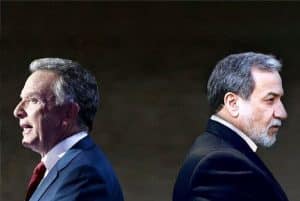
As the exchange of messages between Iran and the United States regarding the second round of negotiations continues under pressure from various lobbies to remove Trump from the negotiating path, the ambiguity surrounding the outcome of this situation can be considered the most important feature of these days. This same ambiguity is also evident in predicting the outcome of Trump’s dual strategy towards Iran.
While some experts describe Trump’s dual strategy as “smart deterrence,” meaning simply “show your power but don’t use it,” for another range of analysts, the risk of “miscalculation” hidden in this strategy is more serious. The main question here is whether this power is truly intended to prevent war or does it inherently have features that increase the likelihood of conflict?