
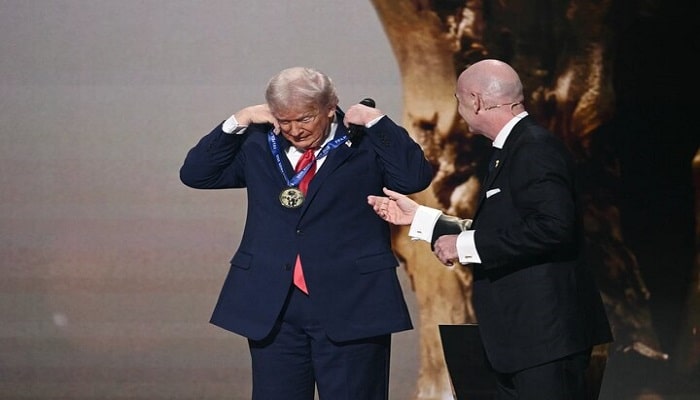
PNN – The FIFA Peace Prize was supposed to be a symbol of the “unifying power of football,” but in practice it became a display of FIFA’s politicking and an attempt to cleanse the image of a president whose name is associated with threats instead of peace.
After Donald Trump failed to win the Nobel Peace Prize, in one of the most surprising and controversial moments in football history, the International Federation of Association Football (FIFA) awarded the first “FIFA Peace Prize” to US President Donald Trump at the 2026 World Cup draw ceremony at the Kennedy Center in Washington; an event that in just a few hours sparked a wave of ridicule, anger and surprise around the world. This award, which had no precedent and even its name was mentioned for the first time at the same ceremony, had no specific criteria, had not undergone a selection and judging process, and was not even, according to some senior FIFA officials, created with the knowledge or approval of the FIFA Council.
The sudden creation of an unknown award
At the start of the ceremony, a video with an exaggerated tone announced that the annual “FIFA Peace Award” would be given to an individual with an “exceptional” achievement in the field of peace. Moments later, FIFA President Gianni Infantino invited Donald Trump onstage and, with great enthusiasm, placed a medal around his neck—one that, as he himself said, Trump “could wear anywhere he wished.” Infantino introduced Trump as the representative of “five billion football fans” and declared that the U.S. President was “fully deserving” of such an honor. Trump, smiling, put the medal around his neck and repeated the familiar claims about ending “eight wars” and “saving millions of lives.” But what many found unbelievable was not merely Trump’s remarks; it was the fact that an award with no process, criteria, or administrative transparency had been invented and suddenly presented to a president known not for peace, but for military operations and international tensions.
Read more:
Beyond Humor: English-speaking Users React to Trump’s Award of the Peace Prize
Global outrage: from mockery to shock
The global reaction was almost immediate, harsh, and widespread. Social media filled with waves of critical comments, with users describing the move as a “political comedy,” “an insult to the concept of peace,” and “political blackmail.” Many wrote that FIFA had “invented an award” just to please Trump, while others mockingly compared the act to “making candy for a child.” Even well-known media figures and international activists described the award as a tool to whitewash Trump’s image, calling it further proof of FIFA’s complete politicization. The backlash was so intense that the award’s name became one of the most repeated topics worldwide within hours, with many calling the move a clear example of hypocrisy by an organization that constantly claims to be “neutral in politics.”
A blatant contradiction with FIFA’s political neutrality rules
For years, FIFA had penalized players for writing even a single sentence about the Gaza war or expressing sympathy with victims of conflicts. Yet now, the same organization, at the height of U.S. election tensions, was awarding a “peace” prize to a president whose naval attacks, military threats against Iran, unconditional support for Israel in the Gaza war, and harsh immigration policies have frequently been condemned by human rights organizations. Many analysts called this behavior a sign of double standards: a world where players are banned from the slightest political gesture while FIFA’s top executives themselves engage in politics at the highest level.
Political ties between Trump and Infantino
Infantino’s close relationship with Trump has long been a subject of media discussion. His frequent participation in U.S. political events, multiple meetings with Trump at the White House, and his vocal support for the idea of awarding Trump the Nobel Peace Prize have all painted a picture of deep political alignment. Some internal FIFA sources have said that ever since Trump became frustrated with not receiving the Nobel Prize, there has been pressure to create an alternative award, and Infantino has been seeking a way to “compensate” for that disappointment. Their relationship drew even more public attention in recent months when, during the Club World Cup final, Trump stood at the center of the championship celebration—despite having no official role—while Infantino handed him an extra medal as a “souvenir.”
Human rights criticism and international consequences
The backlash extended far beyond social media. Human rights activists, researchers, and international organizations described the award as “political whitewashing” and “an abuse of the concept of peace.” A former United Nations official called it “absolute trivialization,” saying FIFA, after its silence regarding Israeli atrocities, was now attempting to absolve Trump by inventing a fake award. Many emphasized that Trump’s actions—from naval operations in the Caribbean to military directives on Iran and anti-immigration policies—have no connection whatsoever to the idea of peace. His selection, they argued, sends only one message: FIFA is willing to abandon its supposed principles in order to maintain its political ties with the U.S. government.
The collapse of FIFA’s last signs of neutrality
FIFA has long been entangled in corruption scandals, bribery cases, and governmental influence, and Infantino’s recent move has delivered yet another blow to the organization’s credibility. Analysts say FIFA has now strayed far from the fundamental principles on which it was built, and that the creation of such an award shows the slogan “football without politics” has turned into an empty and promotional phrase. Some even argue that the peace award is not a tool for honoring achievements, but rather an attempt to cement political relationships and win Washington’s favor—especially since hosting the 2026 World Cup and a major portion of FIFA’s financial projects are directly or indirectly dependent on cooperation with the U.S. government.