
PNN – So far, there has been no coordinated response at the level of Asian countries regarding the Strait of Hormuz, and coordination has been limited to group calls for an end to the conflict.
According to the report of Pakistan News Network, citing Bloomberg, based on this dependence, Asian countries are trying to open the Strait of Hormuz.
Asian countries are vying for leverage and adopting individual approaches in response to Donald Trump’s call to open the Strait of Hormuz on their own, amid mounting economic disruptions.
As the conflict enters its second month, governments from India to the Philippines are negotiating with Iran for safe passage for ships, while forming small circles to find a diplomatic solution — and even a trade deal.
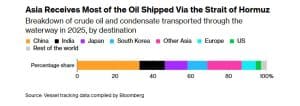
Some U.S. allies, such as Japan, are following a 35-nation effort led by London to restore freedom of navigation to the waterway that just weeks ago handled about a quarter of the world’s seaborne oil trade.
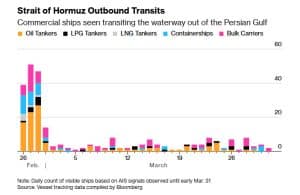
Other countries, such as Pakistan and China, are presenting their own multi-pronged peace plan, as Iran tightens its grip on the shipping artery. In a rare address to the nation on Wednesday evening, Trump said trade would become easier in the coming weeks, claiming the strait would “naturally” open so Iran could sell more oil.
Trump added: Countries around the world that receive oil through the Strait of Hormuz need to be vigilant about this passage. He stopped short of saying the United States would abandon its efforts to help such efforts. “We will be helpful,” he said, but they need to take the lead in protecting the oil they depend on so heavily.
British Foreign Secretary Yvette Cooper will chair a virtual meeting on Thursday with counterparts from countries including France, Canada and the United Arab Emirates to discuss a plan to open the strait, following Trump’s earlier suggestion that the war could end by closing it. A Japanese government spokesman said Tokyo was considering participation. Other US partners in Asia, including South Korea and Australia, are expected to join.
The meeting will explore a joint diplomatic approach to this challenge, as well as economic levers such as sanctions, and could also set conditions for potential military options, if needed.
Asian countries, including Japan, which is legally prohibited from sending its military into a foreign conflict, are unlikely to play a significant role in the use of force. So far, there has been no coordinated Asian-level response to the Strait of Hormuz, and coordination has been limited to group appeals for an end to the conflict. This is partly because while European countries have consulted closely on the Iran war, distrust across Asia – particularly between its largest economies, China and Japan – limits the prospects for joint action.
India, which has negotiated directly with Iran for safe passage for its ships, does not support the Islamic Republic’s control of the Strait of Hormuz but wants to use multilateral forums such as the United Nations to persuade Tehran to open the waterway, according to people familiar with the matter. Officials in New Delhi are concerned about the potential escalation of tensions if Trump threatens to seize the Kharg Island, the people said.
William Klein, who has worked as a U.S. diplomat for more than two decades, said negotiating with Iran over shipping might serve as a temporary solution, but no one is comfortable with unlimited control of the Strait of Hormuz by one country — especially Iran.
Klein, a Berlin-based consulting partner at FGS Global, said: Many countries may support a ceasefire that would allow the strait to reopen, even if Iran retains the de facto ability to control it. However, in the long term, we can expect concerted efforts to establish high thresholds to prevent Iran from exerting influence over traffic in the waterway.
As the crisis continues, many Asian countries have committed to deeper energy cooperation with their diplomatic friends. India is supplying fuel to neighbors like Sri Lanka and Bangladesh, while China has exported shipments of diesel and other fuels to energy-hungry countries across Southeast Asia in recent days.
A Japanese state-backed oil and gas producer is negotiating a swap deal with India to exchange LPG for naphtha and crude oil, according to a Reuters report citing an internal Japanese government document.
Japanese Prime Minister Sanae Takaichi has also had phone calls with the leaders of the Philippines, Malaysia and the Marshall Islands. He told parliament in late March: International cooperation is vital to ensure safe navigation in the Strait of Hormuz and to reduce tensions as quickly as possible.
Masafumi Ishii, a former Japanese diplomat, said: If you don’t cooperate with countries that are fully aligned with our position, this process becomes complicated. Japan can use this to improve relations with China – but it will still be very complicated.
Instead, China has joined forces with its neighbor, Pakistan, to issue a joint call for an immediate ceasefire and protection of shipping through the strait as part of a five-point proposal to restore peace and stability in the Persian Gulf and the Middle East.
Mao Ning, a spokesman for the Chinese Foreign Ministry, avoided answering a question about whether Beijing would consider joining any international efforts to ensure the safe passage of oil through the strait. “The urgent need now is to end the war,” he told reporters at a press conference in Beijing on Thursday, adding that China was ready to play its role.
Many regional governments have tried to keep diplomatic channels open with Iran. South Korea has also refrained from strongly condemning either side, while the Japanese government has also left a channel open for communication with Iran.