
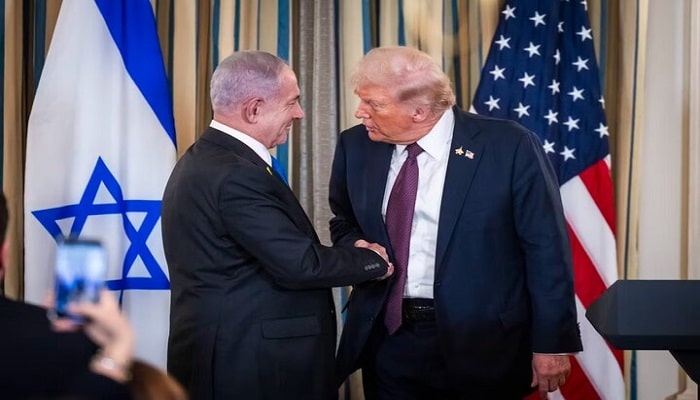
PNN – Over the decades, America has created a cohesive network of military, diplomatic, media, and legal support that has enabled Israel to wage devastating wars at minimal political and legal cost.
The relationship between the United States and the Israeli regime is outwardly defined as a classic political alliance, but in practice it has evolved into a multilayered network of military, legal, media, and ideological support. This relationship has not only ensured Israel’s survival, but has also turned it into an actor capable of continuing destructive wars and large-scale operations against civilians without concern for international consequences. A review of developments over recent decades shows that Washington has gradually moved from the role of supporter to that of an operational partner, facilitating Israel’s path toward committing crimes at multiple levels.
Engineering the narrative; when public opinion is prepared for war
One of the first arenas in which US support for Israel becomes evident is the battlefield of narratives and public opinion. Mainstream American media, through selective use of language, a focus on Israel’s security claims, and the omission of the historical context of occupation, present a one-sided picture of developments in Palestine. Within this framework, airstrikes, blockades, and the destruction of infrastructure are portrayed as “responses” or “defensive actions,” while civilian victims are pushed to the margins. Influential pro-Israel lobbies, by exerting influence over media outlets and think tanks, discredit any critical narrative. The result of this process is the creation of an environment in which Israel’s war is viewed not as a humanitarian crisis, but as a security necessity. This media-driven legitimization lays the groundwork for the continuation of Washington’s political and military support.
US domestic politics; restricting opposition and institutionalizing support
Inside the United States, support for Israel has risen beyond the level of foreign policy and become part of the legal and administrative order. Numerous laws have been passed in various states targeting movements that boycott Israel and making cooperation with them costly. These laws have effectively limited the ability to apply civil pressure on Israel.
Universities and educational institutions have also come under increasing pressure. Many pro-Palestinian student activities have faced restrictions or threats, and university administrators, seeking to avoid legal consequences, have tightened control over campus spaces. Under such conditions, support for Israel has become a “normal” position, while criticism of it has turned into a high-risk act.
Diplomatic immunity; suspending the law at the global level
At the international level, the United States has played the role of Israel’s protective shield through its repeated use of the veto at the UN Security Council. These vetoes have not only blocked binding resolutions, but have also sent a clear message to Tel Aviv: violations of international law will carry no cost. At the same time, Washington has exerted political pressure on legal institutions, obstructing the pursuit of war crimes. This diplomatic immunity has allowed Israel to expand its military operations without fear of sanctions or legal accountability. As a result, international law has effectively been suspended for a specific actor.
The war machine; weapons, technology, and the Gaza battlefield
At the heart of this support lies extensive military cooperation. By allocating billions of dollars in military aid, selling advanced weapons, and transferring sensitive technologies, the United States has turned the Israeli army into one of the most heavily equipped military forces. These capabilities include fighter jets, precision-guided munitions, and advanced intelligence systems that have been used in large-scale operations against residential areas. The level of destruction in Gaza and the high number of casualties demonstrate that these weapons have played a direct role in increasing Israel’s killing power. Without this support, Israel would not have been able to sustain such a level of continuous operations.
Immediate and logistical support
The establishment of US weapons stockpiles in the occupied territories represents another dimension of this cooperation. These depots provide Israel with rapid access to munitions, freeing the war effort from logistical constraints. During the latest war on Gaza, the extensive use of these reserves showed that Washington had already prepared for the continuation of the conflict. After the outbreak of the war, new financial and military aid packages were approved at an unprecedented pace. This speed indicates that the continuation of the war was part of Washington’s strategic calculations, rather than an unintended reaction to developments on the ground.
A social divide; public opinion ahead of the government
Despite the structured and continuous support of the US government for the Israeli regime, clear signs of a deepening divide within American society are emerging, most notably in the growing gap between public opinion and official government policy. Numerous polls show that younger Americans, especially among Democratic and independent voters, have developed a more critical view of Israel and consider the continuation of military aid to it unjustifiable. Images and reports of civilian casualties in Gaza have played a major role in shifting attitudes and increasing sympathy for the Palestinian people.
On university campuses, across social media platforms, and within civil society movements, alternative narratives are gradually spreading, and the new generation is less influenced by the traditional narratives of mainstream media. However, this shift in public opinion has not yet translated into changes in official US policy. The structure of political power, the influence of pro-Israel lobbies, and strategic considerations in foreign policy have prevented this social pressure from turning into concrete decisions. As a result, a widening gap has emerged between society and the state, the continuation of which could have serious political consequences for the future of US policy toward Israel.