
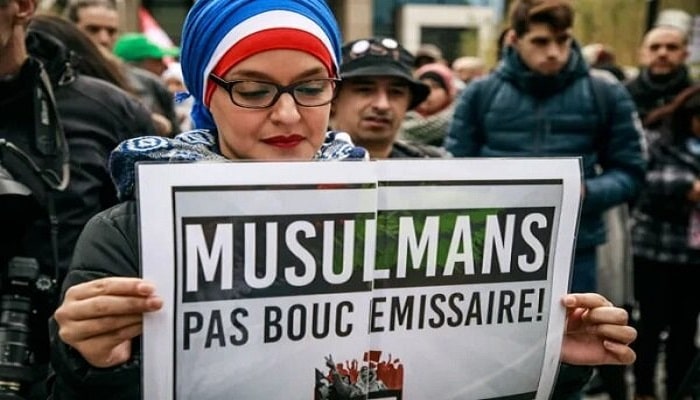
PNN – France, which has long portrayed itself as a symbol of the principles of liberty and equality, has in recent years faced new crises — one of the most significant being the rise of religious discrimination against Muslims.
France, which has long presented itself as a model of liberty, equality, and fraternity, has in recent years found itself confronted with new challenges. One of the country’s major issues is the growing religious discrimination, particularly against Muslims, which has become increasingly visible amid political and social turbulence.
Muslims in France face multiple difficulties, including clear discrimination in areas such as employment, education, and interactions with state institutions. Official reports and social studies show that more than one-third of Muslims in the country experience some form of religious discrimination in encounters with employers, educational institutions, and security forces. This discrimination is especially severe for Muslim women who wear the hijab. Many of these women face challenges in workplaces and schools that force them to leave their jobs or accept reduced professional opportunities. This situation comes despite the fact that France, as a nation governed by strict secular laws, traditionally claims to uphold individual and religious freedoms.
Read more:
One of the main drivers of such discrimination is the set of strict policies adopted by the French government to counter “Islamism.” In recent years, France has enacted a range of new laws intended to combat Islamic extremism and terrorism, which, critics say, effectively target Muslims more than any other group. Among these laws is the “anti-separatism law,” which obliges all educational and public institutions to enforce strict secular principles and eliminate any religious influence from public spaces. These policies — intensified in the aftermath of recent terrorist attacks in France — have drawn criticism for widening social and cultural divides.
In this climate, France’s far-right parties and groups, including the National Rally led by Marine Le Pen, have heavily capitalized on these circumstances. These groups, by highlighting the issue of Islamism and cultural threats, have taken an increasingly hostile stance against Muslims, with some openly advocating for further restrictions targeting them. Marion Maréchal, a far-right member of the European Parliament, is one of the most prominent figures in this camp; she has repeatedly warned in recent years about what she describes as the dangers posed by the expansion of mosques and the growing presence of Muslims in French society.
Accordingly, concerns have intensified over the construction of mosques and Islamic centers in various parts of the country. Some officials and analysts describe these developments as symbols of the threat of Islamism, especially in areas with large Muslim populations. This is despite the reality that many Muslims in France, regardless of their religious beliefs, merely seek to preserve their cultural and religious identity within the legal framework of the republic.
Numerous human rights organizations and civil society groups have criticized these policies, arguing that the laws meant to counter extremism and security threats in practice fuel discrimination against Muslims. They contend that such measures not only fail to serve national security and unity but also push this religious minority into greater isolation. These groups suggest that France should reconsider its approach and, instead of relying on repressive methods, adopt strategies based on interfaith dialogue and efforts to strengthen social cohesion.
On the international level, rising concerns over religious discrimination in France have received considerable attention in global media and international forums. Human rights organizations and several international bodies have urged France to pay more attention to the systemic discrimination faced by Muslims and to refrain from passing laws that risk infringing upon their rights.
Given this situation, it appears that France is on a complex path that requires a thorough reassessment of its policies. While striving to maintain security and combat terrorism, the country must also give due attention to the rights of Muslims and religious minorities to ensure that the fundamental principles of the French Republic — liberty, equality, and fraternity — remain intact.