
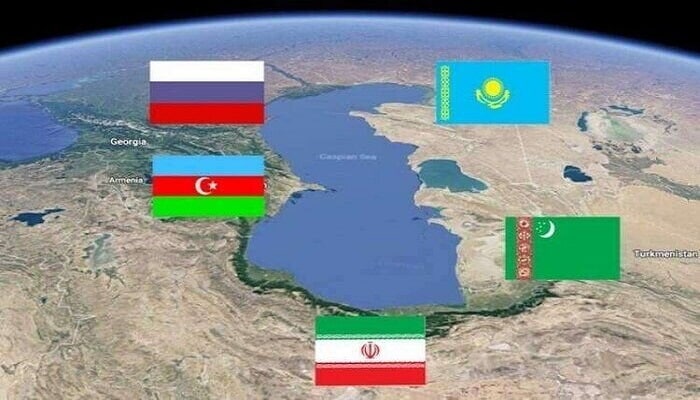
PNN – The geopolitical competition between the three littoral states backed by Türkiye and the Russia-Iran alliance will intensify as both sides continue to expand their economic and military presence in the Caspian region.
The Caspian Sea has increasingly become an important focal point in the emerging geopolitical competition in the Caucasus and Central Asia region. The joint military exercises between Russia and Iran last July, following similar exercises by the Republic of Azerbaijan and Kazakhstan in the northern Caspian Sea, are just one manifestation of the region’s rapid transformation into a network of strategic competitions and evolving security alignments.
Among the littoral states of the Caspian Sea, Azerbaijan, Kazakhstan, and Turkmenistan have assumed prominent roles in shaping its strategic landscape. Their efforts are supported by Turkey, which facilitates the expansion of the three countries’ maritime influence. Russia’s involvement in the Ukrainian war has significantly weakened Moscow’s capacity to exert dominance over the Caspian Sea and effectively use it as part of the North-South international transport corridor connecting Russia to Iran and India. Iran must also intensify its economic and military activity in this sea – which is coveted by NATO and Israel to facilitate access to Central Asia and use its resources, as well as to confront Iran, Russia, and China.
The Caspian Sea was largely considered a Russian lake during the former Soviet era, because Iran, which had only a short coastline in the south of the Caspian Sea, had less ability to use it to exert power, and the Soviet Union did not give Tehran the opportunity to use the potential of the Caucasus and Central Asia. For decades, the Soviet fleet maintained dominance in the Caspian Sea. After the collapse of the Soviet Union in 1991, Moscow sought to maintain the balance of power in the Caspian Sea. In 2018, Russia reached an agreement among the five littoral states of the Caspian Sea on the delimitation of its borders, which ruled out the military presence of non-littoral actors in the sea; although disagreements remained on some issues.
The region witnessed a significant geopolitical shift in 2020 after Azerbaijan won a 44-day war against Armenia over control of Karabakh. Turkey provided military assistance to Azerbaijan during the conflict. After the Azerbaijan-Armenia war, the Caspian littoral states expanded their navies. Turkey continues to support Azerbaijan’s needs for access to modern weapons, equipment, and ammunition. In 2023, Azerbaijani Defense Minister Zakir Hasanov confirmed that Ankara is Baku’s main partner in military cooperation.
The confrontation of the former Soviet republics against Russia
Over the past five years, Turkey has facilitated the expansion of naval influence in the Caspian Sea by Kazakhstan, Azerbaijan, and Turkmenistan. These countries, along with Kyrgyzstan and Uzbekistan, are members of the Turkish-backed Turkic States Organization. Through this framework, Türkiye has taken on a leadership role in US and NATO efforts to reduce Russian influence in the military structure of these countries.
Last year, the joint military exercise Unity 2024 was held at the Uyghur training ground in Kazakhstan and Cape Tokmok along the Caspian Sea coast, the first such exercise without Russian participation. The armed forces of Azerbaijan, Kazakhstan, Kyrgyzstan, Tajikistan and Uzbekistan jointly participated in the exercise.
Then, Azerbaijan and Kazakhstan announced plans to hold joint military exercises called Caspian Breeze in the northern part of the sea near the Russian coastline. The aim of the exercises, held in Aktau, Kazakhstan, was to strengthen the protection of maritime economic infrastructure, naval bases, and shipping lanes. A month later, Russia and Iran began their joint naval exercises, known as CASAREX 2025, under the slogan “Together for a Safe and Secure Caspian Sea.” The exercises were designed to increase maritime security and promote deeper maritime cooperation between the two countries.
These developments indicate an attempt to shift the balance of power in the region. The Caspian littoral states have expanded their naval capabilities in recent years, challenging Russia’s long-standing hegemony in the Caspian Sea region.
Türkiye’s pivotal role in the confrontation with Russia
Turkey plays a pivotal role in the ongoing militarization of the Caspian Sea. It first strengthened the defense capabilities of Azerbaijan, then supported Turkmenistan, and is now actively involved in increasing Kazakhstan’s naval power. Kazakhstan, in particular, has been pursuing a steady, multi-year process of strengthening its naval forces in the Caspian Sea. Over the past decade and a half, Turkmenistan has been trying to build a stronger naval force in the Caspian Sea, including with the help of Turkey. Turkmenistan’s largest ship and one of the largest warships in the Caspian Sea, the Turkish-designed frigate Deniz Khan, was launched and built in 2021. Carrying out various missions, including air, surface, subsurface defense, and patrol, is among the duties of this 1,600-ton frigate, which travels at a maximum speed of 26 knots and has a length of 91.4, a width of 13.3, and a draft of 3.5 meters. A significant number of missiles, rocket artillery and other boats for the Turkmen border guards have also been built based on Turkish designs. The increasing number of actors in the region challenges Moscow’s ability to use the region for strategic connectivity projects.
One of these is the North-South International Transport Corridor, designed to connect Russian ports to Iran, the Persian Gulf region, and the Indian Ocean. The agreement to establish this corridor was initially signed in 2000 by Russia, Iran, and India, and was later joined by the Republic of Azerbaijan and several Central Asian countries. Meanwhile, Iran, while trying to utilize the capacity of the Caspian Sea, is actively seeking alternative trade routes to EU countries, including through Armenia.
Similarly, Turkey is pursuing the integration of Turkmenistan into the Middle Corridor and reducing its reliance on Iran. This is done with the aim of fulfilling Turkey’s long-standing desire to position itself as a strategic logistical bridge connecting Asia and Europe.
Ankara plans to transport Caspian Sea gas through the Republic of Azerbaijan to its territory and then to the European Union, enhancing Turkey’s role as a pivotal energy hub. However, this directly conflicts with Russian and Iranian interests and has the potential to escalate tensions or even confrontation between Turkey-backed countries and the Russian-Iranian alliance over control of Caspian energy resources. Iran and Russia have also clearly opposed the idea that it poses severe environmental risks, especially for Iran.
Solutions ahead for Iran
The geopolitical competition between the three littoral states, backed by Turkey and the Russia-Iran alliance, will intensify as both sides continue to expand their economic and military presence in the Caspian region. The increase in military exercises conducted in the past two years attests to the emergence of new security alignments in the Caspian Sea basin.
At the same time, the following solutions are also envisaged for Iran:
Strengthening the economic and transit role
- A) Strengthening the North-South Corridor: Completing rail and port infrastructure (especially Rasht-Astara and developing Anzali and Amirabad ports) to make Iran the main route connecting India and the Persian Gulf to Russia and Eurasia. This will reduce the dependence of coastal countries on alternative routes (including those supported by Ankara).
- B) Flexible energy diplomacy: including participation in oil and gas swap projects with Russia, Kazakhstan, and Turkmenistan, proposing the creation of joint exploration and technical-engineering service consortiums in the Iranian sector of the Caspian Sea, and the development of small-scale LNG infrastructure and regional electrification.
- C) Deeper ties with the Eurasian Economic Union: Deepening cooperation with the union to reduce tariffs and facilitate trade with Russia, Kazakhstan, and other members.
Active regional diplomacy
- A) Soft alliance building with Russia and Kazakhstan: managing competition through multilateral mechanisms and focusing on collective coastal security; further cooperation with Russia in the areas of search and rescue, environment, and shipping safety.
- B) Reducing tensions with the Republic of Azerbaijan: Reducing security costs through talks on two axes: border affairs and energy, and joint port and transit projects; the higher the level of economic interdependence, the less room for maneuver for external actors.
- C) Using regional organizations: Activating the capacities of the Shanghai Cooperation Organization for security-economic synergy in Central Asia
Deterrence and balanced maritime presence
- A) Modernizing Iran’s shipping fleet in the Caspian Sea: with the aim of increasing patrol, mine-sweeping, electronic warfare, and drone capabilities, with an emphasis on coastal defense missions and protection of shipping lanes.
- B) Increasing joint exercises in the coastal strip: Continuing rescue and maritime safety exercises with coastal countries to consolidate the principle of “maintaining security by coastal countries” and reduce the excuse for external intervention by countries such as Turkey.
- C) Focus on strengthening coastal defense: Strengthening coastal defense and missile systems within the defense framework, to increase the cost of any threat without entering a costly arms race.
Complementary software and economic tools
Including investment in the Anzali and Amirabad free zones to attract capital from Russia, China, and Central Asia, employing maritime scientific-technological diplomacy (sustainable fisheries, attention to the marine environment, pollution management), and diversifying partners (India, China, Central Asian countries) to prevent dependence on one axis.