
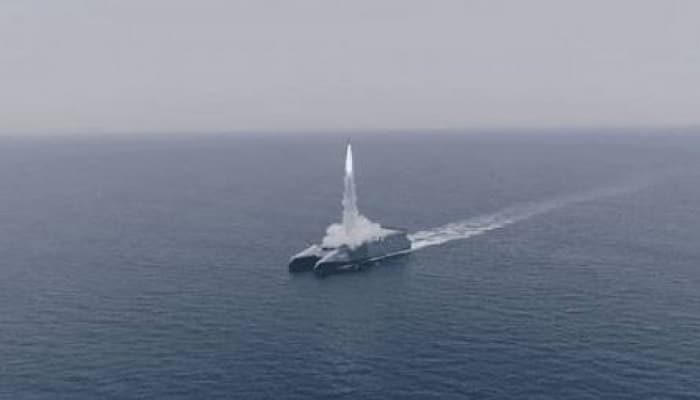
PNN – During the IRGC Navy’s “Smart Control” exercise in the Strait of Hormuz, the “Sayad 3-G” naval defense missile was fired and operated for the first time from the Martyr Sayyad Shirazi ship.
This vertical-launched missile with a range of 150 kilometers, in addition to independent detection and engagement, also has the ability to connect to an integrated command and control network, increasing the survivability of vessels against aerial threats.
In recent days, the “Sayad 3-G” defensive missile (the naval version of the Sayad 3-F) was unveiled during the Iranian Revolutionary Guard Navy’s Smart Control of the Strait of Hormuz exercise.
In this exercise, a Sayyad 3-G missile (the naval version of the Sayyad 3-F) was fired from the Shahid Sayyad Shirazi frigate, the third ship in the Shahid Soleimani class.
This warship, which is considered one of the most advanced combat vessels of the IRGC, is equipped with large vertical launch silos and is capable of carrying six of these missiles; a capacity that has turned it into a mobile regional air defense platform in the southern waters of the country.
150 km range; creating a regional air defense bubble at sea
The declared range of the Sayyad 3-G missile (the naval version of the Sayyad 3-F) is 150 kilometers, a number that places this missile in the medium- to long-range category. This range allows the carrier to intercept and destroy aerial targets, including fighters, high-altitude drones, support aircraft, maritime patrol aircraft, and some cruise threats, at a significant distance.
In an environment like the Strait of Hormuz, which is considered one of the world’s most important energy and maritime trade bottlenecks, creating a 150-kilometer air defense bubble around a vessel significantly increases the defense depth of naval units and complicates the operational equations of any air threat.
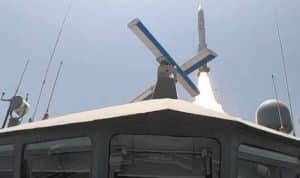
The importance of the vertical launch feature of a missile
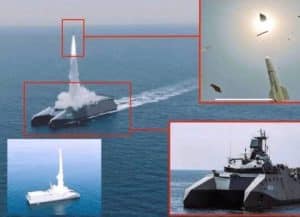
In vertical launch systems, the missile provides 360-degree coverage without the need to direct the launch platform; reaction time to sudden threats is reduced; rapid and consecutive firing is possible against saturation attacks, and the survivability of the ship in combined battles is increased.
“Sayyad 3-G”; the naval version of a strategic family
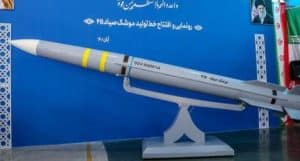
The Sayyad 3-G missile is actually the naval version of the Sayyad 3-F missile, which was introduced on February 18, 2023, along with the unveiling of new defense systems. The Sayyad family has been developed in recent years as a common, modular platform that undergoes specific technical changes depending on the host system.
These changes can include upgrades to the autopilot, flight computer, guidance and control algorithms; data link type, warhead design, proximity fuse, propellant type, and fuel composition, so that each version is optimized precisely to the radar structure and command architecture of the relevant system.
The evolution of Sayyad family of defensive missiles
“Sayyad 1 and Sayyad 1(A)” are designed and produced for surface-to-air air defense systems by reverse engineering the Chinese HQ-2 missile.
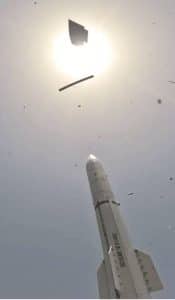
“Sayyad 2” is designed and produced for surface-to-air air defense systems.
“Sayyad 3-E” was designed and produced for the 15 Khordad systems.
“Sayyad 3-F” is operational in the Arman system.
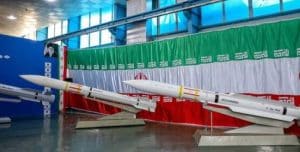
The “Sayyad 4-B” is also used as a long-range missile in the Bavar 373.
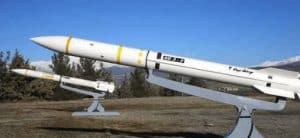
Along the same lines, the “Sayyad 3-G” is a version designed for deployment on combat vessels and, in addition to being compatible with vertical launch silos, has been reinforced against sea vibrations, high humidity, spatial constraints, and specific environmental conditions of the sea.
The importance of ship defense in modern naval battles
In contemporary naval warfare, the main threat to ships comes not only from the sea surface, but also from the sky. Fighter jets, armed drones, anti-ship cruise missiles, and even saturation strikes can pose a serious threat to ships in a short period of time.
Therefore, ship air defense is a critical component of combat survivability. Without an effective defense layer, even the most powerful ships will be vulnerable to multi-layered attacks.
Network-centric defense: combining independent discovery and operational intelligence sharing
The firing of the “Sayyad 3-G” missile as part of the “Smart Control” exercise shows that this system is capable of detecting, intercepting, and destroying aerial targets both independently and by relying on the radar installed on the vessel and within the framework of a network-based structure, it can receive target data from other reconnaissance systems and command centers.
Iran’s long-range naval defense system becomes operational
The operationalization of the Sayyad 3-G at sea should be considered a milestone in the evolution of the Islamic Republic of Iran’s maritime defense. This development not only indicates the maturity of naval vertical launch technology, but also represents the realization of the “common platform – diverse applications” strategy in the Sayyad family.
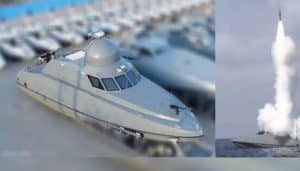
Now, the IRGC’s combat vessels, equipped with a 150-kilometer-range vertical-launch missile, are capable of creating an air defense bubble at a significant depth in their operational environment; a capability that will play a decisive role in deterrence, active defense, and countering hybrid threats scenarios, and has elevated the concept of “sea defense” from a theoretical level to an established operational capability.