
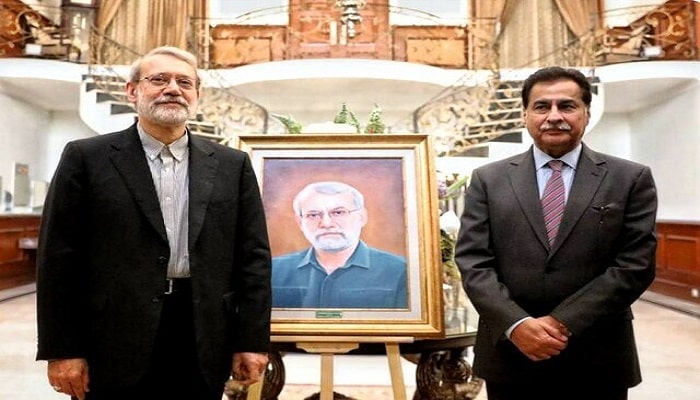
PNN – The recent visit of the Secretary of Iran’s Supreme National Security Council to Pakistan carried important messages regarding energy, security, and Iran’s regional role.
The significant visit of Ali Larijani, Secretary of Iran’s Supreme National Security Council, to Pakistan included meetings with the country’s prime minister, president, and army chief; a visit that carried important messages about energy, security, and Iran’s regional role.
This trip should be considered one of the most important diplomatic events of recent months; a visit that went beyond a formal meeting and carried important security, political, and strategic messages for the region, especially South Asia. This visit followed the recent visits of Iran’s President Masoud Pezeshkian and Parliament Speaker Mohammad-Baqer Qalibaf to Pakistan; a set of coordinated and purposeful moves that clearly shows Pakistan has a special and strategic position in Tehran’s foreign policy.
Larijani’s presence in Islamabad and his meetings with Pakistan’s highest officials, from the prime minister and president to the army chief, indicate Iran’s determination to open a new chapter in relations with a country whose role in the future of regional security is undeniable.
Read more:
Pakistan, Iran pledge closer ties, enhanced cooperation on regional, global issues
Pakistan: An important eastern neighbor
For Iran, Pakistan is not just an eastern neighbor; it is one of the most important players in the Islamic world and a connecting link between South Asia, Afghanistan, and the Indian Ocean. The geopolitical position and political and security capacities of Pakistan make it Iran’s natural partner in shaping regional stability.
The challenges in Pakistan’s surrounding environment — the complex situation in Afghanistan and the historical rivalry with India — are not obstacles but opportunities for strengthening joint cooperation and for Iran’s constructive role in reducing tensions and reinforcing regional peace.
In his meetings, Larijani clearly stated that Iran considers Pakistan “valuable and strategic,” and that Tehran is ready to play a more active role in helping resolve the complex challenges among Islamabad, Kabul, and New Delhi. His use of the phrase “blank check” for assisting Pakistan indicated Iran’s real power and ability to influence and manage regional developments.
Appreciation for the support of the Pakistani people in the 12-day war
One of the highlights of this visit was Larijani’s meeting with scholars, intellectuals, and religious figures of Pakistan. Conveying the warm greetings of Iran’s Supreme Leader to the people of Pakistan was met with remarkable reception by the public, official media, and social networks of the country.
Larijani also expressed gratitude for the broad support of both Shia and Sunni communities and Pakistani elites for Iran during the 12-day war. This level of solidarity demonstrated that Iran’s soft power and social influence in Pakistan is deeply rooted, beyond governmental politics, and based on historical, cultural, and religious ties.
This social backing can provide a reliable basis for strengthening cultural, religious, and social cooperation between the two countries and serve as a strategic asset in reinforcing Tehran–Islamabad relations.
Energy diplomacy: Iran’s potential power and Pakistan’s strategic need
The Iran–Pakistan gas pipeline — halted for years due to foreign pressure on Pakistan — was one of the important points in Larijani’s statements. He emphasized that “if there were no obstacles, the people of Pakistan would now be using Iran’s gas,” making the role of external factors in depriving Pakistan of a stable energy source more apparent.
At a time when Pakistan faces an unprecedented energy crisis, Iran — one of the world’s major energy powers — is naturally the most suitable partner for the country. If external pressures on Pakistan ease, energy cooperation can be expected to become the main pillar of strategic Tehran–Islamabad relations.
Iran and Pakistan: Security convergence for a more stable future
Larijani’s meeting with the army chief of Pakistan was another key part of this trip. Pakistan is a country where the army plays a decisive role in foreign policy and security. Direct talks between Iran’s top security official and this institution are important because Tehran seeks to establish a new model of security and border cooperation — one that can enable better control of border threats, confrontation with extremist terrorist groups, and the strengthening of sustainable security.
Meanwhile, Iran’s power and experience in managing regional crises make Tehran a reliable player for establishing stability in its surrounding environment.
Iran: A power capable of organizing regional peace
Because of its geopolitical position, simultaneous relations with India, Pakistan, and Afghanistan, and long experience in managing crises and regional mediation, Iran is one of the few countries capable of playing an active and decisive role in creating regional peace.
Larijani’s visit showed that Tehran is not only aware of this capacity but also has the will to use this power. The continuation of this approach can increase Iran’s weight in South Asian dynamics and help promote stability in the region.