
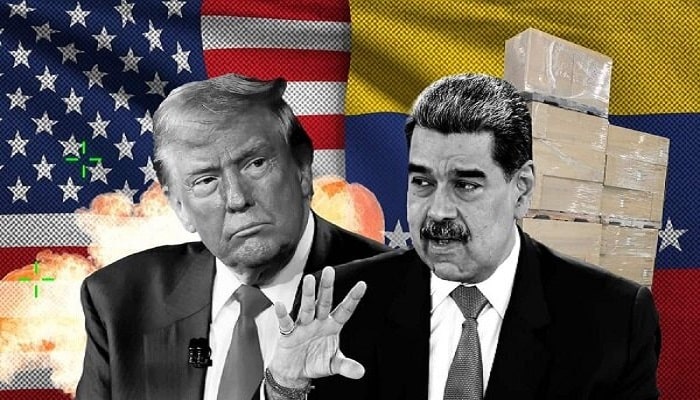
PNN – The Venezuela crisis is a clear example of the complexity of U.S. foreign policy during Donald Trump’s presidency.
In recent weeks, tensions between the United States and Venezuela have reached an unprecedented level. The U.S., under the claim of combating drug trafficking, seeks to defeat the popular resistance of Venezuela. This crisis—which includes military threats, intelligence operations, economic pressure, and complex diplomacy—has caused widespread concern in the Caribbean region and Latin America. Reports indicate that U.S. President Donald Trump has considered multiple options, from direct threats to negotiations, in order to pressure the Maduro government.
Increased U.S. military presence in the Caribbean
For several months, the United States has sharply increased its military presence in the Caribbean. Aircraft carriers *USS Gerald R. Ford*, *Winston S. Churchill*, and others have been deployed near the Venezuelan coast, with thousands of military personnel and modern F-35 fighter jets stationed in the region. This U.S. move, which is the largest naval buildup in the Caribbean since the Cuban Missile Crisis of 1962, has intensified concerns about a possible direct military intervention in Venezuela.
In his latest statements, Trump announced that Venezuela’s airspace and surrounding areas have been “blocked,” increasing fears of a potential U.S. ground invasion. He also emphasized that the U.S. anti-drug operations in the Caribbean could enter a ground phase, although details of this have not been clarified.
Read more:
Political crisis and pressure on Maduro
The U.S. government has used various tools to pressure Maduro. Trump has labeled Maduro as the leader of a “foreign terrorist organization” and has placed a $50 million bounty on his capture—an amount twice the bounty offered for Osama bin Laden after the September 11 attacks. The goal of these measures is to pressure Maduro into surrender or withdrawal from power. However, Maduro has responded with defiance and has recently appeared in military uniform to show his readiness to defend his country. In his public speeches, he has repeatedly declared that he has no intention of surrendering and is prepared to confront any “imperialist threat.”
Intelligence activities and covert operations
Alongside military pressure, Trump has authorized covert operations by the CIA. The aim of these operations is to gather intelligence and potentially target drug-trafficking networks linked to the Maduro government. These measures, in addition to military actions, have increased concerns about violations of Venezuela’s national sovereignty and breaches of international law.
Economic and geopolitical motives
One of the most important factors behind Trump’s hostile policy toward Maduro is Venezuela’s vast oil resources. Venezuela possesses the world’s largest oil reserves, and control over them would provide Washington with a geopolitical advantage. Analysts believe that the U.S. seeks to steer Venezuela toward its strategic interests and prevent the influence of China, Russia, and Iran in the country.
The historical relationship between the U.S. and Venezuela is also complex. In the 1970s, Venezuela was a reliable U.S. ally. But after Hugo Chávez was elected in 1998 and nationalized the oil sector, the relationship deteriorated. Chávez and later Maduro forged closer ties with Russia and China and distanced themselves from cooperation with the U.S. in oil and security spheres. With Trump’s rise to power, Washington adopted an aggressive policy to restore its influence in Venezuela.
Domestic and international reactions
Reactions to Trump’s policies toward Venezuela have varied. Inside the United States, supporters of the MAGA movement worry about entering a long and costly war. Some members, such as Marjorie Taylor Greene, have openly criticized Trump for focusing too much on foreign issues. In contrast, figures such as Marco Rubio support pressure on Maduro, as the issue is popular in Florida among Cuban and Venezuelan communities.
Internationally, many Latin American and European countries have reacted negatively. Russia and China, Maduro’s allies, have strongly opposed U.S. intervention. Russia has called these actions “unacceptable,” and China has emphasized its opposition to any foreign interference. The presidents of Brazil and Colombia have condemned the move as “an aggression against Latin America.”
Legal and humanitarian concerns
Human rights activists and international law experts describe U.S. actions as violations of international law and the U.S. Constitution. Attacks on suspected drug-trafficking vessels—which have resulted in the deaths of more than 80 people—are described as “extrajudicial executions” and violations of human rights. Additionally, labeling the Venezuelan government as a “foreign terrorist organization” is seen as an attempt to justify military actions, while under the U.S. Constitution only Congress has the authority to authorize offensive military operations.
Possible scenarios
Given the current situation, several scenarios for Venezuela’s future are possible:
Limited military attack: Experts believe a large-scale ground invasion is unlikely, but targeted air and missile strikes against infrastructure and military networks may occur.
Negotiations and diplomatic pressure: Alongside military threats, Trump has mentioned negotiations with Maduro. A strategy of increased pressure to force negotiation could reduce tensions or compel Maduro to retreat.
Continued tension and regional crisis: Ongoing U.S. military presence, along with economic and diplomatic pressure, may prolong the crisis and negatively affect neighboring countries, especially Colombia and Brazil.