
PNN – The controversial statements by the US ambassador to Israel about Tel Aviv’s “historical right” have raised concerns about new power realignment in the Middle East.
According to the report of Pakistan News Network; in the days when the Middle East region is once again in a fever of security tensions and military buildups, one sentence was enough to trigger a wave of analysis and concerns. This time, it was not a military commander, nor a regional prime minister, but the US ambassador to Israel, Mike Huckabee, who, with unprecedented remarks, brought the debate over “Israel’s alleged right to dominate the region” to the forefront of the news.
Although some analysts see these statements as a continuation of Washington’s long-standing approaches towards Tel Aviv, their frankness has taken the political and security equations of the Middle East to a new level.
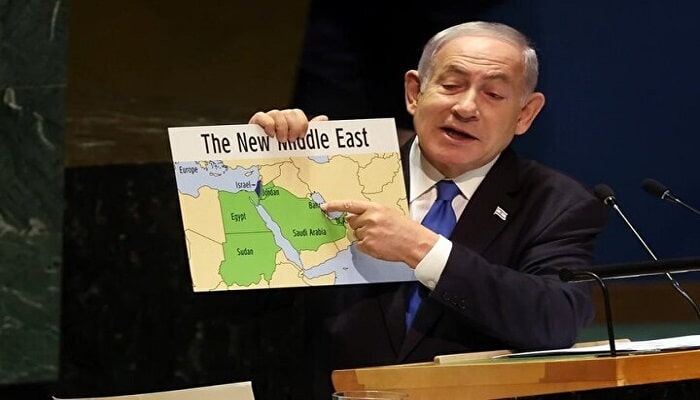
In public speeches, without using conventional diplomatic language, Huckabee spoke of what he called “Israel’s historical right,” a term that for many observers was reminiscent of the ideological literature of the movements supporting the “Greater Israel” plan.
These statements were made in a situation where the region is facing a series of simultaneous developments:
Increasing border tensions on the northern front of the occupied territories
US military movements in the Persian Gulf waters
Changing the arrangement of trans-regional forces
The “Greater Israel” Project
The idea of a “Greater Israel” has been proposed in the literature of some ideological currents for years, a plan that depicts its territory from the Nile to the Euphrates. This idea has had a strong presence in the discourse of some extreme right-wing currents.
Critics argue that even if direct occupation of these territories is not possible, more modern forms of influence have replaced it:
Security intrusion
Political engineering
Economic influence
Creating ethnic and religious divisions
Taking advantage of proxy wars
Washington’s silence
What heightened the sensitivity was the cautious response, or as some would call it, the silence, of the US government. As of the time of publication of this report, the White House has not provided a clear official position on refuting or modifying its ambassador’s remarks.
This is while Washington’s previous positions, especially during Donald Trump’s presidency, have always been accompanied by claims of initiatives such as regional meetings and compromise plans.
Iran: A key player in the region
In strategic analyses, Iran has always been considered a key player in the regional balance. On the one hand, Tehran is linked to a network of regional allies and on the other hand, it has taken an open stance against the Israeli occupation.
China has expanded its technological and infrastructure cooperation with Iran in recent years, and Russia has held joint naval exercises. This convergence transforms any potential conflict from a bilateral dispute into a multipolar competition.
In recent weeks, there have been reports of heightened security alert in Israel and activity on its northern borders. At the same time, the United States has also moved some of its forces to the region and deployed advanced defense systems.
Such actions are not usually undertaken without a strategic background. Some analysts see these moves as part of “active deterrence,” while others see them as a prelude to more aggressive scenarios.
Experts believe that if Arab countries fail to design a coordinated framework to defend their common interests, future developments will take place without their effective participation.
Ahead scenarios
Putting the puzzle pieces together, several scenarios are conceivable:
- Controlled pressure scenario
Increasing verbal and military tension to strengthen deterrence, without engaging in all-out war.
- Limited conflict scenario
Targeted and limited interventions that send a clear political message but prevent the crisis from spreading.
- Geopolitical realignment scenario
Gradual developments during which the map of regional influence changes without necessarily changing the official borders.
- Multipolarization scenario of the crisis
A more active entry of Russia and China into the equation that would elevate any confrontation to a more global level.
What is crucial is that silence in the face of these occupationist statements is not permissible, and if the international community does not stand up now, the Zionist regime will allow itself to advance and commit more crimes.