
PNN – The policy of looting resources, imposing will, and using economic and modern piracy for pressure is part of the very nature of U.S. foreign policy; Trump has merely stripped it bare.
Donald Trump’s remarks about Venezuela cannot be confined to the usual framework of controversial statements or electoral rhetoric. When the U.S. president openly says that “Venezuela took our oil rights” and emphasizes that America “wants to take it all back,” these words are not merely a political stance, but a blunt expression of a worldview—a worldview that has long existed at the core of U.S. foreign policy, yet has traditionally been concealed behind diplomatic language, moral claims, and human rights slogans.
Unlike his predecessors, Trump not only makes no effort to conceal this logic, but presents it as a self-evident right—a right in which ownership of other countries’ resources is regarded as natural and subject to claim. The importance of this admission lies in the fact that, for the first time, the logic of “legitimate plunder” is articulated not in classified documents or critical analyses, but by the highest executive authority in the United States.
This statement lifts the veil on a reality according to which, in the mindset governing segments of the American political elite, the concept of national sovereignty is valid only so long as it does not conflict with Washington’s interests. The moment a country pursues an independent path, its resources are no longer seen as the property of its own nation, but as “America’s lost rights.” This is the point at which Trump’s words shift from media provocation to a strategic document.
Read more:
Venezuela as a model; America’s logic of global ownership
In this narrative, Venezuela is not an exception, but a clear example. A country that holds the world’s largest oil reserves and has for years sought to define its energy and economic policies independently of Washington’s will. In Trump’s view, this very independence constitutes a “violation”—a violation of an order in which the United States sees itself as the owner and overseer. The key question is this: if the U.S. president today makes such a claim about Venezuela, what guarantee exists that tomorrow the same logic will not be applied to other countries?
This is precisely where the logic of neo-colonialism reveals itself. In this logic, countries are valued not on the basis of international law, but according to the degree of their compliance with the U.S.-centric order. Any country that steps outside this orbit is quickly placed in the category of a “threat,” a “rogue state,” or a “violator of the global order,” and its resources are defined as tools of pressure or targets for reclamation. Venezuela occupies this position today, but the history of U.S. foreign policy shows that this list is constantly expanding. From Latin America to the Middle East, the logic is the same: resources belong to those who possess the power to impose their will.
Old plunder with new language and tools
Comparing this logic with classical nineteenth-century colonialism is less an exaggerated analogy than an accurate historical analysis. In that era, colonial powers openly declared that they were entering other lands to exploit resources and expand influence. Today, the same objective is pursued with new terminology: “sanctions,” “economic pressure,” “energy security,” and “combating global threats.” Yet if the linguistic layers are stripped away, the core remains unchanged.
By bluntly articulating America’s demands, Trump inadvertently exposes this historical continuity. He shows that the fundamental difference between yesterday’s colonialism and today’s lies not in intent, but in tools. Yesterday it was warships and military occupation; today it is the global financial system, extraterritorial sanctions, and control over energy transit routes. This is colonialism without a flag—colonialism that claims moral legitimacy while in practice pursuing the same logic of plunder. In this framework, Trump’s statements are not a deviation, but a return to an honest articulation of a logic that for decades was cloaked in diplomatic language.
From tanker seizures to the confiscation of nations’ rights
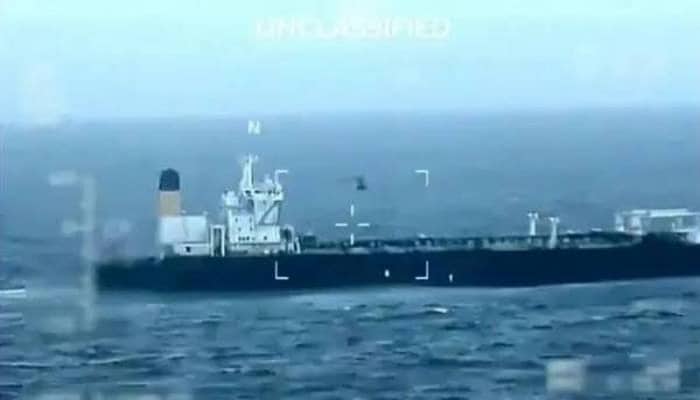
One of the concrete manifestations of this logic is what can be described as “modern piracy.” In today’s world, there is no longer any need for pirates flying black flags; the seizure of oil tankers, the intimidation of shipping companies, and the confiscation of energy cargoes are carried out with official government orders and under the banner of “enforcing sanctions.” In the case of Venezuela, this process is clearly visible. The United States has not only blocked the country’s oil exports, but in some instances has played a direct or indirect role in the seizure of its shipments.
What makes this behavior even more dangerous is the attempt to normalize it within the international system. When piracy is carried out under legal and media cover, the boundary between law and force is completely blurred. In such conditions, any country with greater power can rewrite the rules of the game in its own favor. Trump’s remarks expose this reality without mediation: in America’s logic, if resources belong to a country that does not align with Washington’s policies, those resources are potentially “subject to confiscation.”