
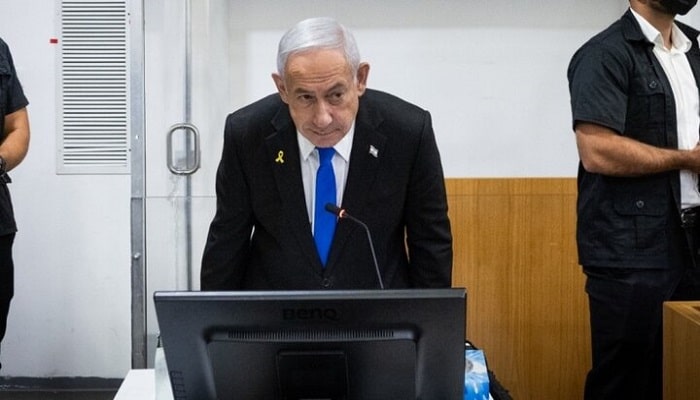
PNN – The possibility of pardoning Netanyahu without admission and acceptance of responsibility not only weakens the credibility of the judiciary of this regime, but will also have consequences beyond political boundaries.
According to the report of Pakistan News Network, the request for a pardon by Benjamin Netanyahu, the prime minister of Israel, from Isaac Herzog, the president of this regime, has placed the occupying regime at a sensitive point. This move, submitted in the midst of his trial on corruption cases, has not only revealed the political and social divisions of Israel, but also has had deep implications for the future of the governing system, the rule of law, and the political legitimacy of the prime minister.
Netanyahu, who is facing charges of bribery, fraud, and breach of public trust in three separate cases, has tried to ensure his presence in power by requesting a pardon before trial. This request has faced strong reactions from the opposition, analysts, and public opinion, and has sparked extensive debate about the president’s authority, the legitimacy of the pardon, and its impact on the rule of law.
Netanyahu’s corruption cases
The prime minister of Israel is accused in three separate cases of receiving bribes and gifts in exchange for granting government concessions. The cases include links with a telecommunications company, a Hollywood producer, and a newspaper publisher. After years of investigation, the Israeli prosecution issued indictments in 2019, and the trial began in May 2020. Netanyahu has denied all charges and described them as a political conspiracy against him. The length of the trial process and repeated delays have angered many residents of the occupied territories and families of those killed in the Gaza war.
Read more:
Why is Netanyahu seeking a pardon after eight years of obstruction?
The pardon request and political implications
According to the president’s office of this regime, Netanyahu’s pardon request is “unusual” and “has significant consequences.” This move could undermine the credibility of the Israeli judiciary and strengthen Netanyahu’s position in power. The opposition has warned that granting a pardon to a prime minister who has neither admitted his guilt nor expressed remorse amounts to legitimizing corruption and weakening the principle of equality before the law. Opposition leaders such as Yair Lapid and Yair Golan have emphasized that a pardon can only be acceptable if Netanyahu explicitly admits his guilt and withdraws from politics. On the other hand, ruling coalition parties and cabinet ministers including Yisrael Katz and Bezalel Smotrich have supported the request for a pardon and described Netanyahu as “a victim of political persecution.” Support from former U.S. president Donald Trump has also increased pressure on Herzog, and according to the opposition, is considered clear foreign interference.
Legal viewpoint and history of pre-conviction pardons
Mika Fetman, Netanyahu’s former lawyer, has emphasized that a pardon before conviction is extremely rare and is not possible without an admission of guilt. A historical example refers to the “Bus 300” case, in which Shin Bet agents, after executing two Palestinians, provided the required confession for a pardon. Netanyahu’s request lacks any admission or responsibility and includes direct accusations against the judicial and security institutions. This indicates that his main goal is to preserve power and solidify his political presence against justice.
Political and social pressures
Following the submission of the pardon request, widespread protests were held in Tel Aviv. Protesters chanted “A pardon equals a banana republic,” meaning “a pardon without accountability equals a corrupt government,” and displayed satirical symbols including bananas and prison uniforms. Demonstrators, wearing Netanyahu masks, held him responsible for the Hamas attack on October 7, 2023, and demanded the rejection of the pardon request. In contrast, former prime minister Naftali Bennett supported a conditional pardon, on the condition that Netanyahu leave politics and the judicial cases be closed. This contrast in reactions reflects the deep political and social crisis in Israel.
Media and expert analysis
Israeli journalists and analysts have described Netanyahu’s pardon request as “a dangerous use of the pardon tool.” They believe this move goes beyond a legal dispute and reflects the depth of the crisis in Israel’s political and judicial structure.
Gidi Weitz, an investigative journalist, has called this request “a corrupt plan” that reinforces the culture of impunity in Israel, sending the message to citizens and politicians that powerful individuals can escape justice without accountability. Moran Azoulay, a reporter for Yedioth Ahronoth, has also emphasized that the pardon request is a sign of Netanyahu’s weakness and fear, as he seeks to obtain complete exoneration and strengthen his power without accepting fault or resigning.
Herzog’s options
Isaac Herzog, the president of the Israeli regime, must make the final decision on Netanyahu’s pardon request. According to the law, he first receives the legal opinion of the Ministry of Justice and the attorney general.
Herzog’s options include the following:
Full acceptance of the request and granting unconditional pardon;
Rejection of the pardon request and continuation of the trial;
Proposing a conditional pardon or legal agreement that includes admission, remorse, and withdrawal from politics.
Analysts believe that every decision will have a direct impact on the timing of elections, the stability of the ruling coalition, and Netanyahu’s political future.
If Herzog accepts the pardon request, Netanyahu will achieve his greatest victory against the judiciary and the culture of impunity in Israel will be consolidated. If the request is rejected, the trial will continue and Netanyahu will likely launch an aggressive election campaign.
In that case, the upcoming elections will be far more tense and polarized. A conditional pardon also has its own challenges. Past experiences have shown that even with written commitments, the possibility of returning to politics exists, and this can create another legal crisis.
According to media in this regime, the Zionist regime is now at a decisive point. The issue is not only the corruption cases, but the struggle over the identity of the political system, the power of law in the face of politicians’ influence, and the future of governance in Israel.
Granting a pardon without accountability not only weakens the credibility of the judiciary, but also has consequences beyond political boundaries and may create a wave of social distrust and institutional crisis in the Zionist regime. Experts of this regime believe that Israeli society is facing a fundamental question: Can a prime minister accused of corruption and abuse of power be exempted from accountability before the law? The answer to this question will shape the political, legal, and social future of Israel.