
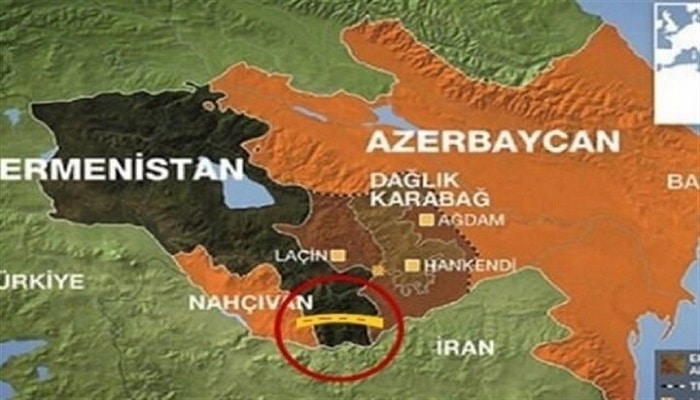
PNN – Deepening Iran’s cooperation with Russia and China to maintain balance in the Caucasus region is extremely important; the so-called “Trump Route” in fact aims to reduce the influence of all three countries in the Caucasus.
With the simultaneous emergence of the idea of creating the “Trump Route for International Peace and Prosperity (TRIPP),” abbreviated as the “Trump Route,” in southern Armenia, speculation about the reasons behind the United States’ interest in being present in this region has also increased. Although this issue has significant geopolitical dimensions and, if realized, would lead to a direct U.S. presence near the borders of Iran and Russia and even grant the United States access to the Caspian Sea, the economic dimensions of the U.S. presence in Armenia’s Syunik Province must also be seriously examined.
Similarities between the Trump Route and the Panama Canal
Perhaps the Trump Route in the South Caucasus can be described as America’s Panama Canal on land, especially since these two transit routes share similarities in various respects. These similarities are as follows:
- A “transit passage in the form of a corridor”
Both routes are “transit passages in the form of corridors” and are considered vital paths for the movement of goods, energy, or transit between important regions by reducing the required distance and time.
The Trump Route is intended to be a land corridor connecting the main territory of the Republic of Azerbaijan to the Nakhchivan region and from there to Türkiye and Europe. It will include railways, oil and gas pipelines, fiber-optic lines, and transport infrastructure. Its creation would therefore replace the long alternative route connecting Nakhchivan and Türkiye to Azerbaijan via Georgia.
The Panama Canal, meanwhile, is a vital waterway that connects the Atlantic and Pacific oceans, significantly shortening the maritime trade route between the eastern and western parts of the world. Without it, ships would have had to sail all the way around South America, a route that was much longer, riskier, and more costly.
Read more:
Activating the “trigger mechanism” brings Iran closer to Russia and China
- Strategic importance for international trade and enhancing the United States’ geopolitical role
The Trump Route could play an important role in the transit of goods and energy and in strengthening connectivity and influence among the countries of the Caucasus region, Central Asia, Türkiye, and Europe. It would create a smooth and stabilized route among these countries aimed at reducing the transit and geopolitical importance and influence of Iran, Russia, and China.
The Panama Canal has long become one of the world’s most vital commercial waterways under U.S. influence, enabling the connection of two oceans and greatly facilitating global trade in line with American preferences.
- A symbol of international influence and power for the controlling countries
Managing the Trump Route and granting its development concession to the United States by Armenia, and using it as a tool for influence in the Caucasus, indicates an effort to complete America’s project of power generation and transnational influence.
The Panama Canal was originally built by the United States and for years symbolized American power and engineering capability. The creation and control of the Trump Route, at a time when the United States is grappling with China for global hegemony, would, if realized, become a symbol of major regional and global U.S. influence.
Although the Trump Route and the Panama Canal differ in aspects such as one being land-based and the other maritime, geographic location, ownership and sovereignty, and the nature of use, both projects exemplify the U.S. strategy of creating infrastructure aimed at gaining power and then international influence. In other words, the Trump Route and the Panama Canal are not merely physical routes but geopolitical tools for regional or global influence and control.
This comparison helps us understand that control over or access to transit routes—whether maritime or land-based—in today’s world is not merely an economic issue but one related to power and influence.
Therefore, for countries or actors involved in the Trump Route issue (Caucasus countries, Türkiye, Russia, and Iran regarding the Trump Route, and many countries worldwide and maritime actors regarding the Panama Canal), these routes are tools for securing strategic interests.
The lucrative table of the Trump Route
The United States intends to allocate 150 million dollars to create the Trump Route. This route is only 42 kilometers long within Armenian territory, but the project would allow the United States to gain control over a massive volume of natural resources, including critical minerals from Central Asia and the South Caucasus.
The United States will be present in the region for 99 or 49 years, but most likely 99 years, to benefit from the Trump Route. Implementing this project would mean a complete separation of the South Caucasus from Russia and a reduction of Russian influence in Central Asia.
Central Asia holds enormous reserves of natural resources. Countries in this region possess rare earth elements, oil, gas, the world’s largest tungsten reserves, and many other resources. Currently, there is a major logistical problem in transporting these resources. Doing so through Iran is not desirable for the United States, as it does not want to create a large and stable source of revenue for Iran or, by consolidating Iran’s corridor role, turn Iran’s security into a concern for other countries. Routing through Afghanistan and Pakistan is also not logical due to internal and cross-border conflicts. The only remaining route is the creation of a middle corridor through Armenia. For the Americans, implementing this project would be a massive geopolitical success. That is why they are pursuing it.
Armenia’s Syunik Province contains 8 percent of the world’s molybdenum reserves, twice the total reserves of Russia. In addition, the Zangezur Copper and Molybdenum Combine, currently operating in the city of Kajaran in Syunik Province, holds 7 percent of global reserves, and the Agarak Copper and Molybdenum Plant nearby holds nearly 1 percent. This raw material plays an important role in key industries, including military industries.
Molybdenum is mainly used in the production of steel alloys to increase strength, hardness, and corrosion resistance, and it also has wide applications in lubricants (molybdenum disulfide), catalysts (oil and polymer industries), electronics (heating elements and electrodes), and agriculture (fertilizers). Due to its high melting point, it is used in high-temperature industries as well as in paints and the glass and ceramics industries.
Syunik Province also holds 1.5 percent of the world’s iron reserves, valued at one trillion dollars, as well as vast reserves of gold and silver. More than 100,000 tons of uranium reserves, equivalent to 2 percent of global reserves, are also located in Syunik. Rare minerals such as aluminum, platinum, arsenic, antimony, mercury, zinc, tungsten, titanium, coal, peat, diamonds, and others are also found in this province.
All of these are located in an area of 4,500 square kilometers, precisely where this corridor will run. By creating the Trump Route, the Americans will gain access to all of these mineral resources.
Regardless of what Armenian leaders say, by creating the Trump Route they will effectively lose a region rich in rare and strategic mineral resources for 99 years. Naturally, ensuring the security of private companies extracting these important mines is essential. Therefore, it is highly likely that an American private military company consisting of 1,000 to 1,500 personnel will be deployed near the Trump Route to provide security and oversight. The likelihood of deploying official U.S. military units there is also very high, because this route is located near Iranian territory and not far from Russian territory. Thus, according to the Americans, maintaining its security is necessary.
Pashinyan, who believes that through this route he will gain a leverage of control against Türkiye and Baku, will open the door wide for Trump and act according to U.S. wishes. If this trend continues, the United States will become the dominant power in the South Caucasus, and Türkiye will turn into a regional actor in the South Caucasus and Central Asia under U.S. control, implementing its directives.
Russia and Iran will also largely lose their influence in the region, and Central Asia’s dependence on the logistical capabilities of these two countries will sharply decrease, because this route will be the shortest and most profitable path for transferring large quantities of raw materials to global markets under U.S. management.
To advance the idea of the Trump Route, the Americans welcome the continuation of Pashinyan’s presence in power for another term. Therefore, they will turn a blind eye to the arrest of church officials and the detention of opponents by Pashinyan. If this trend continues, Pashinyan will remain in power for another five years. Trump will also remain president for another three years and will have the opportunity to make money for himself through the Trump Route.
The U.S. ambassador to Türkiye, Tom Barrack, who has repeatedly supported the creation of the Trump Route, is a close friend and business partner of Trump. His personal wealth, valued at 25 billion dollars, will grow more and more with the creation of the Trump Route, and Erdoğan also hopes to benefit from this process.
What should Iran do?
Watching from the sidelines is the worst possible action Iran could take in response to this trend. Iran must complete its corridor routes from Sarakhs in the east to Cheshmeh-ye Soraya in the west, and from Chabahar and Bandar Abbas to the borders of Armenia and Baku, and must seriously place the construction of railways in the Aras corridor on its agenda.
Under these conditions, Azerbaijan, Russia, Türkiye, India, the Persian Gulf countries, Central Asia, and Europe will need Iran as a low-tension, safe, and fast option. Even if Türkiye considers the Trump Route risky and slow, the Iranian route will be the best alternative.
Strengthening relations with Armenia should also be on Iran’s agenda. The creation of the Trump Route runs counter to Armenia’s interests, as it jeopardizes the country’s sovereignty over the sensitive Syunik Province on the border with Iran and lays the groundwork for identity and demographic manipulation in this province and its separation from Armenia.
Therefore, Iran should increase investment to widen the Syunik transit road and Armenia’s north–south highway, strengthen the capacity for trilateral trade among Iran, Armenia, and India, and reinforce energy exchange projects such as electricity-for-gas. This will create “positive dependence” of Armenia on Iran and weaken the Trump Route.
Deepening cooperation with Russia and China to maintain balance in the Caucasus region is also very important. The Trump Route in fact targets the reduction of all three countries’ influence in the Caucasus, and Iran can increase security and transit cooperation with Russia and China in the South Caucasus. The Iranian route should be consolidated as Russia’s priority for transit to India and the Persian Gulf, joint diplomatic pressure on Baku to preserve Armenia’s borders should continue, and this cooperation should strengthen a “balance of power” against the Trump project.
Finally, creating a more attractive economic model than the Trump Route is of great importance. If the Iranian route is more economically cost-effective, regional countries will prefer to use Iranian territory. Reducing transit tariffs, creating joint free zones, faster development of rail lines, and full digitalization of waybills and customs procedures must be placed on the agenda. Let us not forget that transit is a function of three components: security, speed, and price.
If Iran makes the effort, it can easily outperform the Trump Route in at least the first two of these three components. Otherwise, with the creation and consolidation of the Trump Route, conditions in the Caucasus will become even more difficult for Iran than before.