
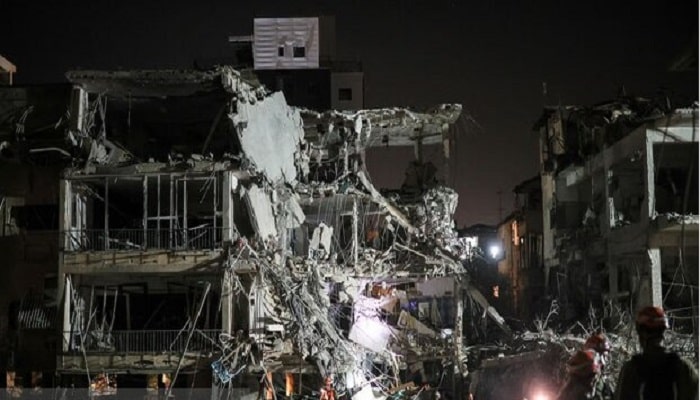
PNN – Official statistics and statements show that the Zionist regime’s invasion of Iran was one of the most costly and unsuccessful periods in the regime’s fake history.
The 12-Day War was one of the greatest defeats the Zionist regime has experienced in its fabricated history. According to the Supreme Leader, this aggression was the result of Israel’s 20-year plan to confront Iran, which ended in complete failure. The actual statistics of the damages caused by the severe media censorship in the occupied territories have never been fully published, but an examination of the confessions of Israeli officials and media outlets shows that the regime suffered enormous economic, military, and social losses. These statistics only show a small part of the true dimensions of the crisis, but they clearly explain why Tel Aviv agreed to a ceasefire after 12 days.
Zionist officials admit failure
One of the most prominent statements came from Major General Giora Eiland, former head of the Israeli Security Council. In an interview with the regime’s media, he stated: “Israel’s interests were in ending the war and accepting a ceasefire; continuing the war was not in its interest.” These words directly reflected an admission of failure to achieve strategic goals. According to Eiland, the costs of continuing the war, including economic losses and international pressure, outweighed the potential gains.
Former Israeli Prime Minister Ehud Olmert also said about the 12-Day War: Iranian missiles have caused widespread damage to Israeli cities, and Iran has no intention of peacefully coexisting with Israel. This open admission indicates that the regime’s 20-year plan to confront Iran has failed.
Read more:
Netanyahu’s Great Failures: From October 7 to the 12-Day War with Iran
Financial and economic losses
According to the Israeli Tax Administration, 41,651 damage cases have been registered since the start of the war with Iran:
32,975 cases related to damage to buildings
4,119 cases related to cars
4,456 files related to equipment and property
It is estimated that thousands of damaged buildings remain unrecorded. Shlomo Moaz, an economic analyst for the Ma’ariv newspaper, wrote that Israel’s 12-day military operation cost about $16 billion, and the regime’s GDP was damaged by the same amount.
The disruption to economic activity caused an estimated $1.5 billion in losses per day, crippling the high-tech, transportation, tourism, restaurants, and manufacturing sectors. Airport closures and flight cancellations also put additional strain on the economy. Even assuming that half of the damages are compensated in the future, there would still be a loss of about $8 billion, equivalent to 1.3 percent of Israel’s GDP.
Military and defense spending
Israel’s military spending averaged $725 million per day, totaling $8.7 billion over 12 days. This included airstrikes, F-35 fighter jets, and the use of various munitions. The activation of advanced missile defense systems, including Iron Dome, Arrow, and David’s Flak, cost between $10 million and $200 million per day. Each interceptor missile cost between $700,000 and $4 million, and the total defense and military spending for these 12 days was estimated at about $12.2 billion.
Damages caused by Iranian attacks
The Iranian missile attacks caused an estimated $3 billion in direct damage to infrastructure. Key targets included the Haifa oil refinery, the Weizmann Institute, and military buildings in Tel Aviv. The Israeli Tax Authority gave an initial estimate of damages at $1.3 billion, which is expected to exceed $1.5 billion; this figure is double the direct damage from previous Iranian attacks. More than 18,000 people were forced to evacuate their homes, and the cost of emergency housing was estimated at around $500 million. Rebuilding infrastructure and homes will take several years and tens of billions of dollars.
Macroeconomic consequences
Following this failed war, the regime’s budget deficit rose to 6 percent of GDP and defense spending rose to 20-30 billion shekels. The Central Bank of Israel lowered its 2025 economic growth forecast to 3.5 percent and estimated the cost of the war at 1 percent of GDP (about $5.9 billion). The regime’s credit rating was also affected, with warnings issued by Standard & Poor’s and Fitch. The United States also spent an estimated $1-1.2 billion on Israel’s defense, mainly through THAAD systems, but abandoned the expansion of the conflict after failing to achieve its initial goals.
Conclusion
The 12-day war between Israel and Iran was one of the most costly and unsuccessful episodes in the Zionist regime’s fabricated history. Official statistics and statements indicate that the economic costs to Israel are between $12 and $20 billion, but more comprehensive estimates indicate $40 billion.
Main costs include:
Direct military spending: $12.2 billion
Economic disruption and business closures: $21.4 billion
Damage from Iranian attacks: $4.5 billion
Evacuation and reconstruction costs: $2 billion
These figures, even including the regime’s official statistics, indicate the severe economic, military, and social strain on Israel. The long-term consequences, including budget deficits, reduced economic growth, damage to tourism, the exodus of professionals, and reduced investor confidence, remain. Ultimately, the 12-day war proved that Israel’s 20-year plan to confront Iran had failed, and Tel Aviv was forced to accept a ceasefire to prevent further damage and economic collapse. This narrative, based on the Israelis’ own confessions and their media sources, presents a clear picture of the true dimensions of the defeat and losses, and shows that the Zionist regime, despite all the claims and hype, was almost paralyzed under pressure from the Islamic Republic of Iran.