
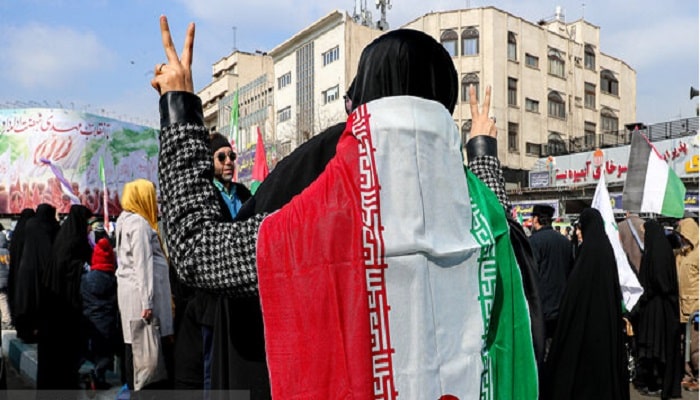
PNN – Despite the continuous and increasing conspiracies of the American-Zionist axis, the Islamic Revolution of Iran continues its path towards the peaks of progress, always more successful and proud than before.
The victory of the Islamic Revolution in Iran in 1979 was a historical turning point in the end of American influence and the emergence of an independent Iranian policy in opposition to American-Western domination. Since then, as Iran’s economic and military power increased and its peaceful nuclear program developed, the United States has tried in every way possible to hinder Iran’s progress and impose sanctions on Iran to weaken it.
After the victory of the Islamic Revolution in Iran, America launched a series of conspiracies and sabotage against the fledgling Islamic regime in Iran, perhaps to stifle this popular revolution in its infancy. In this period of about half a century, which began with the beginning of the interventions in Iran and continued until the last round of nuclear negotiations, the Islamic Republic of Iran has remained steadfast in its principles, interests, and national rights, despite all threats, severe sanctions, and even direct attacks and anti-security measures, and has continued to make progress in various fields.
The Iranian Revolution and America’s Continuous Conspiracies
Al-Manar News Agency wrote in an article referring to the performance of the Islamic Republic nearly half a century after the victory of the glorious Islamic Revolution in Iran: Over the past half century, Tehran has developed its regional and international relations, signing important agreements with leading global countries such as China, Russia, and other countries, while continuing to support liberation movements in the region.
These actions did not please the United States and the Zionist regime, and in addition to assassinating Iranian political leaders, scientists, and military commanders such as General Qassem Soleimani, they participated in numerous security incidents and seditions at various times and stages.
The US withdrawal from the nuclear deal in 2018 was a sign of US concern about Iran’s increasing power despite sanctions. The American-Zionist hostility towards Iran led to an open and military aggression against Iran in June 2025, in which thousands of Iranian people, including the country’s military commanders and scientists, were martyred. Washington also attacked Iran’s nuclear reactors in an attempt to weaken the Iranian economy and regime.
Despite this, Iran stood firm and resilient against this aggression, and its response to the heart of the Zionist regime was missile attacks that passed through the multi-layered Zionist, American, and European systems and accurately hit the sensitive targets it intended. Tehran also responded to the US aggression by attacking a major US base in Qatar. The war ended after 12 days, but threats and attempts to undermine the Iranian regime did not stop.
The Union Studies and Research Center also examined in an analytical report the process of successive conspiracies by the US government and how they failed to influence Iranian sovereignty, which led to a change in the direction of the US decision from maximal goals such as regime change to minimal goals, namely negotiations on the nuclear issue.
The Iranian Revolution and the Nuclear Negotiations
Al-Manar further stated that in 2002, after Iran unveiled its peaceful nuclear facilities in Natanz and Arak, negotiations began between Tehran and the European Troika (Germany, France, and Britain), with the United States behind them. The parties reached an agreement in 2003, but the West did not adhere to its guarantees and promises to lift or reduce sanctions against Iran.
Following the indirect Geneva talks that began in 2013, Iran entered into negotiations with the P5+1 countries, namely the United States, Britain, France, Russia, China, and Germany, and a comprehensive joint action plan known as the “JCPOA” was formed.
Under the JCPOA, Iran agreed to reduce its peaceful nuclear activities and reduce the percentage of uranium enrichment in exchange for the gradual lifting of Western economic sanctions, but the agreement was violated by US President Donald Trump in 2018, when he unilaterally withdrew from it.
The Al-Ahd news website also wrote in this regard that Washington does not see the negotiation as a long-term legal obligation, but rather considers it a temporary tool that should serve to achieve the country’s strategic goals.
Iran’s missile program falls into this same category. Iran, which has been denied the ability to upgrade its air force for decades due to sanctions, sees ballistic missiles as its only available deterrent. The call for their dismantling is not, from Tehran’s perspective, a security measure, but rather an attempt to deprive it of its right to defend itself and turn it into a strategically vulnerable country.
The Islamic Revolution and Iran’s Scientific Advances
Al-Ahed adds that after the Islamic Revolution, Iran pursued investment in the development of science and knowledge as a solution to confront Western sanctions, and despite all the challenges, it has succeeded in building a multi-level scientific system that includes nuclear energy, medicine, aerospace, and high-tech technology.
In Iran after the Islamic Revolution, scientific development was not left solely to the laws of the market, but was included in the government’s strategic planning, and scientific policies were directed to serve the people and the country, achieve self-sufficiency, and reduce dependence on foreign countries. Some of the areas of Iran’s progress in scientific fields include the following:
Peaceful nuclear program:
Iran developed a peaceful nuclear fuel cycle relying on domestic cadres, at a time when technology transfer channels were completely closed. This capability was not limited to enrichment, but also included civilian applications in the fields of medicine, agriculture, and energy.
Pioneer in medical and biological sciences:
Data from the Iranian Ministry of Health shows significant progress in areas such as organ transplantation, infertility treatment, and the production of advanced medicines, especially biotechnological drugs.
Aerospace and breaking monopolies
Iran’s space program is one of Tehran’s most important scientific advancements in the international arena. Space has been the monopoly of major powers for decades, and the entry of developing countries into this field was seen as crossing red lines.
However, in recent years, Iran has announced the launch of several indigenous satellites and the development of launch platforms and satellite carriers with national capabilities.
High-tech technology and investment in scientific fields
In addition to space, Iran has had a serious presence in the fields of advanced technologies. For example, in nanotechnology, Iran has achieved high global rankings in terms of the number of published scientific research and scientific achievements. Research institutions are also developing national AI applications in the fields of medicine, industry, and data management.