
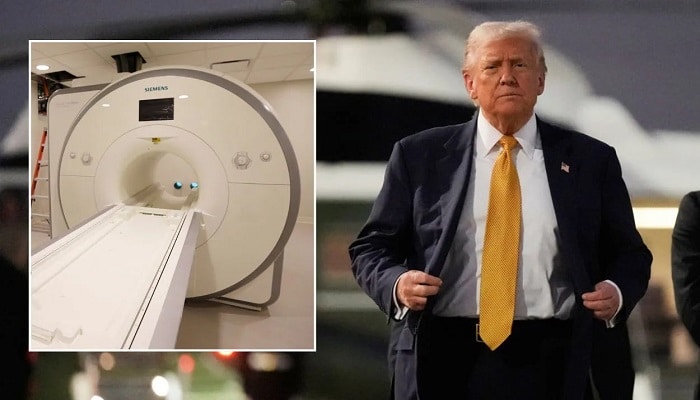
PNN – Despite Donald Trump’s announcement of his readiness to release the results of the MRI conducted in his new physical examinations, the White House still does not provide a clear explanation about the reason for this imaging and the area examined; an issue that has increased questions about the health status of the 79-year-old US president.
According to the report of Pakistan News Network, Donald Trump, the US president, announced that he will release the results of his MRI test, which was conducted in October.
The US president told reporters: If you want these results to be published, I will publish them.
Trump claimed that the MRI results were “excellent.”
So far, the White House has refused to provide details about why Trump had an MRI during last month’s medical examination or which part of his body was scanned.
Caroline Leavitt, White House spokeswoman, also claimed that Trump underwent “advanced imaging” at the Walter Reed National Military Medical Center “as part of his routine medical examination,” and the results show that Trump remains in “exceptional physical health.”
Trump also said he has “no idea” which part of his body was scanned. “It was just a test. Which part of the body? I don’t know, but it was not the brain, because I took a cognitive test and did excellently.”
Trump’s Chronic Venous Insufficiency
Trump’s health was also a topic during his first term, and many rumors about his health status were circulated. However, recent images show a clear bruise on his hand, fueling further speculation about his health, and the White House explanations have not convinced the public, so the speculation continues.
In December 2024, Trump told Time magazine about the bruise on his right hand that it was only due to “very frequent handshakes.” Still, on social media, rumors persist that Trump may be receiving treatment through injections or regularly taking blood tests.
Trump’s spokesman had previously explained the bruises as due to repeated handshakes and aspirin use. In July, the White House announced that Trump suffers from “chronic venous insufficiency,” a harmless condition in the leg veins, mostly seen in older adults.
Dr. Sean Barba, Trump’s doctor, also stated that these symptoms “match slight skin irritation caused by frequent handshakes and the use of aspirin, which is part of a standard cardiovascular disease prevention regimen.”
He confirmed that Trump has chronic venous insufficiency and described it as a benign and common condition, especially in people over 70 years old,” adding that medical examinations showed “no signs of deep vein thrombosis (DVT) or arterial disease in Trump.
Trump’s treating physician also stated that “mild swelling in the lower legs of Trump was observed, and for full caution, this swelling was completely evaluated by the White House medical unit.”
What illnesses does Trump have?
Some medical reports also indicate that Trump has high cholesterol and takes atorvastatin (Lipitor). His high weight and body mass index fall within the mild obesity range, which increases the risk of heart disease.
Other reports suggest that Trump has kidney or prostate problems and for a period took finasteride, usually prescribed for hair loss or enlarged prostate. Also, reports of coronary artery calcification in previous years have been published, which is a sign of mild heart disease.
An unexpected examination at Walter Reed Hospital in 2019 caused rumors about Trump’s health, but the White House called it a routine checkup. Some opponents even question Trump’s mental health, especially regarding impulsive behavior or lack of focus, but no official medical evidence of mental illness has been published.
Chronic venous insufficiency occurs when the veins in the legs cannot effectively return blood to the heart, and MRI provides detailed imaging from inside the body. This method can be used to monitor a wide range of diseases.