
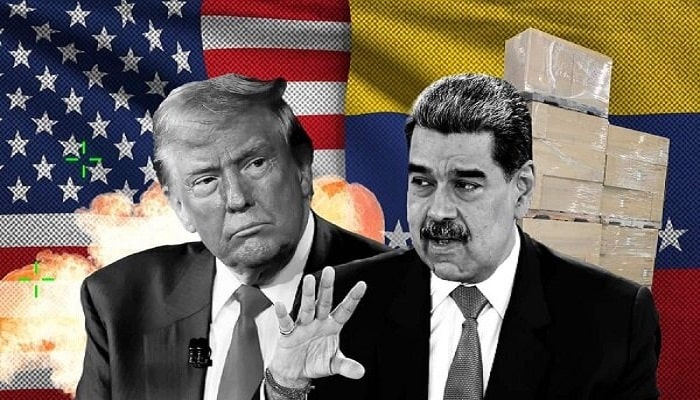
PNN – What has been published about the arrest of “Nicolás Maduro” and his departure from Venezuela has placed a collection of contradictory narratives and media claims before public opinion.
What has been published regarding the arrest of “Nicolás Maduro” and his exit from Venezuela has, more than presenting a clear picture of a decisive military operation, placed a collection of contradictory narratives and media claims before public opinion. At the heart of these narratives is the claim by U.S. President Donald Trump that America has carried out extensive and successful attacks against Venezuela, resulting in Maduro and his wife being arrested and removed from the country. This claim is, at first glance, met with question marks.
Within this framework, the report by Sky News, published citing sources within the Venezuelan opposition, gains particular importance. These sources have emphasized that what happened was most likely not a military arrest but the result of a negotiated exit or a behind-the-scenes agreement. The presentation of such an analysis by Maduro’s opponents, who have the most motivation to accept the narrative of American power projection, is in itself significant. When even the internal opposition does not find the scenario of U.S. forces entering to arrest the incumbent president and his seamless exit from the country believable, skepticism towards Washington’s official narrative becomes inevitable.
Read more:
Reactions to the US military attack on Venezuela; what position did the Russians take?
Venezuela is not a country without defense and security structures. For years, this country has been under intense pressure from U.S. sanctions, military threats, and intelligence operations, and precisely for this reason, its security structures and army have been in a state of constant readiness. The notion that U.S. forces could enter Venezuelan territory without significant conflict and meaningful resistance, arrest the country’s president, and then easily remove him from the country is not easily acceptable.
In contrast, the hypothesis of a negotiated exit has more compatibility with the political and behavioral realities of the actors in this case. Despite his sharp anti-American stances in recent years, Maduro has repeatedly tested non-public avenues for negotiation and pressure reduction. Indirect negotiations regarding sanctions, judicial cases, and even limited cooperation in some areas indicate that communication channels between Caracas and Washington have never been completely closed. Under such circumstances, this possibility is strengthened that, under increasing economic pressures, security threats, and domestic political deadlock, a scenario based on a controlled and agreed-upon exit was designed for Maduro. In this scenario, America tries to present the outcome as a military victory to public opinion, while reality has followed a different path.
From Washington’s perspective, exaggerating such a narrative serves a dual function. On one hand, for domestic consumption and on the eve of political competition, it paints a picture of authority and the return of American power to the global stage. On the other hand, a threatening message is sent to independent governments opposing U.S. policies. This message does not necessarily need to fully correspond with reality and relies more than anything on psychological and media impact. However, such narratives quickly suffer a loss of credibility when measured against on-the-ground realities and objective evidence.
If we take the assumption of Maduro’s negotiated exit seriously, many existing ambiguities become explainable. The lack of widespread military resistance, the relative silence of security structures, the absence of images of conflict, and the vague, non-transparent narratives of U.S. officials all find meaning within this framework. This scenario is also consistent with known patterns of international politics. In numerous cases, leaders under severe pressure to preserve their lives, assets, or political futures have agreed to deals that were later represented in the form of heroic or security-related narratives.
Ultimately, what is important in this case is to avoid unquestioning acceptance of the official narratives of intervening powers. Contemporary history has repeatedly shown that America, at critical junctures, sacrifices reality for narrative and presents political and intelligence operations under the guise of military victories. The story of Maduro’s arrest via a military operation is also not acceptable until independent and convincing evidence is presented. Under such conditions, the hypothesis of a negotiated or voluntary exit by Maduro is not only not far-fetched but, from an analytical perspective, is considered one of the most probable scenarios ahead.