
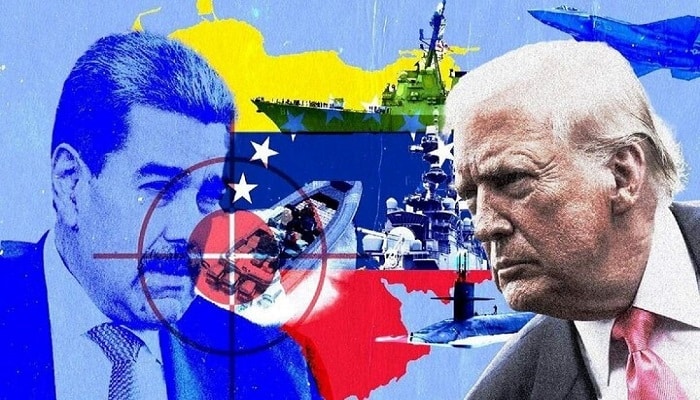
PNN – The intensification of sanctions, the seizure of oil tankers, and US military movements around Venezuela indicate that Washington, by reviving the Monroe Doctrine, has turned the country into a field of strategic confrontation in the Western Hemisphere—but to what end?
US-Venezuela relations in recent days have entered their most sensitive phase since Donald Trump’s return to the White House. The seizure of the tanker Skipper in the Caribbean Sea, sanctions imposed on relatives of Venezuelan President Nicolás Maduro, and the deployment of thousands of US troops in the region form a set of measures that many analysts see as evidence that Washington has moved beyond purely economic pressure toward the use of hard power. What distinguishes this phase of tension from previous periods is not only the intensity of the pressure, but the strategic framework within which these actions are taking shape.
Trump, who during his first presidency also subjected Venezuela to harsh sanctions, has returned to the scene with a different approach. The revival of the Monroe Doctrine in US national security documents, explicit emphasis on Washington’s dominance over the Western Hemisphere, and prioritization of military tools over diplomacy point to a significant shift in US policy toward Latin America. The failure of the Biden administration’s efforts to manage the Venezuela crisis through negotiation and limited engagement has given Trump the opportunity to pursue a policy of maximum pressure under the justification of “strategic decisiveness.”
From sanctions to seizure: Washington’s strategic pivot
The main difference between the current US approach and previous policies is that economic pressure is no longer the primary tool. The seizure of the Skipper tanker on December 10 was not merely the enforcement of a sanction, but a practical demonstration of US military power in one of the region’s most sensitive waterways. The move sent a clear message to Caracas that Washington is prepared to use tools beyond the economic sphere to impose its will.
Simultaneously, in recent days, the US Treasury sanctioned close relatives of Maduro and several shipping companies active in Venezuela’s oil sector. US officials have described these measures as part of efforts to disrupt the financial networks of the Venezuelan government, but critics argue that such policies are defined more by political and strategic pressure than by legal considerations or genuine anti-smuggling efforts.
Washington’s official justification regarding the fight against drug trafficking has also faced skepticism. Some regional leaders, including the president of Colombia, have emphasized that Caribbean routes account for a limited share of the global drug trade, and linking this issue to extensive military actions serves a political function rather than being based on field data.
Meanwhile, the deployment of the aircraft carrier USS Gerald Ford along with submarines, F-35 fighter jets, and several other warships has highlighted the military dimension of this shift. Several US military analysts have stressed that such a deployment, without a specific operational objective, lacks strategic justification and signals that the option of using military force is at least being seriously considered.
Reviving the Monroe Doctrine: a message to the region and rivals
The revival of the Monroe Doctrine in the Trump administration’s foreign policy is not merely a historical or symbolic reference, but reflects a redefinition of Latin America’s role in Washington’s geopolitical calculations. This doctrine, which in the 19th century defined Latin America as the United States’ exclusive sphere of influence, is now being reinterpreted in a more security-oriented framework, in which the presence or influence of non-Western powers in the Western Hemisphere is regarded as a direct threat to US interests.
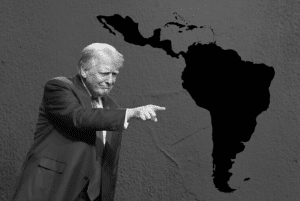
In this framework, Venezuela has become a prominent example. Unlike previous periods, when Washington’s primary focus was on containing leftist governments or applying economic pressure, the current approach is less about changing Maduro’s behavior and more about sending a strategic message to the entire region: that the United States intends to rewrite the rules of the game in its traditional backyard and has no hesitation in using hard tools to enforce its will.
This message is not directed solely at Caracas; countries such as Brazil, Colombia, and Mexico, which in recent years have sought to pursue more independent foreign policies, are closely monitoring these developments. The main concern in the region is that the revival of the Monroe Doctrine signals a lower tolerance from Washington toward dissenting policies and a return to an interventionist model in Latin America—a model with a long and costly history in the region.
At the extra-regional level, this policy also sends a clear message to Russia and China. Both countries have expanded their political, economic, and military presence in Latin America in recent years, with Venezuela becoming a key focal point. From Washington’s perspective, Moscow’s military support and Beijing’s economic and diplomatic backing of Caracas are seen not only as threats to regional stability but also as a direct challenge to US geopolitical supremacy in the Western Hemisphere.
From this perspective, recent US actions can be understood as an effort to achieve three simultaneous objectives: weaken Maduro’s government, limit Russian and Chinese influence, and restore Latin America to the orbit of traditional US foreign policy. In this equation, Venezuela is less a final objective than a testing ground for this broader strategy—a field whose success or failure will have consequences extending beyond its borders.
Field war or psychological operation?
One key question in the current crisis is the distinction between a real military threat and psychological warfare. The deployment of US forces, naval movements, and strong statements from Washington officials are all indicators of readiness to escalate pressure. Yet the question remains whether these measures are the prelude to an actual conflict or primarily part of a deterrence and intimidation strategy.
Media reports indicate that multiple options, ranging from limited air strikes to broader scenarios, have been discussed in White House security meetings. However, closer examination suggests that the operational and political obstacles to a full-scale confrontation are significant. US experiences in Iraq and Afghanistan, public sensitivity to costly wars, and the absence of domestic political consensus all act as strong deterrents.
From a military standpoint, any ground operation in Venezuela would require the deployment of tens of thousands of troops and readiness to enter an asymmetric war in urban and jungle environments. Military experts have repeatedly warned that air and naval superiority does not guarantee a swift victory, and that holding occupied areas could draw the United States into a protracted conflict—one that would carry high human, financial, and political costs.
By contrast, limited air strikes are seen as a lower-risk scenario. Such strikes could target military infrastructure, sensitive facilities, or symbols of the Maduro government’s power, creating significant psychological and political pressure without dragging Washington into a ground war. Even so, such action could trigger wide regional and international reactions and potentially push the crisis beyond control.
On the other side, the Venezuelan government, emphasizing a strategy of long-term resistance and asymmetric warfare, seeks to portray any military intervention as costly for Washington. Although experts assess Caracas’s military capabilities as limited compared to the United States, historical experience shows that even weaker actors can prolong and raise the cost of conflict through guerrilla warfare, militia networks, and the use of complex terrain.
Overall, the US military threat cannot be dismissed as mere political bluffing, yet the evidence also does not point to an immediate appetite for an all-out war. The most likely path is the continuation of a hybrid pressure campaign combining sanctions, displays of military power, and psychological warfare—an approach aimed at forcing Maduro into political concessions without bearing the heavy costs of direct confrontation.