
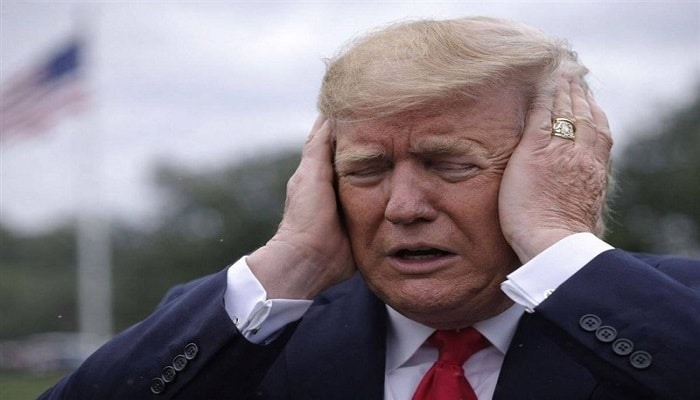
PNN – Trump’s contradictory statements show that he is seeking to retreat under the guise of “victory” by admitting defeat.
According to the report of Pakistan News Network, US President Donald Trump’s new rhetoric about war with Iran has caused regional and international circles to ridicule him once again.
Trump’s indirect admission of defeat in Iran
In this regard, Al-Akhbar newspaper wrote in an article by Yahya Dabouq, a prominent writer of the newspaper: Trump’s speech represents a tactical retreat covered by the language of victory; by redefining the goals of the war after failing to achieve them, amid signs of a strategic impasse that is pushing Washington towards the option of negotiation rather than a military settlement.
Donald Trump’s speech, which contained a strange mix of denial and indirect admission of defeat – albeit cloaked in terms of victory and superiority – indirectly announced the beginning of an organized tactical retreat, disguised as “victory.” In fact, signs of this retreat had been forming over the past three weeks, before Thursday morning’s speech culminated in a narrative titled “We won,” despite many facts that contradicted the claim of victory.
The issue of enriched uranium is one of the most important issues that has exposed the US impasse. At the start of the war, one of the stated US goals was to seize Iran’s highly enriched uranium reserves, and Trump himself said in a press conference three weeks ago: We don’t want any uranium enrichment in Iran, and we want all the enriched uranium there, even nuclear dust, to be handed over, and that is a fundamental condition for any agreement with Iran.
But before yesterday’s speech, a reporter asked Trump about that uranium, and he replied: The uranium is so deep in the ground that I don’t care. We’ll just monitor it through satellites. Although Trump didn’t use the same phrase in his speech yesterday, he ignored the call to strip Iran of its nuclear capabilities and focused on destroying them.
But what was said simply means that the United States is redefining the purpose of its war against Iran midway through, after the initial goal has become impossible to achieve.
Similarly, when Iran closed the Strait of Hormuz in the first week of the war, Trump immediately pledged that the US Navy will open the strait within 48 hours. Then the deadline passed, and Trump extended it to 5 days, then to 10 days, before dropping it altogether.
In a television interview before his speech yesterday, Trump was asked about the delay in reopening the Strait of Hormuz, and he responded with an unexpected phrase: America doesn’t buy oil from there. We are an oil exporting country now. Why should we bear this burden alone? He then told Europe and Asia: This is your passage. Open it yourself.
In his recent speech, Trump echoed this idea, saying: I told them, go to the Strait and take it. Protect it yourself. You depend on it. We don’t.
He also added, in what appeared to be an admission that the Strait of Hormuz might not open: If you can’t open it, buy oil from America.
Trump’s remarks appear to be a declaration of his country’s abdication of responsibility for global navigation, marking a radical shift in its role as guardian of the Persian Gulf and its energy resources. More importantly, they represent a tacit admission that the US Navy has failed to open the Strait of Hormuz, as Trump had promised.
Also, in the first week of the war, after the initial attacks on Iran, Trump told the Iranians, “This is the opportunity of a lifetime to get rid of your oppressive regime.” This clearly indicated his acceptance of the goal of regime change in Tehran. But the popular uprising that Trump had expected did not occur in Iran, and the Iranian regime resisted, so Trump stopped repeating the phrase “opportunity of a lifetime” and instead of “overthrowing the regime,” started talking about “weakening the regime.”
In the next phase, Trump began talking about “negotiating with the new leadership of Iran,” even though the same leadership was still in place.
Reproducing the signs of retreat in the guise of “victory”
So, it can be said that Trump did not offer anything new in his 19-minute speech, but rather reproduced the signs of retreat and decorated them with “victory” phrases. Also, although his speech was long enough to make the listener feel like he had listened to a complete program; it was devoid of any real detail: So what are the real goals of the war? What has been achieved so far? How can the United States achieve these goals in the midst of a stalemate and Iranian resistance?
When will Washington then withdraw its forces from the conflict, even if unilaterally? And what will be the form and content of the day after the war? How will the United States prevent Iran from rebuilding its capabilities on that day? And what about other theaters and Tehran’s allies there? Then how does the continued closure of the Strait of Hormuz not affect the United States, even if the United States does not provide the oil passing through it? How has the Strait of Hormuz at the same time become the unit of measurement for every failure or success in the war?
Trump’s Two Bad and Worse Options against Iran
Given these issues, one can speak of one of two options and practically no third option: First: continuing the war and risking ground operations that will be necessary to break the deadlock, second: going to the negotiating table where the Iranians have their leverage, just as the Americans have theirs, and this is contrary to what Trump mentioned in his speech.
Also, since Trump avoids dangerous ground operations due to their consequences and the uncertainty of their effectiveness, he will be forced to negotiate, even if this path is accompanied by a period of denial and attempts to extract maximum concessions from Iran.
These negotiations, if they begin, will cast their shadow over other conflict scenes such as Iraq, Yemen, and Lebanon, and will pave the way for further solutions and agreements, as the negotiating scenario makes it difficult for Iran to separate from its allies.
As a result, Trump’s speech yesterday effectively says that he will not win at all.