
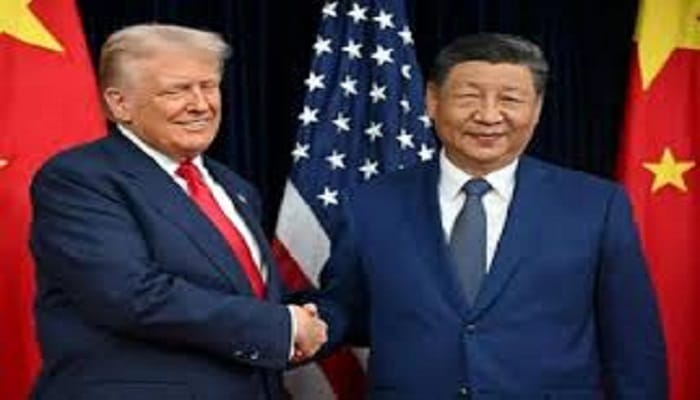
PNN – The Iran war has further strained fragile Sino-US relations and could jeopardize the trade truce between the China and America.
According to the report of Pakistan News Network, According to the New York Times, Trump announced that he had requested a postponement of his trip to Beijing due to the war. The meeting, which was scheduled to take place at the end of this month, has been thrown into doubt by escalating tensions over the war and the virtual closure of the Strait of Hormuz.
He had previously threatened to delay the meeting if China did not send warships to end Iran’s de facto blockade of the Strait of Hormuz.
Trump’s strange request to China
Trump says he has a very good relationship with Xi Jinping. However, the reaction from Chinese officials suggests that relations between the two countries may not be as warm as Trump says.
Trump’s request to escort commercial ships through the Strait of Hormuz has even been met with ridicule outside of official Chinese circles. A prominent Chinese blogger wrote that the request was so bizarre that it seemed as if the US president should ask Iranian warships to escort American ships.
The Global Times newspaper, affiliated with the Chinese Communist Party, asked about this:
“Is it really a matter of sharing responsibility or sharing the risk of a war that Washington started and is unable to end?”
America’s war, not China’s problem
Beijing has little incentive to risk its forces and ships or to weaken its ties with Iran, its closest partner in the region. Iran has said it will only target ships linked to the United States and its allies, and will allow oil tankers bound for China to pass through.
For Xi Jinping, who is trying to solidify China’s position as a superpower and global leader, the deployment of Chinese warships could also be seen as a sign of compliance with American leadership.
Klaus Song, Mercator Institute analyst in China studies says:
“From Beijing’s perspective, this is America’s war, not China’s problem. A positive response to Trump’s request creates the impression that China is doing her bidding.”
The risk of a re-ignition of the trade war
However, leaving Washington’s request unanswered could jeopardize the fragile trade truce between the two countries.
Beijing had hoped the meeting would ease pressure on China as it tries to reform and rebuild its slowing economy. China wants the United States to reduce support for Taiwan, ease restrictions on technology exports and extend a tariff freeze that was achieved after months of a trade war.
Possible Chinese pressure to open the Strait of Hormuz
At the same time, although China has invested in renewable energy and electric vehicles to reduce its dependence on imported oil and had increased its oil reserves before the start of the Iran-Iraq war by the US and Israel, it is still suffering from the closure of the Strait of Hormuz, as about 40 percent of China’s oil imports pass through this route.
Maritime transport data since the start of the war shows that few Chinese ships have been willing to pass through this route. At least nine Chinese ships have been stopped in the Persian Gulf, according to an analysis by the Center for Strategic and International Studies.
Yun Sun, director of the China program at the Stimson Center in Washington, says: Opening the Strait of Hormuz is in everyone’s interest. He believes Beijing may try to mediate or secretly pressure Iran to open the strait.
According to him, playing a more active role in opening the strait could help improve the atmosphere of relations with Washington before the leaders’ meeting, strengthen China’s image as a responsible power, and also help China’s partners in the Persian Gulf.