
PNN – After the end of World War II in 1945, the United States emerged as a global superpower in the world and shaped its foreign policy based on expanding influence and containing what it called the “threat of communism.”
These interventions, which included coups, covert CIA operations, support for dictatorial regimes, and proxy wars, have had profound consequences for the politics, economy, and human rights of the targeted countries.
These actions were usually carried out under the guise of fighting communism, but in reality, their main goal was to prevent the formation of governments that pursued a development path independent of American foreign policy.
We once again examined CIA involvement in Guatemala in the 1950s in issue 8 of this series of reports. Since our reports are organized according to a chronological sequence in addition to being broken down by country, this report is about CIA interventions in the same country in the 1960s, but before that, to maintain the continuity of the text in this report, we will also briefly mention US actions in the 1940s and 1950s.
Introduction: Historical context and situation in Guatemala
Guatemala is a country in Central America, bordered by Mexico, Honduras, El Salvador, and Belize. The country is known for its beautiful nature, dense forests, mountains, and rich cultural heritage of the Mayan civilization. However, throughout its modern history, it has faced very deep problems such as severe social inequality, widespread poverty, and political violence.
Most of Guatemala’s people are indigenous Hindus, who make up about three-quarters of the population. This group is largely made up of very poor farmers and farm workers who live in conditions close to slavery.
In the early 20th century, Guatemala was effectively dominated by dictators and foreign corporations, particularly a large American corporation that owned vast tracts of fertile land and used the very cheap labor of the natives to export bananas and coffee. Natives were often seen as beasts of burden, working on large plantations where their owners sometimes sold them like commodities.
After World War II, reformist movements emerged in Guatemala. In 1944, the October Revolution took place, overthrowing the dictatorship. Two more democratic governments came to power: Juan José Arevalo and then Jacobo Arbenz. These two presidents attempted to carry out land reform, that is, to take large tracts of land from foreign owners and wealthy locals and give them to poor farmers. These changes were necessary to improve the lives of the indigenous people, as more than half of children under five died from malnutrition, digestive diseases were common due to the lack of clean water and sanitation, and agricultural pesticides, often sprayed on people from airplanes, caused poisoning and death.
1954 coup: Overthrow of the Arbenz government and the beginning of direct intervention
The real story of American intervention began with the coup of 1954. President-elect Jacobo Arbenz passed a law that confiscated unused land owned by an American company and gave it to poor farmers. The company, which had very close ties to the US government, saw this as a major threat and portrayed it as communist influence.
This intervention directly served American economic interests. The American company took back its land, and Guatemala became a classic example of a country run by foreign economic domination. The coup became a model for subsequent American interventions in the region.
1960s: The rise of the guerrilla movement and a very violent response with US support
After the coup, people’s dissatisfaction grew day by day. The natives continued to live without land, without education, and with very low wages. In 1960, a group of army officers who wanted minor changes revolted against the coup regime, but were suppressed by the CIA. These officers later formed the core of the guerrilla movement. The guerrillas’ main goals were land reform, social justice, and greater independence from the United States.
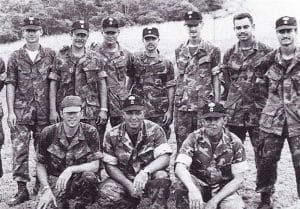
In 1962, there were widespread protests against the government. The United States saw these protests as a communist threat and encouraged the Guatemalan military to crack down heavily. That same year, the United States established a special base for counter-guerrilla training in key areas of guerrilla support. US Special Forces trained Guatemalan officers in ambush techniques, trapping, jungle survival, and extermination operations.
In 1963, another coup was carried out with US support, and Enrico Peralta Azurdia took power. He brutally murdered eight political and labor leaders. In 1966, a civilian named Julio Cesar Mendez Montenegro became president with US support to give the regime a liberal face, but he was completely under the control of the military.
The details of torture during this period are beyond imagination. One common method was to pull plastic bags filled with toxic insecticide over the victims’ heads. Military field phones connected to small generators were also used to deliver electric shocks to the most sensitive parts of the body, especially the genitals; technology and training exported to Guatemala directly from the Vietnam War experience.
During this period, a group called “Mano Blanca,” meaning White Hand, was one of the most notorious death squads in Guatemalan history. Its full official name was Movimiento de Acción Nacionalista Organizado (Organized Nationalist Action Movement), abbreviated as MANO. But because its logo was a white hand and it was more commonly known by that name, it was commonly called the Mano Blanca, or “White Hand.”
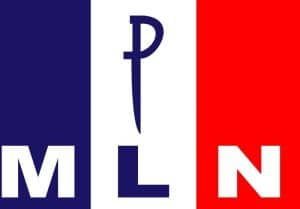
Death squads like the “Mano Blanca” (White Hand) became a tool for committing crimes for which the army did not want to accept responsibility. Their motto was simple: See a communist, kill a communist. But what was their definition of a communist? The American priest, Blaise Bonpin, recounts that when he asked the leader of the White Hand why he wanted to kill a certain student, he replied: Because I heard him say he was willing to sacrifice his life for the poor; therefore he is a communist. They marked the houses of the opponents with black crosses so that they could go to them at midnight.
1970s: Escalation of killings and expansion of the role of the police with American help
In 1970 and 1971, under the presidency of Carlos Arana Osorio, known as the “Butcher of Zacapa,” a state of siege was declared. Nighttime movement was prohibited, even for ambulances and doctors.
The United States, through the Agency for International Development and the Office of Public Security, expanded the Guatemalan police force and trained thousands of police officers at training centers in the United States and Panama, including methods for combating urban unrest and identifying political opponents.
During the presidency of Jimmy Carter, the US Congress restricted military aid due to widespread human rights abuses, but these restrictions were incomplete and the US continued to provide arms and training through other means (including through Israel).
The 1980s: The Reagan Era and the Height of Organized Violence
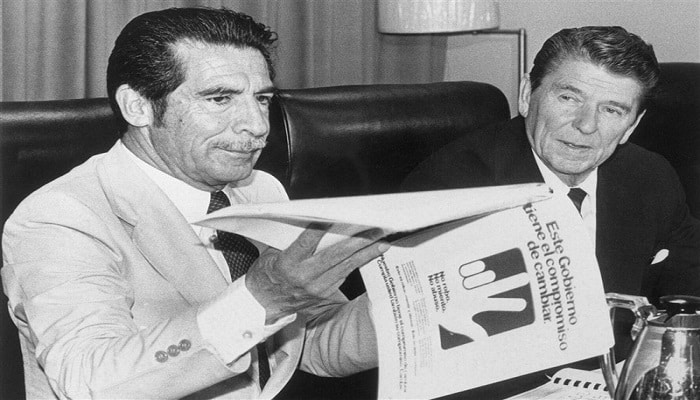
Aid increased again with Ronald Reagan’s victory in the 1980 election. Guatemala’s right-wing leaders saw Reagan as their savior. In 1981 and 1982, there were widespread massacres: thousands of villagers were killed; dozens of Christian Democratic Party officials and labor leaders were assassinated.
The repression entered a new phase with the election of Donald Reagan in the United States in 1980. His administration deceived Congress into resuming arms shipments by fabricating reports of a “Soviet hit list” for the takeover of Central America.
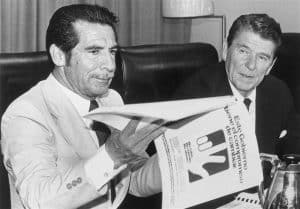
In 1982, General Efrain Rios Montt came to power in a coup. After meeting with him, Reagan said that Rios Montt had brought bad luck and denied the charges against him. During Rios Montt’s seventeen-month term, more than four hundred villages were destroyed and more than two thousand six hundred people were killed in the first six months alone. Despite this, Reagan claimed that the dictator was being unfairly criticized and called him a man committed to democracy.
In the 1980s, the US continued to provide Guatemala with helicopters, spare parts, and military training. Guatemalan army officers were trained at the American school in Panama, and even Cuban exile forces (supported by the CIA) taught them assassination and covert operations techniques.