
PNN – Although Iran’s strategic position and leverage of power reflect part of the concern of the American-Zionist project, the more important factor must be sought elsewhere.
According to the report of Pakistan News Network, citing Al-Mayadeen, since the beginning of the Israeli war against the Gaza Strip on October 7, 2023, this war has no longer been limited to a limited geography or a traditional, controllable conflict; rather, the conflicts have expanded, the fronts have become wider, and the deterrence equations that had dominated the region for decades have changed.
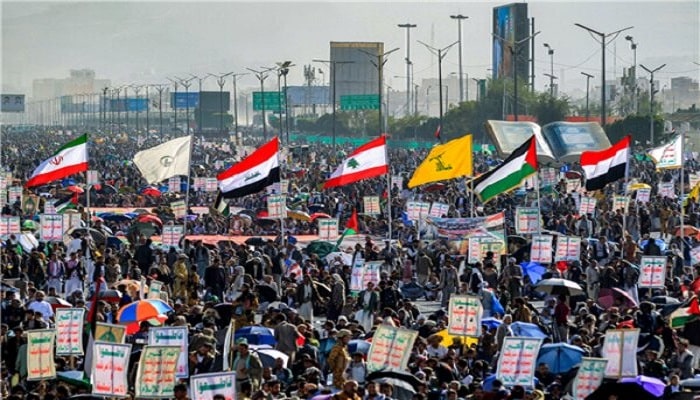
The Gaza War showed that the arrogant forces led by the US and the Zionist regime are not fighting a single front, but rather an interconnected axis whose scenes extend from Gaza to southern Lebanon, Iraq, and Yemen.
Iran’s strategic position and levers of power
Noting that “Iran’s position in the conflict with the forces of arrogance cannot be examined from a single angle,” Al-Mayadeen wrote that Iran is not just a state with a sensitive position, but also a revolutionary political system against the Western model and its dictates, which has become a source of constant concern for America.
The report adds that Iran is at the heart of one of the most sensitive and volatile regions in the international order, a point where energy interests, trade networks, and security equations between East and West intersect.
Iran’s dominance of the Persian Gulf and the Strait of Hormuz, as one of the vital arteries of the global economy, and its long coastline on the Strait of Hormuz, through which about a fifth of global oil trade passes, gives Tehran the potential to influence international energy security, and any conflict with it would expose global markets to extra-regional costs.
The West’s understanding of the importance of Iran’s position is not unrelated to Tehran’s understanding of the importance of its geography. The West cannot ignore Iran’s position in energy security and regional balance, and Tehran sees it as a constant reason for its efforts to dominate and contain it.
The idea of Iranian independence and the threat to Western sovereignty
Although Iran’s geography is part of the West’s concern, it alone is not enough to understand the depth and persistence of the West’s fear of Tehran. The West’s real fear of Iran is related to the idea of independence that Tehran promotes. Therefore, the concern and fear of the West, and especially the United States, about Iran is not only because it has military, missile, or nuclear capabilities, but also because it has succeeded in creating a political, economic, and security project outside the rules that the West has developed for the unipolar international system.
The West’s problem with this idea is not limited to the Iranian experience; it is also concerned about its repeatability. The fact that a country outside the Western orbit can impose its will, resist sanctions, and not collapse is a threat to the interests of the hegemonic regime. Therefore, the inability to subdue Iran is more than a tactical failure for the United States; the success of an independent sovereign project, even on a small scale, raises worrying doubts about the ability of the existing international order to maintain its monopoly of “power” and “legitimacy.”
In this regard, US President Donald Trump has repeatedly said that the US government’s problem with Iran is not limited to its military behavior, but rather to its transformation into a country that seeks to establish its independence outside the framework of Washington’s rule. He added that Washington, in cooperation with its allies, does not rule out the option of “regime change” in Iran, which could be pursued through military threats or within the framework of increasing political and economic pressure.
Despite this, Iran gradually began to build a network of relations and alliances with regional countries and resistance and liberation movements that overlapped with its political ideology. Iran’s approach was based on the idea of opposing American and Israeli dominance, which helped redefine the concepts of power, defense, and deterrence in the West Asian region in various arenas.