
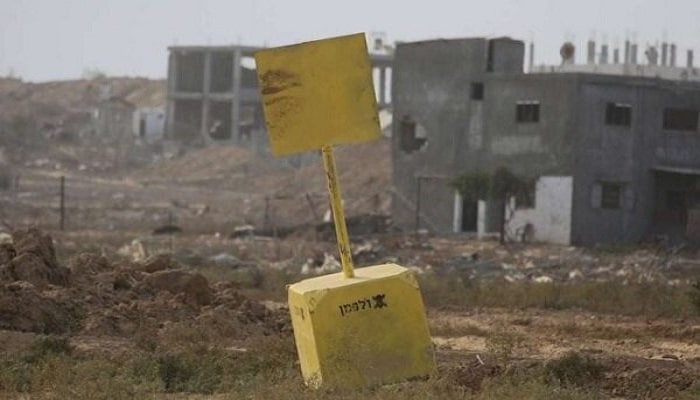
PNN – The Yellow Line in Gaza, or as many call it the “Trump Yellow Line”, is not merely a military line, but rather a symbol of a new phase of occupation and confiscation of Palestine’s future.
The Gaza Strip has been managed for years not just by siege and war, but by “lines”; lines which have each further restricted a part of Palestinians’ lives and darkened their future. Among these, the “Yellow Line” is the newest and at the same time the most dangerous line imposed on Gaza’s geography after the October 2025 ceasefire agreement. This line, which was ostensibly introduced as the area for the Israeli regime’s army withdrawal, has in practice become a tool for consolidating occupation, deepening military control, and demographic engineering. The Yellow Line is now not just a military term, but an objective reality that has suspended the daily life of hundreds of thousands of Palestinians between home, displacement, and death.
Where did the Yellow Line originate?
The concept of the “Yellow Line” officially entered political and media discourse after the announcement of a ceasefire agreement between the Zionist regime and the Hamas movement in October 2025. The Israeli regime introduced this line as a temporary boundary for its forces’ deployment in the first phase of the ceasefire, but field indicators from the very first days showed that this line was not intended to be temporary. Its rapid consolidation with yellow concrete blocks, the continued presence of military forces, and ongoing security operations all indicated that Tel Aviv was turning a temporary mechanism into a permanent reality. In reality, the Yellow Line is a continuation of the Israeli regime’s long-standing strategy of imposing facts on the ground prior to any political agreement.
Geographic coordinates and extent of the Yellow Line
Geographically, the Yellow Line stretches along the eastern edge of the Gaza Strip and has a depth of between two to seven kilometers. This line encompasses the areas of Beit Hanoun and Beit Lahia in the north, passes through eastern neighborhoods of Gaza City such as Shuja’iyya, Tuffah, and Zeitoun, and reaches the east of Khan Younis and Rafah in the south. Based on various estimates, this area comprises between 52 to 58 percent of Gaza’s total area; meaning more than half of this small and densely populated strip. A significant portion of agricultural lands, vital infrastructure, and residential areas lie within this zone, effectively turning them into forbidden and deadly areas.
The Yellow Line; from an operational line to a “new border”
Although the Israeli regime initially tried to portray the Yellow Line as a temporary operational line, explicit statements by this regime’s military officials revealed the reality. The Chief of Staff of the Israeli regime’s army explicitly referred to the Yellow Line as the “new border”; an expression indicating a shift from a ceasefire logic to a logic of permanent occupation. A border that is not the result of negotiation and agreement, but of military pressure, ultimately becomes a permanent tool of control. This shift in discourse clearly shows that the Yellow Line is part of the Israeli regime’s long-term strategy to redefine Gaza’s security geography in its own favor.
Humanitarian consequences; life in the shadow of death
For residents of areas adjacent to the Yellow Line, this line means nothing but a constant threat. Families living in the east of Khan Younis, Shuja’iyya, or other areas, face the sounds of drones, direct gunfire, and artillery shelling every day. Statistics of those killed since the start of the ceasefire show that this line has not brought security, but has become a new epicenter of violence. Approaching this area, even to visit a destroyed home or farmland, can cost people their lives, making normal life virtually impossible.
One direct consequence of the Yellow Line is the intensification of internal displacement in Gaza. Continuous bombardment of eastern areas, systematic destruction of homes, and the creation of permanent insecurity force residents to move to more crowded western areas. This forced displacement is not the result of people’s free choice, but the product of targeted military pressure. Many observers believe the Israeli regime uses the Yellow Line as a tool to empty strategic areas of Palestinian presence to facilitate its long-term control. This process is reminiscent of classic policies of gradual cleansing.
Security vacuum and the role of local militias
Behind the Yellow Line, a significant security vacuum has formed, paving the way for the emergence of local armed groups. These groups, mainly formed in 2025, operate in areas where ordinary Palestinians are forbidden to enter. Numerous reports indicate direct or indirect connections between these groups and the Israeli regime’s army and security apparatus. The presence of these militias, besides increasing insecurity, has become a complementary tool for the Zionists to maintain their influence deep within Gaza without a large formal presence.
The Yellow Line as a political pressure lever
The Israeli regime has explicitly stated that withdrawal from the Yellow Line is conditional upon the complete disarmament of the resistance and the removal of Hamas from the power structure in Gaza. This condition-setting has turned the Yellow Line from a purely military issue into a political pressure lever. Within such a framework, this line plays the role of a hostage-taker; a hostage to which Gaza’s political future, reconstruction, and even the entry of humanitarian aid are tied. This policy essentially turns negotiations into a tool for imposing the demands of Tel Aviv and Washington.