
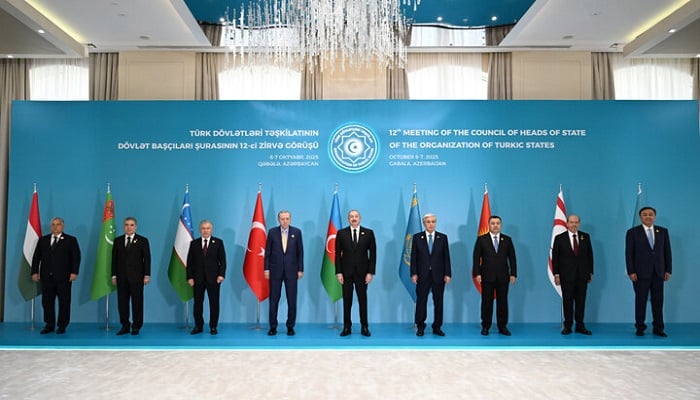
PNN – The Turkic world, as an emerging power bloc increasingly positioning itself as an arm of the right-wing Trump administration in Central Asia, must compete with Iran and Russia across multiple domains.
On Monday and Tuesday last week, “Kobanychbek Umaraliev,” Secretary-General of the Organization of Turkic States (OTS), attended two official events in Washington, D.C.
He first participated in a workshop organized by the Heritage Foundation and later met with the President and CEO of the Hudson Institute. The content of these meetings and the discussions held have significant implications for the geopolitics of the Caucasus and the roles of Iran, Russia, and China in the region.
Promoting the Turkic worldview in the U.S.
During his meeting with John Walter, President and Executive Director of the Hudson Institute on December 16, the Secretary-General reviewed regional and global trends and explained the geopolitical and geoeconomic developments from Central Asia to the Black Sea.
The discussions also focused on energy issues, with specific attention to the geoeconomic aspects and long-term potential for economic relations in the region, including investment opportunities, transit routes, and the role of regional energy resources in meeting international demands.
The creation of a “structured dialogue” between the Organization of Turkic States and the Hudson Institute was also discussed. Hudson expressed interest in expanding cooperation and analytical exchange with the OTS Secretariat, including joint studies, roundtables, and policy consultations to inform American policymakers about regional conditions. This indicates an effort to connect U.S. analysts with the regional body, framing U.S. perceptions of Eurasian developments through the lens of OTS priorities.
Topics discussed at the Heritage Foundation workshop
The workshop “The Future of the Turkic World: From Central Asia to the Black Sea” was held on December 15 at the right-wing Heritage Foundation.
Key points included:
Strategic growth of the OTS: The Secretary-General emphasized that the OTS has evolved from a simple organization into an institutionalized, result-oriented intergovernmental body with a growing strategic role regionally and internationally.
Priorities for cooperation: He highlighted expansion in economic development, transportation and transit infrastructure, regional security, and people-to-people exchanges. The OTS operates across political, economic, transportation, and cultural spheres.
Engaging U.S. analysts and policymakers: Workshop participants agreed that interest in OTS member countries among U.S. think tanks is rising, and the organization’s influence on Washington’s foreign policy calculations is growing, potentially clarifying U.S. perspectives on regional corridor and security projects.
Implications of U.S. right-wing think tanks’ attention to the OTS
Strengthening political-analytical channels with the U.S.: Requests for structured dialogue with the Hudson Institute and participation in Heritage workshops show OTS’s effort to foster a positive perception within Republican-aligned think tanks influencing Trump on foreign, economic, and security policy, supporting effective U.S. engagement in the region per OTS member interests.
Integrating economics and security in Central Asia: Focus on geoeconomics (energy and security) suggests OTS seeks to link infrastructure and energy projects with regional security and diplomacy, attracting investors and foreign actors.
Advancing cultural and soft power policies: Alongside the Secretary-General’s participation, global attention to Turkic cultural issues, such as UNESCO recognizing a “World Day of Turkic Languages Family,” has increased in 2025, reinforcing a cultural identity framework to amplify political and economic messaging to Washington.
Impact on Iran and Russia
As a rising power bloc increasingly serving as a right-wing Trump administration tool in Central Asia, the Turkic world must compete with Iran and Russia across identity, civilization, economic, security, and political domains.
The OTS Secretary-General has engaged not in neutral academic structures but in two key U.S. neoconservative think tanks—the Heritage Foundation and Hudson Institute. These Republican-aligned institutes have long designed strategies to contain Iran, Russia, and China, promoted U.S. presence in “Greater Central Asia” as a buffer against Russia and China, and actively lobbied to reduce Russian influence in the post-Soviet space. They now significantly shape Trump’s foreign policy and his focus on Central Asia vis-à-vis Russia and China.
These think tanks clearly advance a comprehensive Turkic world integration project, viewing it as an ideal lever to penetrate Eurasia, weaken Russia and China, and gain influence. Washington, under the pretext of sovereignty support and developing the central corridor with economic façades, aims to turn the OTS into an alternative power center, redirecting logistics and resources away from Russia and China toward the West, separating Beijing from Europe, and creating permanent tensions along Russia’s southern borders, especially through strengthened U.S.-Turkic military cooperation.
The Atlantic Council has similarly highlighted that the OTS has moved beyond a cultural institution to become a key economic, corridor, security, and political actor. The U.S. should collaborate with its members, especially Turkey, in trade, energy, security, and technology.
The corridor connectivity discussed in the Secretary-General’s U.S. meetings primarily aims to bypass Russia and Iran, replace Russian gas using Kazakh, Turkmen, and Baku energy resources, counter Chinese infrastructure projects, and diminish the Belt and Road Initiative’s influence, keeping Chinese economic links under U.S. and Turkic oversight.
Recommended Iranian approach
Strengthen Iranian think tanks: Iran should shift from a defensive posture to active engagement, enhancing domestic think tanks and their interaction with regional and international counterparts. Producing content in English and Turkish, regular participation in U.S. and European conferences, and informal Track II dialogues with independent U.S. think tanks (e.g., Quincy Institute, Stimson) can break the monopoly of Turkish–American narratives on Central Asia, the Caucasus, and the Turkic world. Inviting foreign researchers and sending Iranian scholars to decision-making centers in Central Asia is crucial.
Build an alternative Eurasian think tank network: Establish an Iran-Russia-China–Central Asia think tank network, collaborating with institutions in Kazakhstan, Uzbekistan, Kyrgyzstan, India, and select European entities to counterbalance the Turkey-U.S. think tank network.
Counter Turkish narratives on the Turkic world: Highlight the region’s multiethnic nature, the destabilizing impact of pan-Turkism, analyze conflicts of interest among OTS members, and assess the security and political costs of full alignment with U.S. interests. Iran can emphasize that Turkey’s expansionist policies destabilize the Caucasus and Central Asia, harming Central Asian countries and U.S. interests, while positioning itself as a stabilizing actor in transit and energy corridors.
Targeted diplomacy with key OTS members: Not all OTS members share the same security, trade, economic, or cultural priorities, and they may not fully follow Turkey or Baku. Balanced diplomacy with Kazakhstan, Uzbekistan, Turkmenistan, and Kyrgyzstan can enhance their cooperation with Iran, including providing suitable transit and corridor access via Iranian ports like Chabahar and Bandar Abbas.