
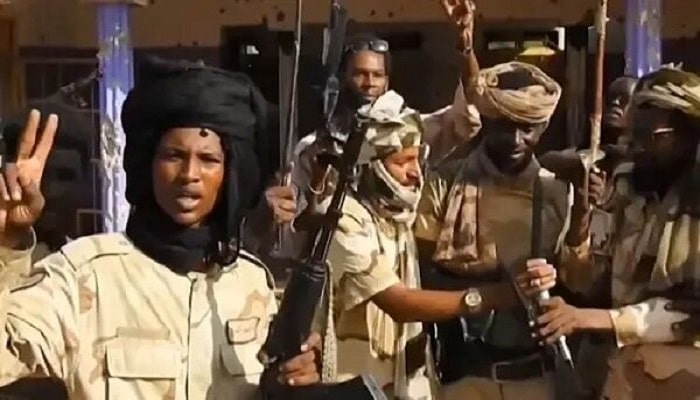
PNN – The European Union has continued to export weapons to Sudan in recent years despite warnings from international bodies that European military equipment was ending up in the hands of the Rapid Support Forces.
According to the report of Pakistan News Network, citing Al Jazeera, Sudan was on the verge of a prolonged crisis even before the open outbreak of war in April 2023. Several decades of authoritarian rule under Omar al-Bashir had left behind a fragile economy, fragmented security forces, and deeply rooted paramilitary structures.
After the fall of Omar al-Bashir following the 2019 coup, the transitional arrangements between civilians and the military failed to unite rival factions. As a result, political instability, local rebellions, and intense competition between the Sudanese Armed Forces (SAF) and the Rapid Support Forces (RSF) escalated into all-out war.
Despite geographical distance, the European Union has played a significant role in these developments. For nearly a decade, the EU has pursued a strategy of “internationalizing” migration management, channeling aid, training, and equipment to African countries under the pretext of reducing illegal migration to Europe.
In Sudan, this approach produced unintended and devastating consequences, as funds allocated under the labels of “migration management” and “capacity building” became intertwined with arms smuggling and weak oversight.
Read more:
US: Colombian recruitment network for Sudanese civil war added to sanctions list.
European governments, particularly the United Kingdom, continued their assistance even though they knew this money was turning into equipment that was reaching the Rapid Support Forces.
Between 2014 and 2018, the EU injected more than 200 million euros (approximately 232 million dollars) into Sudan through the “EU Emergency Trust Fund for Africa (EUTF)” and the “Better Migration Management” initiative. These funds effectively strengthened cooperation between the EU and Sudanese security structures, including units that later merged into the Rapid Support Forces.
The Enough Project warned in early 2017, in a report titled Border Control from Hell that the most dangerous aspect of Europe’s role in Sudan is that the RSF may be benefiting from European financial assistance.”
Two years later, the EU was forced to suspend several migration-control activities in Sudan due to concerns that the resources could be diverted for repressive purposes. Deutsche Welle revealed this through an official EU document.
These contradictions raise a fundamental question: if the EU was aware of the risks of resource diversion, why did it continue injecting hundreds of millions of euros into Sudan under conditions of weak oversight?
European weapons in the Sudan war
As the conflict deepened, foreign—predominantly European—arms and ammunition were found among RSF fighters. Verified images, open-source analysis, and serial-number tracking confirmed the presence of European-made weaponry in the Sudan war.
In November 2024, Amnesty International published an investigation showing that “Nimr Ajban” armored vehicles had been fitted with defense systems manufactured by the French company Galix. The organization released photos and videos from several locations in Sudan and concluded that the deployment of these systems in Darfur constituted a violation of the United Nations arms embargo that has long applied to the region.
Field investigations conducted by France 24 and Reuters in April last year showed that the 81-millimeter mortars found among RSF weapons in northern Darfur were of Bulgarian origin. Markings on the ammunition matched those of mortars produced by a Bulgarian company.
The Guardian revealed last October that British military equipment—including light-weapons targeting systems and armored-vehicle engines—was in the possession of the Rapid Support Forces.
Taken together, this evidence shows that European-manufactured weapons, despite bans and safeguards, have reached the warring parties in Sudan. Nevertheless, European governments, particularly the United Kingdom, continued issuing new licenses for arms exporters, even though they were aware that their equipment had ended up in the hands of the RSF, which is considered a terrorist force.