
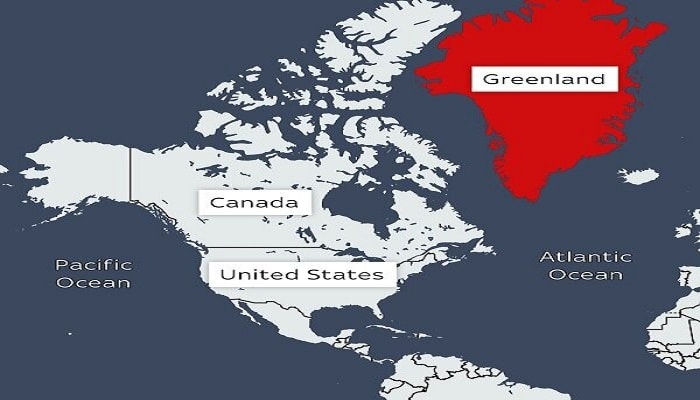
PNN – The Greenland dossier is more than merely a regional issue; it is a clear symbol of the return of America’s unilateralist policies and the challenges facing the international order in the twenty-first century.
The return of “Greenland” to the top of the U.S. foreign policy agenda, especially with rhetoric and actions reminiscent of nineteenth-century expansionist logic, has sounded a serious alarm for Europe and the international system. Donald Trump’s decision to revive his old project to gain control over this Arctic island is not a personal idea or a media stunt, but part of a structural worldview—a view that sees geography, sovereignty, and international law as subservient to the interests of major powers. The sharp reaction from Denmark and the growing concern of other European countries indicate that the Greenland dossier is rapidly turning into a transatlantic diplomatic crisis.
Greenland: From Geographical Periphery to Center of Power Rivalry
Until just a few decades ago, Greenland was considered a remote, frozen, and sparsely populated region, its importance limited to its specific geographical position in the North Atlantic. However, climate change, the melting of polar ice, and the increasing rivalry among global powers over natural resources have transformed this island into one of the key geopolitical points of the twenty-first century. Greenland today not only offers new shipping routes but also, according to reliable international reports, possesses significant deposits of rare earth elements, strategic metals, and vital mineral resources for advanced industries.
Under such circumstances, the direct entry of the United States into the Greenland dossier, with rhetoric evoking concepts of “ownership” and “annexation,” is highly sensitive. For Europe, Greenland is not merely a territory but part of the continent’s legal and political order—an order built on respect for national sovereignty and the non-alteration of borders through pressure and threat.
Read more:
Trump’s representative gives conflicting statements on Greenland.
Trump’s Special Representative: Diplomacy or Political Pressure?
Trump’s decision to appoint a “special representative” to Greenland is a symbolic yet highly significant move. In diplomatic practice, such an action is typically reserved for crisis zones or countries with complex relations, not for a territory officially under the sovereignty of a U.S. ally. This very issue led Danish officials to describe the move as interventionist and unacceptable.
The public statements by this representative about “efforts to join Greenland to the United States” essentially removed any doubt and showed that Washington’s goal goes beyond economic or security cooperation. This approach not only questions the principle of Denmark’s sovereignty but also sends a dangerous message to the world that the U.S., upon identifying strategic interests, is willing to pressure even its own allies.
Europe’s Reaction: Defending Sovereignty and International Order
Denmark’s response to Washington’s maneuvers was swift, clear, and firm. Officials of this country, emphasizing that “Greenland is not for sale,” sought to draw a clear line between legitimate cooperation and unlawful interference. On a broader level, this stance reflects Europe’s deep concern about the return of America’s unilateralist policies—policies that during Trump’s first presidential term also created serious tensions in transatlantic relations repeatedly.
For the European Union, the issue is not just Greenland; it is the principle of respect for territorial sovereignty and international rules at stake. If such pressure is applied to Denmark today, tomorrow it could target other European countries or sensitive regions of the world. Hence, the Greenland dossier has become a symbol of European resistance against America’s “power-centric” logic.
The Monroe Doctrine and the Reproduction of an Outdated Logic
Political analysts assess Trump’s policy towards Greenland within the framework of a practical revival of the “Monroe Doctrine”—a doctrine formed in the nineteenth century to justify U.S. dominance over its peripheral spheres. Although today’s world is fundamentally different from that era, the mindset governing this policy is still based on dividing the world into spheres of influence.
In this view, strategic regions are defined not based on the rights of nations, but on their geopolitical and economic value. Greenland, with its exceptional position and potential resources, fits precisely within this framework. The return of such logic, especially in the twenty-first century, has created deep concerns about the future of the international order.
Natural Resources: The Hidden Driver of the Crisis
Although American officials try to justify their maneuvers under the guise of security or economic cooperation, the reality is that Greenland’s natural resources play a decisive role in this equation. The rare earth elements and strategic metals of this island are vitally important for advanced technology industries, new energy sectors, and even the military. In a world where competition over the supply chains of these resources has intensified, direct access to such deposits is considered a major strategic advantage.
From Europe’s perspective, this is precisely the point where American policy shifts from legitimate cooperation to geopolitical pressure. Attempting to control a territory’s resources indirectly or directly, without regard for the political will governing it, is a clear example of disregarding accepted international principles.
The Transatlantic Consequences of the Greenland Crisis
The Greenland dossier has revealed deeper rifts in U.S.-Europe relations. This crisis shows that even among traditional allies, there is no common understanding of concepts such as sovereignty, security, and interests. For Europe, collective security is meaningful within the framework of respect for international law, whereas Trump’s approach is more power-centric than rights-based. The continuation of this trend could have consequences beyond a diplomatic dispute—from weakening mutual trust to increasing Europe’s desire for strategic independence from America. In other words, Greenland may become a turning point in redefining transatlantic relations.