
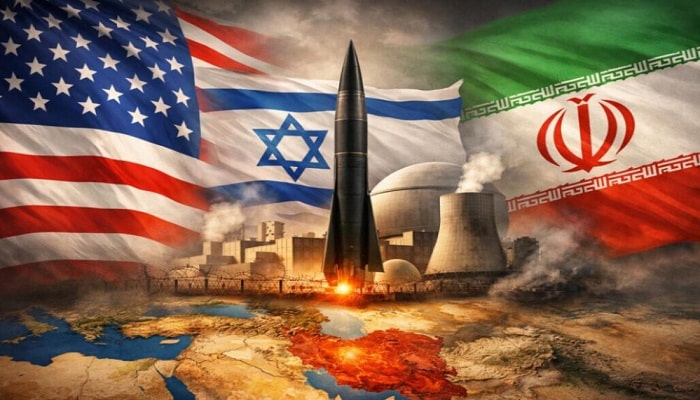
PNN – The continuation of the imposed American-Zionist war against Iran, after five weeks, has not only discredited the initial claims of a quick victory, but also, with the increase in confessions from military and political officials on the opposing side, has revealed signs of structural erosion and strategic crisis on the aggressors’ front and became a nightmare of Trump and Netanyahu.
According to the report of Pakistan News Network; the war’s entry into its fifth week has been accompanied by a noticeable change in the rhetoric of the Israeli regime’s officials, a change that has gone from denial and censorship to confession and warning. Statements by figures such as Yair Lapid, who speaks of a “security disaster,” as well as warnings from the regime’s Chief of General Staff about “ten red flags” and the inability to continue mobilizing reserve forces, indicate a deep gap in the regime’s security and military structure.
The exhaustion of reserve forces, repeated deployments, and reduced operational capacity indicate that the war has shifted from a strike mode to a war of attrition, a war whose costs can no longer be hidden. These confessions are in fact a break with the long-standing policy of censorship in the occupied territories, a policy that has always been used to maintain internal cohesion.
The collapse of victory narratives
In contrast to these confessions are the initial claims of American and Zionist officials. At the beginning of the war, Benjamin Netanyahu spoke of the rapid destruction of Iran, and Donald Trump, in exaggerated terms, spoke of “complete victory” and even “erasing Iran from the map.”
But the reality on the ground has now challenged these narratives. The wave of resignations, domestic protests in the United States, and increasing criticism in the occupied territories show that these claims have not only not been fulfilled, but have also become self-contradictory. What was once presented as a show of strength has now become a symbol of the inability to achieve strategic goals.
This gap between claim and reality, more than anything else, reflects a crisis in war management and an inability to correctly assess the capabilities of the other side; a mistake whose consequences are now becoming apparent.
Iran’s authority and the disruption of equations
On the other side of the field, Iran, relying on national unity, coherent military planning, and utilizing the capacities of the Resistance Front, has been able to fundamentally change the equations of war. Combined operations and precise targeting of enemy interests and bases in the region demonstrate a high level of intelligence superiority and operational capability.
Smart management of the Strait of Hormuz, as a strategic lever, has also had a direct impact on the global economy and the resilience of the adversaries. This is while repeated calls for NATO intervention or the participation of other countries indicate the inability of the other side to independently manage the crisis.
The entry of actors such as Yemen and other resistance groups has broadened the dimensions of the war and shown that this battle is not simply a bilateral confrontation, but rather part of a new regional alignment.
The path forward and the formation of a new order
Despite the continued attacks on civilian infrastructure and targets, the reality on the ground shows that the initiative lies with Iran and the Resistance Front. The combination of social and economic resilience with military power has created conditions where any new adventure, especially in the land domain, could bring heavy costs to the aggressors.
The Zionist regime, which once considered itself the preeminent military power in the region, now faces challenges in achieving even limited objectives in Gaza and the West Bank. This situation, along with the role played by Hezbollah and other resistance groups, indicates a changing balance of power in the region.
In this context, the recent confessions of Zionist and American officials not only indicate a temporary failure, but also a sign of the formation of a new order based on indigenous security; an order in which dependence on extra-regional powers will no longer guarantee security.