
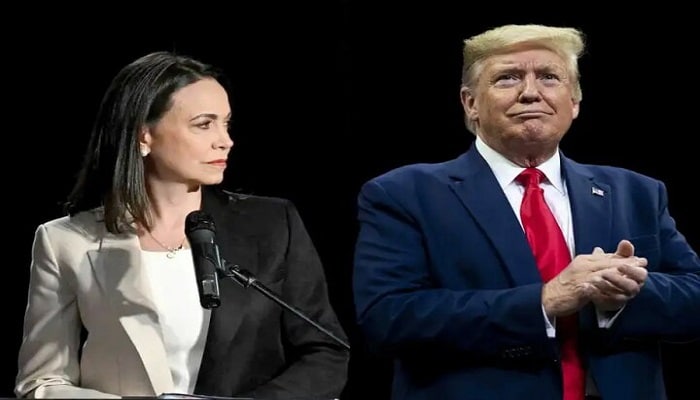
PNN – While the Venezuelan opposition found itself on the verge of a power transition after the arrest of Maduro, Trump showed that the opposition had no place in his calculations by ignoring it and preferring to talk to the power circle.
When US Special Forces arrested Nicolás Maduro in Caracas and transferred him to New York, the Venezuelan opposition thought their golden moment had arrived.
Maria Corina Machado, the 2025 Nobel Peace Prize laureate, immediately issued a statement calling it the “hour of freedom.” Edmundo González Urrutia, the alleged winner of Venezuela’s 2024 elections, called for a transfer of power from his exile in Spain.
Opposition groups who had for years called for U.S. military intervention were shouting with joy that their dream had finally come true. But in the White House, Donald Trump was executing a different scenario; a scenario in which no role was defined for the Venezuelan opposition. In his press conference at Mar-a-Lago, Trump announced he had negotiated with “Delcy Rodríguez,” Maduro’s vice president, and that America would run Venezuela itself. Regarding Machado, the woman to whom he had presented the Nobel Prize a few months earlier, Trump said: “She lacks the respect necessary for leadership.”
This is not just Venezuela’s story. It is the repeated pattern of Trump’s foreign policy; a pattern in which America-dependent liberal opposition groups, even after years of begging for Washington’s intervention, are cast aside at the critical moment.
From Nobel Laureate to “Discredited”: Machado’s Miscalculation about Trump.
Machado’s political path, more than being the story of “one person’s fall,” is a clear example of the miscalculation by opposition groups who confuse symbolic legitimacy with real power. In a short span, Machado transformed from a figure whom Western institutions introduced as a symbol of democracy into a politician who, in Trump’s calculations, was not even worth a phone call; not due to personal weakness, but because her political capital had no function in the arena of power.
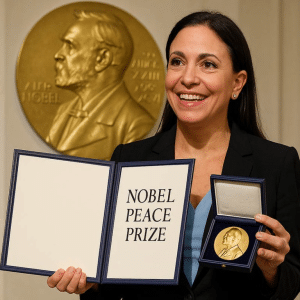
The awarding of the Nobel Peace Prize in October 2025—which Trump also claimed to have received—significantly strengthened Machado’s international standing. The Nobel Committee introduced her as a symbol of the peaceful struggle for democratic transition of power, and Western media spoke of the “future face of Venezuela.” However, this prestige remained largely symbolic, rather than being connected to the ability to effect change within Venezuela. Machado overlooked this gap and tried to turn the Nobel into a tool for solidifying relations with Trump; a relationship she believed would culminate in a transfer of power at the moment of military intervention.
In the following months, through repeated praise of Trump and open support for the policy of maximum pressure, she tried to establish herself as Washington’s natural choice. The declaration of the “Hour of Freedom” after Maduro’s arrest was a continuation of this same assumption that American military action would automatically lead to the opposition’s rise to power. However, the Mar-a-Lago press conference showed how far this assumption was from the actual logic of U.S. foreign policy. Trump’s remark about “lacking the necessary respect” was not merely a personal insult, but a clear expression of the assessment that Machado lacked on-the-ground weight and the tools to exert power.
Trump’s disregard for Machado, while simultaneously preferring dialogue with a figure from within the ruling structure, showed that in his logic, the criteria for selection is not a democratic background, nor a Nobel Prize, nor media alignment, but rather the ability to manage resources and institutions, and practical subservience.
From this perspective, sidelining Machado was not an emotional decision, but the result of a cold calculation; an opposition that has democratic expectations but controls neither the army, the oil, nor the power structure is seen at the moment of intervention not as a partner, but as an obstacle.
Here, Machado’s fall acquires a meaning beyond the fate of one politician. Her experience is a reminder of the reality that in American foreign policy, symbolic legitimacy does not replace real power. A Nobel Prize, media praise, and even years of alignment with Washington are no guarantee of a place in the power equation. Opposition groups who ignore this distinction are often eliminated precisely at the moment they believe they are closest to their ultimate goal.
The Logic of Elimination and the Repeated Pattern: From Afghanistan and Syria to Venezuela.
What happened in Venezuela is not an exception, but part of an established pattern in Donald Trump’s foreign policy; a pattern in which America-aligned opposition groups are sidelined at critical moments, and Washington either directly engages with established powers or prefers to take the initiative itself. Afghanistan, Syria, and now Venezuela each in their own way reflect this same logic: distrust of political proxies and prioritizing the direct management of interests.
Afghanistan; Removing the Aligned Government from the Decision-Making Equation
In February 2020, the Trump administration signed an agreement with the Taliban in Doha that outlined the path for the withdrawal of U.S. forces from Afghanistan. The defining aspect of this process was not merely the agreement itself, but how it was formed; the Afghan government of the time, which had operated for years with American political, financial, and security support, was effectively excluded from the negotiations. This decision signaled a shift in Washington’s approach; a point where America preferred to negotiate directly with an actor that had on-the-ground control and the capacity to exert power inside Afghanistan, rather than relying on the aligned government.
Analysts later emphasized that excluding the Kabul government from the negotiation process sent a clear message: that Washington no longer saw itself committed to the continuation of the previous model. The result of this approach was the weakening of the incumbent government’s position and the swift transfer of initiative to the other side. Regardless of judgment about Afghanistan’s internal actors, this experience showed that in Trump’s calculations, “political alignment” without the backing of real power has no stable place.
Syria; Preferring Withdrawal over Commitment to On-the-Ground Partners
The second prominent example of this pattern is seen in Syria; where the “Syrian Democratic Forces” (SDF), comprised of Kurdish and Arab forces were America’s on-the-ground ally for years. The U.S. armed and trained them and repeatedly emphasized its continued support, to the point where in the minds of these forces, partnership with Washington was seen as a security guarantee.
However, in October 2019, Trump, in a phone call with “Recep Tayyip Erdoğan,” ordered the sudden withdrawal of U.S. forces from northern Syria; a decision made without effective coordination with the Pentagon and which effectively paved the way for Turkey’s military operation against areas controlled by Kurdish forces. Following the start of Operation “Peace Spring,” hundreds were killed and hundreds of thousands displaced, and forces that were America’s partners just the day before found themselves compelled to turn to the Damascus government for survival. In defending this decision, Trump explicitly stated that America had no commitment to these forces.
Now, in Trump’s fresh look at Syria, those same former allied forces have no place in his calculations. Instead, he is prepared to cooperate with “Ahmed al-Shara,” the leader of Hay’at Tahrir al-Sham, a figure with a terrorist background; an individual who was once on the U.S. wanted list but who, due to his control of Damascus and willingness to engage with Washington, has become a negotiable option.
This shift shows that in the logic of Trump’s foreign policy, neither ideological history nor previous ties, but solely “real control of power” and “utility for American interests” are the criteria for choosing a partner—even if that choice means abandoning old allies.
In summary, these examples, from Afghanistan and Syria to Venezuela, share a common message: that in Trump’s foreign policy, America-dependent opposition groups have an instrumental and temporary role. They are of interest as long as they help advance pressure or lend legitimacy. But at the moment of final decision-making, if they lack on-the-ground power, control of resources, or the capacity to impose order, they are easily cast aside. Venezuela is merely the latest stage for the execution of this logic; where it has been shown once again that political proxy, without the backing of real power, does not endure in Washington’s calculations.