
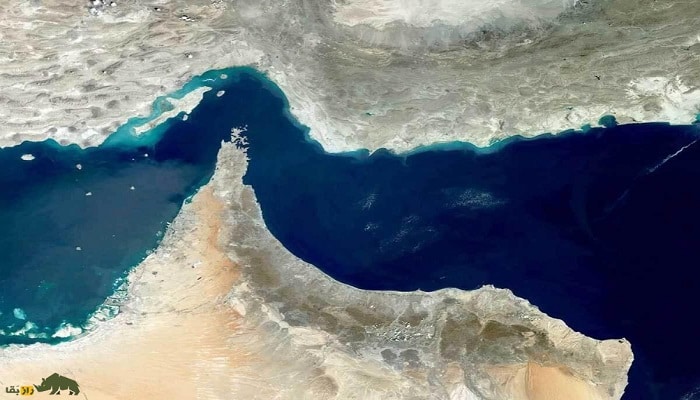
PNN – The contradiction in the positions of American officials regarding the passage of oil tankers through the Strait of Hormuz and the continuous denials by the White House and Western media are a sign of Washington’s operational and psychological confusion regarding the geopolitical reality of the Persian Gulf and Iran’s absolute dominance over this waterway. While Iran emphasizes its strategic position in this vital passage, the American media narrative is facing a crisis of credibility more than ever.
In recent days, as the price of oil and petroleum products has risen, a series of contradictory statements have been made by US officials about the situation in the Strait of Hormuz. First, Trump claimed that the Strait of Hormuz was open and that traffic was flowing through it. Then, the US Secretary of Energy claimed on social media that an oil tanker escorted by the US Navy had passed through the Strait of Hormuz; a claim that was immediately met with a reaction from Iranian officials. Shortly after, the tweet was deleted and a source in the White House stated that the information was released “prematurely.”
At the same time, media outlets such as Reuters and Al Jazeera also reported that the White House did not fundamentally approve of the escort of oil tankers in the Strait of Hormuz. This series of denials and revisions of narratives shows that the American political and media apparatus has encountered a kind of confusion in managing the narrative of the crisis. In such an environment, the publication of uncoordinated news is a sign of confusion and a gap in decision-making and information dissemination.
Read more:
If America makes a mistake, another strait will become similar to Hormuz
Psychological manipulation of global markets
Iranian Foreign Minister Seyyed Abbas Araqchi’s statements about “spreading fake news to manipulate markets” can also be evaluated in this context. He has emphasized that such actions cannot save the United States from the economic consequences of its policies, especially the wave of domestic inflation.
The global energy market is highly sensitive to developments in the Strait of Hormuz. According to some estimates, if there is a widespread disruption in this route, a large volume of global oil supply will be affected. In this context, some analysts have spoken of the possibility of a daily shortage of about 20 million barrels of oil; a figure that, if realized, would be even greater than historical crises in the energy market.
Comparing this situation with events such as the Arab oil embargo of 1973, the Islamic Revolution of Iran in 1979, and the Iraq-Kuwait war of 1990 shows how vulnerable the global energy market is to developments in the Persian Gulf. Hence, hasty narratives can be seen as a sign of passivity in the face of Iran’s absolute power in managing traffic in the Strait of Hormuz.
The Strait of Hormuz and the geopolitical reality of the region
The Strait of Hormuz is one of the world’s most important energy corridors, with a significant portion of the Middle East’s oil exports passing through it. For this reason, any tension or restriction in this region has immediate global repercussions.
In such circumstances, Iran’s role as an actor adjacent to the strait assumes special importance. Tehran has always emphasized that the security of this passage must be ensured within the framework of regional security and with the participation of the Persian Gulf littoral states, not through the military presence of extra-regional powers.
When even some Western sources report that shipping companies have been hesitant about passing through this route and that despite Trump’s insistence, no vessel is willing to pass through this strait, this shows that the geopolitical realities of the region go beyond short-term political narratives.
Operational chaos after the tensions
A series of contradictory messages from the US government and some Western media outlets has reinforced the perception that operational and psychological focus in Washington has been disrupted following the escalation of tensions. In such circumstances, the publication of disjointed news or its rapid removal from social media could be a sign of a lack of coordination at the decision-making level.
On the other hand, this situation indicates that the Strait of Hormuz remains one of the most important influential points in regional and global power equations. Any movement in this passage affects not only the security equations of the Persian Gulf but also the energy markets and the global economy.
The narrative crisis in Washington should be seen as the result of Iran’s military dominance and the effectiveness of its perceptual battle around one of the world’s most sensitive geopolitical crossroads; a crossroads whose field realities are rapidly challenging many political narratives and military and security equations.