
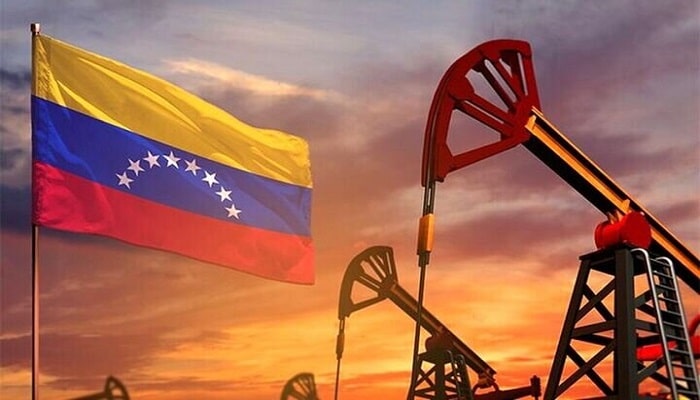
PNN – Evidence suggests that the US effort to wage war on Venezuela and overthrow the Maduro government is aimed at Washington’s control over the country’s vast oil resources.
According to the report of Pakistan News Network, citing CNN, the US State Department claimed that Venezuela’s oil resources are not the US’s motivation for sending more than 12 warships and 15,000 American troops to the region. The Trump administration claims that its military threats are part of US efforts to stem the flow of illegal immigrants and illegal drugs from Venezuela.
Venezuela’s huge treasure of black gold
Venezuela has vast oil reserves of 303 billion barrels of crude oil, which the U.S. Energy Information Administration estimates is about one-fifth of the world’s oil reserves, making it the largest known crude oil region in the world.
Venezuela produces about one million barrels of oil per day, which, of course, only accounts for about 0.8 percent of global crude oil production. This figure is less than half of Venezuela’s oil production before Maduro came to power in 2013 and less than a third of the oil produced in the country before the socialists came to power in 1999.
Read more:
The U.S. Energy Information Administration believes that international sanctions imposed on the Venezuelan government and the country’s economic crises, as well as a lack of investment, have contributed to the stagnation of its oil industry. As a result, Venezuela’s energy infrastructure is deteriorating and its oil production capacity has declined.
The United States has sanctioned Venezuela since 2005. In 2019, during Trump’s first administration, all crude oil exports to the U.S. from the state-owned oil company Petróleos de Venezuela were halted. In 2022, Joe Biden, the former U.S. president, granted Chevron permission to operate in Venezuela as part of efforts to reduce gasoline prices, but Trump revoked this license last March. However, he later reissued it on the condition that no revenue be transferred to Maduro’s government.
The United States produces more oil than any other country in history, yet it still needs to import oil, especially Venezuela’s heavy crude. The U.S. produces light crude oil, which is suitable for gasoline production, but heavy crude—such as Venezuela’s—is essential for producing certain refined products, including diesel, asphalt, fuel for factories, and other heavy equipment. In this regard, diesel production worldwide is facing supply shortages, partly due to sanctions imposed on Venezuelan oil.
According to the U.S. Energy Information Administration, since last September, the United States has imported 102,000 barrels per day of oil from Venezuela. This makes Venezuela the tenth-largest oil exporter to the U.S., but from Washington’s perspective, this is not an ideal ranking, and the U.S. needs Venezuelan oil more than it admits.
Phil Flynn, senior market analyst at Price Futures Group, says Venezuela is geographically close to the United States, and its oil is relatively cheap. Furthermore, most American refineries were built to process Venezuela’s heavy crude and are much more efficient using Venezuelan oil than American oil.
Americans want to topple Maduro’s government in Venezuela and turn the country into a vast oil source for their own use. Such an outcome could create opportunities for Western oil companies. The U.S. seeks to use Venezuela’s massive oil reserves as leverage to counter the risk of rising prices.
On the other hand, Russian oil is similar to Venezuela’s oil, which is why India and China remain heavily dependent on it despite international sanctions against Russia. Increasing Venezuela’s production capacity could provide an alternative for U.S. allies to reduce their reliance on Russian oil and weaken Russia’s economy, which is a competitor to the United States.
All of these factors show that Venezuela’s oil reserves play a major role in Trump’s decision to ignite conflict in Venezuela and increase pressure on Maduro’s government. Gustavo Petro, the president of Colombia, said in an exclusive interview with CNN: “Oil is the core of the issue. I think this is Trump’s objective.”