
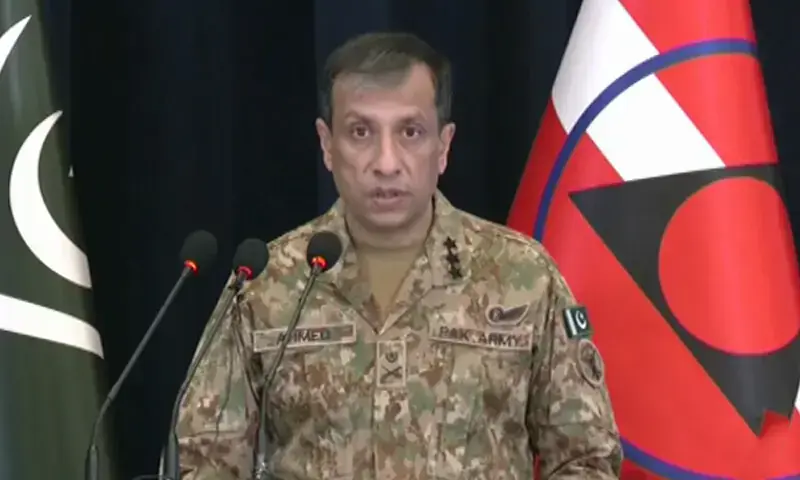
PNN: Pakistan’s chief military spokesperson on Tuesday alleged that militant groups based in Afghanistan, with Indian support, were driving terrorism inside the country, warning that Pakistan faced an unprecedented security challenge in 2025
Addressing a press conference, Director General of Inter-Services Public Relations Lt Gen Ahmed Sharif Chaudhry said militant organisations were using Afghan territory as their operational base, while funding and support were coming from India.
Referring to what he described as new investment patterns linked to terrorism, Chaudhry said, “The most prominent pattern affecting Pakistan points towards India.” He added that Afghanistan remained the base of operations for militant groups targeting Pakistan.
The DG ISPR said a “war economy” was a major driver of terrorism. Citing reports, he said around $147 billion was spent on Afghanistan’s reconstruction, raising questions about where the money went. He said when such financial flows stopped, groups dependent on conflict sought to sustain themselves by spreading terrorism across the region.
He also said $7.2 billion worth of US military equipment, including advanced weapons, was left behind in Afghanistan, adding that political and internal facilitation had taken place during the same period. Pakistan, he said, took a firm stand against these elements in 2023.
Chaudhry said developments in Afghanistan since 2021 had reshaped the terrorism landscape. He referred to the Doha agreement between the Afghan Taliban and the United States and its international partners, which committed to forming an inclusive government, preventing the use of Afghan territory for terrorism and protecting women’s rights.
However, he said those commitments were not fulfilled. “An inclusive government did not form, Afghan territory was used by multiple terrorist organisations, and groups such as the Balochistan Liberation Army (BLA) and Tehreek-e-Taliban Pakistan (TTP) began operating from Afghanistan,” he said.
He added that due to the situation in Syria, around 2,500 militants had recently moved to Afghanistan, saying they were neither Afghan nor Pakistani.
The military spokesperson said 2025 was a “landmark and consequential year in our fight against terrorism,” as security forces launched an extensive nationwide campaign amid a sharp rise in attacks.
“This is the only purpose of this press conference, and I would request that we remain focused on counter-terrorism, as terrorism is the biggest threat being faced by the state of Pakistan right now,” he said.
According to the DG ISPR, security forces conducted an average of more than 206 intelligence-based operations (IBOs) daily in 2025. By the end of the year, the total number of IBOs reached 75,175.
Most operations were carried out in Balochistan, where 58,778 IBOs were conducted. Khyber-Pakhtunkhwa followed with 14,658 operations, while 1,739 took place in the rest of the country.
Chaudhry said 5,397 terrorist incidents were reported nationwide during the year. Khyber-Pakhtunkhwa was the worst affected, with 3,811 incidents, accounting for 71% of the total. Balochistan recorded 1,557 incidents, or 29%, while only 29 incidents were reported elsewhere.
Security forces killed 2,597 militants during the year, including 1,803 in Khyber-Pakhtunkhwa and 784 in Balochistan, he said. A total of 27 suicide bombers were reported, with 16 in Khyber-Pakhtunkhwa and 10 in Balochistan.
The DG ISPR said Fitna-al-Hindustan – a term he used to refer to Baloch militant groups – had no connection with Balochistan. He added that security forces faced intense challenges, with 1,235 soldiers martyred during operations.
Presenting data from 2021 to 2025, Chaudhry said terrorism-related incidents showed a steady and then sharp rise. In 2021, there were 761 incidents, with 193 militants killed and 592 security personnel martyred.
In 2022, incidents increased to 1,020, with 443 militants killed and 644 personnel martyred, he said.
The situation worsened in 2023, when incidents rose to 1,811. During the year, 691 militants were killed and 980 security personnel lost their lives.
In 2024, incidents climbed further to 3,014, with 1,053 militants killed and 989 personnel martyred, he said.
“The surge peaked in 2025,” Chaudhry said. “Incidents jumped to 5,397, 2,597 militants were killed, and the number of martyred personnel reached its highest level at 1,235.”
He also outlined major attacks carried out during the year across the country, targeting military installations, law enforcement personnel, civilians and children.
On March 4, Bannu Cantonment in Khyber-Pakhtunkhwa was attacked, killing 18 people, including five law enforcement personnel and 13 civilians. Security forces killed 16 militants.
On March 11, the Jaffar Express was attacked in Bolan, killing 25 people four law enforcement personnel and 21 civilians while 33 militants were killed. On March 16, a bus carrying Frontier Corps personnel was attacked in Nushki, killing five people, including three law enforcement personnel and two civilians.
On May 21, a school bus was attacked in Khuzdar, killing five civilians. One militant was killed.
After a brief lull, attacks resumed in September. On September 2, Frontier Corps North headquarters in Bannu was attacked, killing six law enforcement personnel. On September 30, an attack on Frontier Corps headquarters in Quetta killed 11 people, including three law enforcement personnel and eight civilians.
On October 10, a police training school in Dera Ismail Khan was attacked, killing seven people six law enforcement personnel and one civilian. In November, a cadet college in Wana was attacked, killing five people, including three law enforcement personnel and two civilians
On November 11, an attack on the Judicial Complex in Islamabad killed 11 civilians. The final incident occurred on November 24 in Peshawar, where an attack on Frontier Corps North headquarters killed three law enforcement personnel.
Chaudhry said Fitna Al-Khawarij – a name used for banned TTP militants – were the first to use armed quadcopters, alleging full Indian support.
He said a specialised militant wing operated armed drones to target mosques, public places and residential areas, often using women and children as human shields.
“The Pakistan Army uses drones only for surveillance purposes,” Chaudhry said.
He rejected what he called a false narrative that the fight against terrorism was the military’s war alone, stressing that it was a national struggle.
“If the nation does not stand united, its consequences will reach homes, schools, markets and offices,” he warned.