
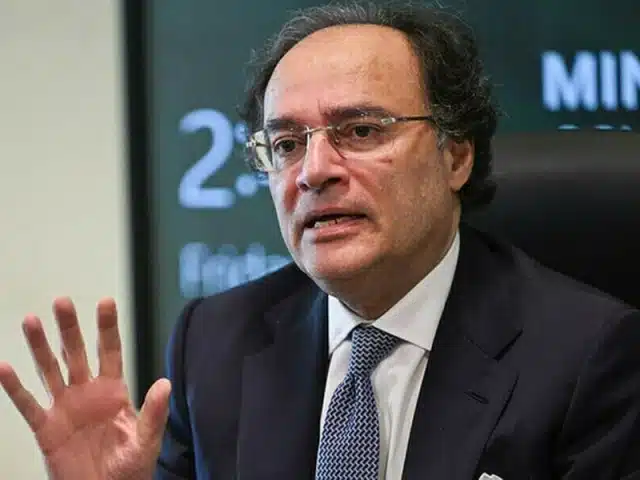
PNN: Finance Minister Senator Muhammad Aurangzeb on Wednesday held a series of meetings with international investors, development partners and foreign officials, focusing on private sector-led growth, capital mobilisation and Pakistan’s ongoing economic reforms, according to statements issued by the Ministry of Finance.
In a meeting at the Finance Division, the minister engaged a high-level international investors’ delegation comprising representatives of the International Finance Corporation (IFC), British International Investment (BII), the Asian Development Bank (ADB) and Baltoro Capital. Discussions centred on expanding private sector participation, reducing sovereign risk exposure and strengthening investment flows through local currency financing mechanisms.
Aurangzeb acknowledged IFC and ADB as long-standing development partners and welcomed their increased engagement in private sector financing and local currency initiatives.
He noted that protecting and expanding private sector exposure remained essential for sustaining investment momentum and lowering reliance on sovereign-backed funding.
The minister told participants that Pakistan had made notable progress in restoring macroeconomic stability over the past 18 months. He cited improvements in currency stability and foreign exchange reserves, which are projected to reach coverage of around three months of imports by the end of the year. He added that government efforts were focused on narrowing the investment gap and creating a more predictable economic environment.
Briefing the delegation on trade reforms, Aurangzeb outlined the government’s tariff rationalisation and broader trade liberalisation programme aimed at improving competitiveness and dismantling protectionist barriers. He said the reform trajectory was intended to place Pakistan on a development path comparable to successful Southeast Asian economies, while pointing to continued growth in services exports.
Energy sector reforms, tax policy changes and steps to improve tax administration were also discussed. The minister reiterated the government’s commitment to broadening the tax base, improving collection efficiency and aligning fiscal policy with growth objectives.
On external financing, Aurangzeb said Pakistan was meeting its repayment obligations while exploring re-entry into international debt markets through approved instruments, including the inaugural Panda Bond and the Global Medium-Term Note framework. He stressed that strengthening domestic investor confidence was equally important, citing recent local investment transactions as positive signals.
Representatives of the participating institutions reaffirmed their support for Pakistan’s reform agenda, with a growing focus on catalysing private investment in infrastructure, small and medium enterprises, mid-sized firms and job creation. Participants also underscored the need to mobilise domestic capital, rationalise tax structures affecting investment vehicles and build a pipeline of private equity platforms.
Separately, Aurangzeb met John Mark Pommersheim, Deputy Assistant Secretary at the US Department of State, accompanied by US Chargé d’Affaires Natalie A Baker. The meeting reviewed Pakistan’s economic outlook, reform progress and prospects for expanding bilateral economic cooperation.
The finance minister briefed the US delegation on macroeconomic stabilisation, highlighting a reduction in the fiscal deficit, an improved current account position supported by remittances and IT exports, and positive movement in credit ratings. He said the government would continue to prioritise fiscal discipline, external stability and structural reforms, including state-owned enterprise restructuring and public sector right-sizing.
Pommersheim acknowledged Pakistan’s stabilisation efforts and noted improvements in key indicators. He said a stable and prosperous Pakistan was in the shared interest of both countries, adding that US businesses were closely monitoring reform implementation and policy consistency.
Aurangzeb reiterated Pakistan’s commitment to facilitating foreign investment and maintaining engagement with the US business community, including regular interaction with American commercial bodies. He also outlined plans to return to international capital markets and provided an update on the privatisation programme, including proposed transactions in banking, power distribution and airport outsourcing.
In another meeting, the finance minister received a delegation from Gobi Partners, led by Chairman Thomas Tsao, to discuss venture capital and technology investment. Aurangzeb welcomed the firm’s interest in Pakistan’s startup ecosystem and stressed the importance of risk capital in scaling entrepreneurship, fostering innovation and generating employment.
The delegation outlined Gobi’s investments in Pakistan through Techxila Fund I and shared plans for a proposed $50 million Techxila Fund II targeting fintech, logistics, health technology and software services. Discussions also covered regulatory and tax measures to encourage greater domestic participation in venture capital and private equity. The minister reaffirmed the government’s focus on macroeconomic stability, business climate reforms and mobilisation of domestic and foreign capital to support sustainable, innovation-led growth.