
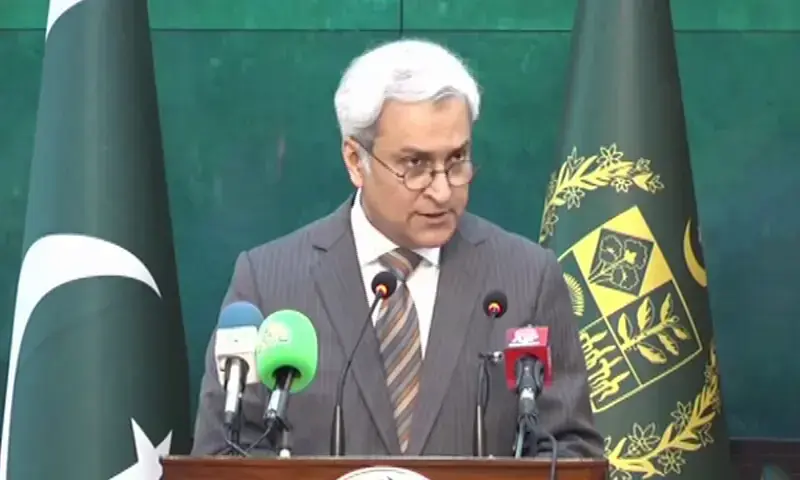
PNN: Foreign Office spokesperson Tahir Hussain Andrabi stated Thursday that, under the Indus Waters Treaty, India is not permitted to misuse its limited allowance by unilaterally constructing hydroelectric projects on the western rivers.
He made the remarks while responding to a question about India’s approval of the 260-megawatt Dulhasti Stage-II hydropower project on the Chenab River in Kishtwar district of India-held Jammu and Kashmir.
The IWT is a water-distribution agreement between India and Pakistan, brokered by the World Bank and was signed in Karachi on Sept 19, 1960 by President Ayub Khan and Prime Minister Jawaharlal Nehru. The treaty gives India complete rights to waters of the eastern rivers (Ravi, Sutlej and Beas) and gives Pakistan the rights over the western rivers (Indus, Jhelum and Chenab) with limited allowance for use of water by India from the western rivers for purposes of, among others, power generation.
In his remarks, Andrabi said, “We have seen these media reports regarding Indian plans to construct the Dulhasti Stage-II hydroelectric [project] on the Chenab River. Obviously, these reports raise serious concerns as no prior information or notification was shared with Pakistan with regard to this project.”
He further said that sharing of this information was mandated by the IWT.
“Such acts of commission and omission yet again exemplify a complete disregard of international law and bilateral treaties. The Pakistani commissioner for Indus water has sought clarification from his counterpart in India regarding the nature, scope and technical details of the reported projects, and he also wishes to ascertain whether this constitutes a new run-of-the-river project, an alteration or additional work on an existing plant,“ he said.
He said that under the IWT, India could not misuse its “restricted allowance” for unilaterally building any hydroelectric projects on the western rivers.
“Any such project on the western river is subject to strict design and operational controls as well as information sharing requirements,” he said.
“In the absence of formal communication from the Indian side, Pakistan is unable to access the project’s conformity with the treaty provisions. We, therefore, call upon India to urgently return to treaty compliance and respond to the queries raised by our Indus water commissioner in his latest as well as his earlier communications.“
He said that Pakistan reiterated that IWT remained a binding international agreement. He said that Pakistan remained committed to the peaceful resolution of disputes with India but would “never compromise on our existential water rights”.
During his briefing, Andrabi said also said that Pakistan and India had exchanged a list of their respective nuclear installations.
He said that “ a list of nuclear installations and facilities in Pakistan was officially handed over to the representative of the Indian High Commission in the FO today“.
“I understand that the Indian government is also sharing the list of Indian nuclear installations with our High Commission in New Delhi today,” he added.
The FO spokesperson further said that the “agreement provides that both countries shall inform each other of their nuclear installations and facilities.