
PNN: Muttahida Qaumi Movement-Pakistan (MQM-P) on Sunday assailed the PPP-led Sindh government for moving a resolution in the provincial assembly against the creation of any new province, terming it “unconstitutional”.
On Saturday, the Sindh Assembly on Saturday passed a resolution declaring Karachi an “inseparable part” of the province and opposing any move that suggested otherwise.
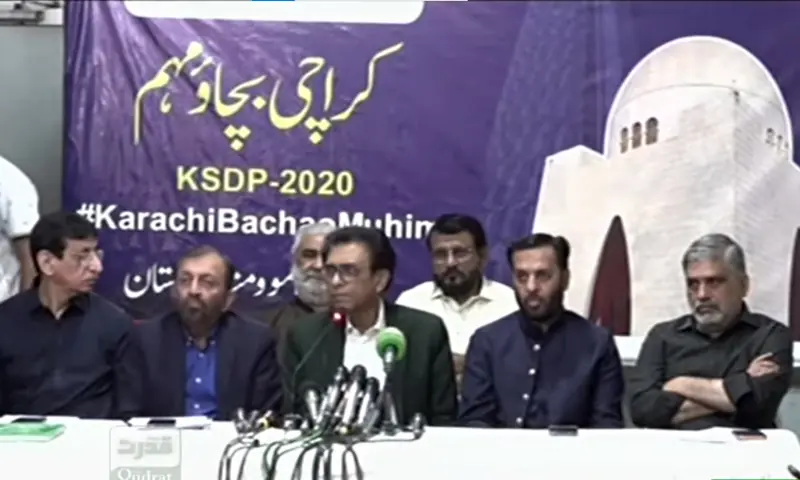
Subsequently, on Sunday, MQM-P Convener Khalid Maqbool Siddiqui flanked by Farooq Sattar, Mustafa Kamal and Senator Faisal Subzwari addressed a press conference in Karachi on the development.
“Yesterday, a resolution against the Constitution of Pakistan was passed by one assembly of Pakistan,” Siddiqui said at the outset of his speech.
“A province had carried itself as if it were a separate country,” Siddiqui, also the federal education minister, said while referring to Sindh.
The MQM-P leader asked the public and the “intellectuals” of Sindh whether any province could pass a resolution that “went against the Constitution”.
“This [resolution] challenged Pakistan, its Constitution, its law and its state,” he remarked, noting that it was being done by the party that had been in power in the province for the past 17 years.
Siddiqui contended that Article 239 of the 1973 Constitution provided the procedure for establishing new provinces.
“This resolution is not against any demand of ours but against Pakistan’s Constitution, its state, presence and the PPP leader (Bhutto),” he said.
The MQM-P leader also referred to Articles 246 and 248 of the Constitution, which he said gave presidential powers for “extraordinary circumstances”.
He recalled that the MQM-P had demanded the empowerment of local governments even at the time of the 26th Amendment, when “the Pakistani state, government and democracy were in dire need of us”.
Siddiqui emphasised that the solution to the issue was “dialogue, not threats”.
“What fear made you table this resolution?” he asked, asserting that no demand ever made by the MQM-P was in violation of the Constitution.
“The incident and trauma that Pakistan suffered in 1970, a show of solidarity had to be made after that. Then what happened? The Punjab Assembly declared Urdu its provincial language. Sarhad (Khyber Pakhtunkhwa) and Balochistan also chose Urdu as their provincial language,” he said.
However, Sindh, he said, was the only province which didn’t do so because the ruling party here had “other dreams and intentions, which have been proved today.”
“As long as we are here, every dream of establishing Sindhudesh will be shattered,” he declared. “As long as we are here, we cannot let this happen.”
Speaking about Pakistan’s electoral history, he said that in the elections of the 1970s, there wasn’t a single candidate representing the PPP from West Pakistan, i.e. 55 per cent of the country, declaring itself a lingual party. Only 1.5 provinces had PPP representation.
“Today, a party with a manufactured majority has held control of Sindh since 1972. I want to ask the state of Pakistan: is there any other province where such segregation exists along linguistic lines? In 1970, the quota system was not merely an administrative arrangement; it was structured on the basis of language.”
Siddiqui then questioned the prime minister, the president, the state of Pakistan, the courts, and the nation at large, asking whether the kind of treatment meted out to Sindh’s cities has ever been seen in any other part of Pakistan. He said that whenever anyone raises their voice for their rights in Sindh, they are branded as traitors.
He further said that the MQM-P had “never made any demands that go against the interests of Pakistan,” adding that when their founding leader made remarks against the country, he was separated from the MQM, stressing that for the party leaders, it is Pakistan first, then MQM.