
PNN: Energy Minister Awais Leghari on Thursday told the National Assembly that only a small fraction of solar consumers would be affected by the government’s decision to replace the net metering system with net billing, stressing that the policy change would not burden the common man.
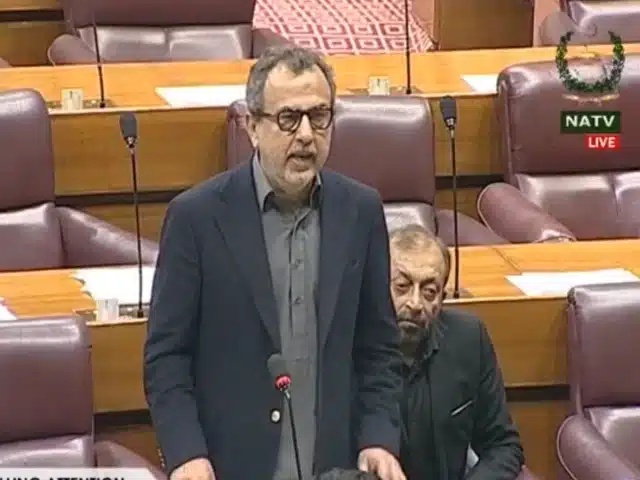
Responding to a point of attention raised by Pakistan Peoples Party (PPP) lawmaker Sharmila Faruqui, he said that out of Pakistan’s total installed solar capacity of 20,000 to 22,000 megawatts, only around 6,000 megawatts are linked to net metering. As a result, he said, just 600,000 to 700,000 consumers – about eight to ten per cent of total solar users – would be impacted. “There will be no impact on lower-income consumers,” he assured the House.
The minister recalled that he had introduced the net metering system in 2017 and that it had since undergone four to five regulatory changes. He acknowledged widespread debate and criticism of the recent revisions, including opposition from members of his own party.
However, he rejected claims that the new regulations were anti-solar, explaining that reducing the profit margin of net-metered consumers from 50 per cent to 37 per cent was not an anti-people measure. “Is that so bad?” he asked, stressing that “no one was going to incur any losses”.
The minister added that the proposed regulation had retained the purchase rate for existing users at Rs27 due to “contractual obligations”, though he acknowledged this had “sparked another debate”.
He said net-metering consumers had questioned the disparity, asking why electricity bought from them at Rs27 was sold back at Rs45–65 per unit.
Responding to the criticism, the minister argued the comparison was misleading. He said that when electricity generated from hydel, solar, wind, nuclear, gas, and coal sources was combined, the average cost stood at Rs8.31 per unit making the Rs27 rate difficult to justify.
He added that 55 per cent of electricity generated during 2024-25 came from clean energy sources and said Pakistan was confident of meeting its international commitment to raise this share to 60 per cent by 2030 – possibly even earlier. The minister said Pakistan will become a 90 per cent clean energy country in terms of power generation by 2034.
Earlier this week, the National Electric Power Regulatory Authority (Nepra) revised the terms and conditions for all existing and future net-metered solar consumers to manage rising solar penetration and protect the state-owned power network.
In a separate intervention, Leghari said that around 466,000 consumers were responsible for system-related issues, while also acknowledging their role in promoting clean energy. He accused critics of undermining public trust in government policies and international agreements.
Highlighting broader power sector reforms, the energy minister said circular debt had been reduced by Rs780 billion, while losses due to electricity theft had fallen by Rs190 billion.
Responding to the minister’s remarks, Faruqui objected to what she described as the government “shifting the blame to net-metering users for burdening the national grid”.
“These consumers are the ones who followed the government’s clean energy policy,” she said, arguing that the authorities had taken a “U-turn on their policies”. “Now they are justifying it by blaming people who were at the forefront of your policy,” she added.
Faruqui maintained that the Power Division was effectively passing on costs arising from “line losses, transmission losses, inefficiency, inconsistency, corruption and capacity payments” to ordinary citizens. She termed the move “broad daylight robbery”.
Meanwhile, MQM lawmaker Moin Pirzada raised concerns about prolonged load-shedding on K-Electric feeders. Parliamentary Secretary for the Power Division Aamir Talal said detailed responses regarding K-Electric would be provided in the next sitting, triggering protests from MQM members. The deputy speaker directed Talal to furnish the information in the following session.
Talal also informed the House that the nationwide installation of Advanced Metering Infrastructure (AMI) meters would be completed by the end of this year. He said load-shedding was imposed on feeders with high losses and that the installation of Aerial Bundled Cables and AMI meters would help curb power theft. He added that an anti-pilferage campaign was currently underway.