
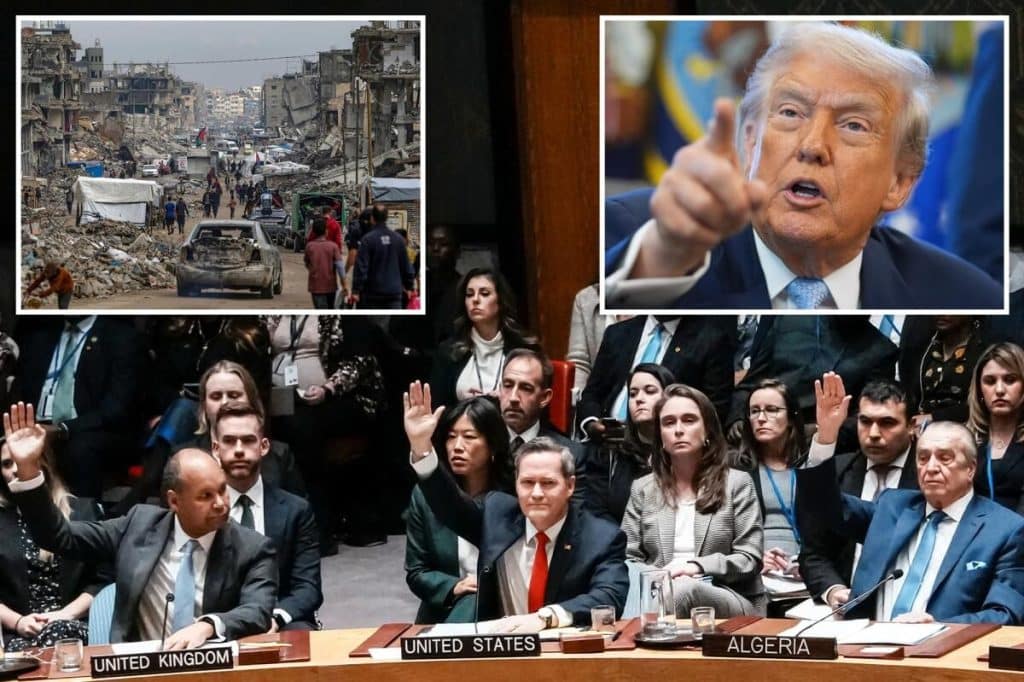
$2 Billion Conditional US Aid: Humanitarian Gesture Amid Aid Cuts.
The United States announced a $2 billion pledge for humanitarian aid to the United Nations on Monday, as the Trump administration continues to cut foreign assistance and warns UN agencies to “adapt, downsize, or close” in response to new financial realities.
This funding is a fraction of what the United States has contributed in the past, but analysts say it is enough to maintain Washington’s position as the world’s largest humanitarian donor. The pledge establishes a trust fund through which resources can be allocated to various agencies and priorities—this is a key aspect of U.S. demands for significant changes to the UN structure, which has raised concerns among aid workers and led to substantial cuts in programs and services.
The $2 billion is just a small portion of the U.S. humanitarian budget for UN-sponsored programs, which has reached $17 billion annually in recent years, according to UN data. U.S. officials claim that only $8 billion to $10 billion of that amount comes from voluntary contributions, while the United States also pays billions in annual dues for its UN membership.
Critics argue that cuts to Western aid are short-sighted, pushing millions into starvation, displacement, or disease, and undermining U.S. soft power around the world.
This is a critical year for UN humanitarian aid. The Trump administration has already slashed billions in U.S. foreign aid, forcing reductions in spending, the cancellation of aid projects, and the laying off of thousands of workers. Other traditional Western donors have also cut back on spending, increasing the challenges faced by many UN agencies, including those focused on refugees, migration, and food aid.
The U.S.’s commitment to UN relief programs, as the world’s largest humanitarian donor, is outlined in a preliminary agreement with the UN Office for the Coordination of Humanitarian Affairs (OCHA), led by former British diplomat Tom Fletcher. Despite the cuts, global needs continue to rise. This year, famines have been reported in war-torn areas of Sudan and Gaza, while floods, droughts, and natural disasters—many of which scientists link to climate change—have resulted in numerous deaths and the displacement of thousands from their homes.
According to the UN, total U.S. humanitarian aid to the UN is projected to drop to about $3.38 billion in 2025, which would represent just 14.8 percent of global aid. This reflects a decrease from $14.1 billion last year and $17.2 billion in 2022. The budget cuts will significantly impact UN agencies such as the International Organization for Migration, the World Food Programme, and the UN Refugee Agency, which are receiving substantially less funding from Washington this year compared to the previous U.S. administration under President Joe Biden or even during Trump’s first term.
Under the new plan, Fletcher’s office, which initiated the “Humanitarian Realignment” initiative last year to enhance efficiency, accountability, and effectiveness in spending, will serve as the main conduit for U.S. and other countries’ aid, rather than distributing funds through multiple requests from different agencies.
A senior State Department official, who spoke on the condition of anonymity, told The Associated Press that the United States is seeking “more centralization of leadership authority” in the UN’s humanitarian aid distribution system. According to the official, Fletcher and his coordination office are expected to take charge of how money is allocated to agencies.
“This humanitarian realignment at the UN should deliver more aid with fewer taxpayer dollars and provide focused, results-oriented assistance that aligns with U.S. foreign policy,” stated Michael Waltz, the U.S. ambassador to the UN.
U.S. officials indicate that the $2 billion is just the first step in funding OCHA’s annual appeal, which was announced earlier this month. In early December, the UN launched a $23 billion appeal for 2026 to assist 87 million people at risk. This figure represents half of the $47 billion requested for 2025 and points to a decline in donor support at a time of record global needs.
Fletcher has scaled down this year’s request, citing the outlook for the aid sector. Other traditional UN donors, including Britain, France, Germany, and Japan, have also reduced their contributions this year and called for reforms.
The U.S. push for UN reform aims to align humanitarian functions to reduce bureaucratic costs, unnecessary interference, and ideological bias. The U.S. State Department stated, “Individual UN entities must adapt, shrink, or be eliminated,” emphasizing that reform is most urgent in the humanitarian institutions and agencies that carry out some of the UN’s critical work.