
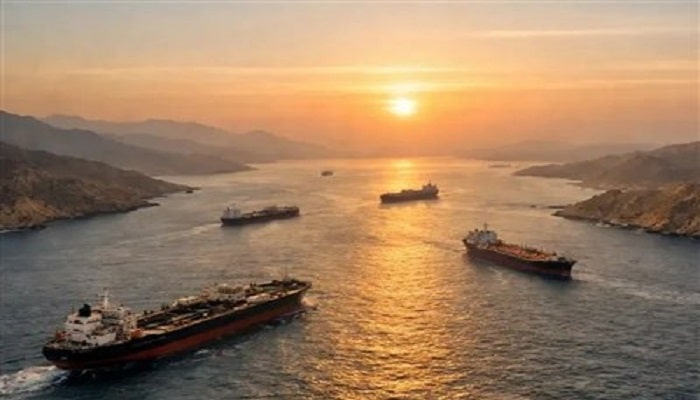
PNN – The Associated Press reported that Iran has taken steps to create a secure corridor in the Strait of Hormuz.
According to the report of Pakistan News Network, an American media outlet reported that amid the ongoing conflicts and despite the virtual closure of the vital Strait of Hormuz waterway to many ships, about 90 vessels, including oil tankers, have passed through this passage since the beginning of the war, and Iran continues to export millions of barrels of oil.
The Associated Press, based on data from maritime and commercial platforms, wrote that by exercising control over this key passage, Iran has succeeded in effectively creating a secure corridor for certain traffic while maintaining exports.
Analysts believe that Tehran has used its influence in the strait to provide a route for its affiliated ships, as well as vessels from specific countries with which it has entered into negotiations.
Read more:
Euronews: Strait of Hormuz crisis risks rising insurance premiums
Kun Cao, client manager at Redal Consulting, said: By using control over the strait, Iran has both benefited from oil sales and “maintained its export artery.”
According to Richard Mead, editor of Lloyd’s List, these transits have been accompanied by “at least some level of diplomatic intervention” and Iran has “effectively created a safe corridor” through which some ships travel near the Iranian coast.
The Associated Press has further detailed these movements and exports.
- Traffic statistics: Between March 1 and 15, at least 89 ships passed through the Strait of Hormuz, 16 of which were oil tankers. This figure is compared to between 100 and 135 ships passing through this route daily before the war.
More than a fifth of these 89 ships are attributed to Iran, and the rest are mainly dependent on China and Greece.
- Passages under other flags: In addition to Iranian ships, vessels under the flags of Pakistan and India have also managed to pass through the strait in recent days. The Pakistani oil tanker “Karachi” passed through the strait last Sunday.
Two Indian ships carrying liquefied petroleum gas (LPG), the Shivalik and the Nanda Devi, also passed through this route on March 13 or 14. The Indian Foreign Minister confirmed that the passage of the two ships was made possible after negotiations with Iran.
- Iran’s oil exports: Kepler, a trade data analytics platform, estimates that Iran has exported more than 16 million barrels of oil since the beginning of March. “Continued resilience” is evident in Iran’s oil export volumes, with China being the largest buyer of Iranian oil due to Western sanctions and related risks.
- Methods of passage: Many ships that have passed through the strait have used the “dark passage” method (turning off tracking systems) to evade sanctions and surveillance by Western governments.
Some ships have also presented themselves as being affiliated with China or with an all-Chinese crew to reduce the risk of attack, taking advantage of Beijing’s close ties with Tehran.
Other reactions and developments: Iraq is also negotiating with Iran to allow its tankers to pass through. In return, Iran has threatened not to allow “even a drop of oil” to pass through to the United States and its allies.
On the other hand, the United States has announced that it will allow the passage of Iranian tankers to stabilize oil prices, which have increased by more than 40% due to the war and have exceeded $100 per barrel.
US Treasury Secretary Scott Besant said: Iranian ships are leaving and we have allowed this to happen so that the rest of the world can be supplied.
Ultimately, analysts believe that the Strait of Hormuz is not “closed,” but rather selectively closed to some traffic while remaining open to Iranian exports and a limited number of non-Iranian traffic that are permitted.