
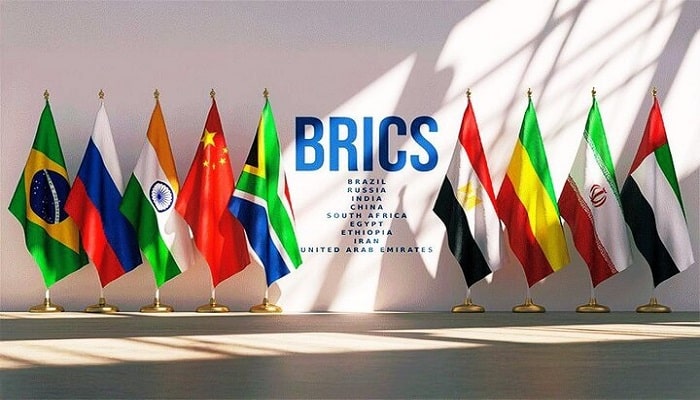
PNN – BRICS member states witnessed significant developments over the past week in the fields of strategic relations, the economy, science, technology, and culture.
According to the report of Pakistan News Network, citing TV BRICS, Russian President Vladimir Putin announced that at the national level, Russia is China’s largest partner among European countries. Speaking at a major press conference and direct dialogue program held at the Gostiny Dvor complex, he said bilateral trade has reached nearly $250 billion, and relations between Moscow and Beijing are expanding steadily across all sectors, including high-tech industries, science, education, and space exploration.
In Africa, Ethiopian Prime Minister Abiy Ahmed and Indian Prime Minister Narendra Modi elevated the historic relations between their countries to the level of a strategic partnership following joint talks in Addis Ababa. The two sides signed a series of agreements and agreed to double the number of educational scholarships.
Read more:
BRICS Literature: A Tool for Soft Diplomacy and Dialogue of Civilizations
In the space sector, the Egyptian Space Agency announced the successful launch and orbital placement of the scientific satellite SPNeX. Fully developed domestically, the satellite is tasked with studying Earth’s ionosphere.
Official statistics show that South Africa’s food services sector recorded an 8.4 percent increase in revenue in October 2025 compared to the same period last year. Calculated at constant 2019 prices, this growth reflects the continued economic recovery and changing consumption patterns in the country.
In China, forecasts indicate that the value of the country’s artificial intelligence industry will exceed $140 billion in 2025. Rapid technological development, advanced innovation, and supportive policies have positioned China as a major global player in this field.
In India, researchers at the Institute of Nano Science and Technology have developed an innovative method for treating Alzheimer’s disease. Based on multifunctional nanoparticles, the treatment could open new horizons in combating the disease.
Brazil has also launched a new national program to strengthen the protection of its archaeological heritage. Under the program, technical visits to the Serra da Capivara region will form the basis for public policymaking and long-term management of archaeological sites.
In Southeast Asia, the Indonesian government has identified 15 countries as priority tourism markets for 2025 and 2026. The strategy aims to increase tourist arrivals, length of stay, and visitor spending.
Iran has proposed the creation of a joint network of scientific laboratories among BRICS member states. The initiative is aimed at deepening intra-group scientific and technological cooperation.
At the end of the report, the United Arab Emirates concluded its participation in the Asian Youth Para Games, hosted in Dubai, with a total of 23 medals. The competition, marked by new records, highlighted the growing capabilities of Asia’s Paralympic athletes.