
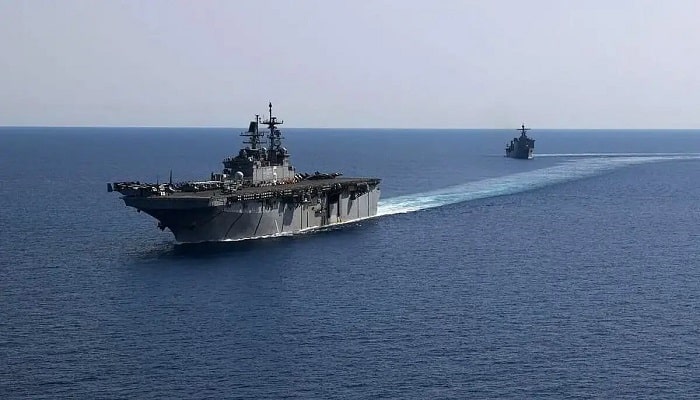
PNN – CNN announced that the US Department of War (Pentagon) and the National Security Council underestimated the impact of an attack on Iran on the Strait of Hormuz during planning.
According to the report of Pakistan News Network, CNN announced that the US Department of War (Pentagon) and the National Security Council underestimated the impact of an attack on Iran on the Strait of Hormuz during planning.
CNN reported Thursday night local time, citing several informed sources: The Pentagon and the National Security Council significantly underestimated Iran’s willingness to close the Strait of Hormuz in response to US military strikes when planning this attack.
According to CNN, the sources added that US President Donald Trump’s national security team had not fully considered the possible consequences of what some officials are now describing as a “worst-case scenario” for the administration.
According to sources, although senior officials from the US Departments of Energy and Treasury were present in some official planning meetings for the attack on Iran before it began, the analyses and forecasts of this institution, which were considered an important part of the decision-making process in previous administrations, were a second priority in this case.
These sources acknowledged that Treasury Secretary Scott Besant and Energy Secretary Chris Wright were key players during the planning and execution of the conflict.
However, sources said, Trump’s preference to rely on a narrow circle of close advisers in national security decisions has largely sidelined interagency discussions about the potential economic consequences if Iran were to close the Strait of Hormuz in response to US and Israeli attacks.
US officials said on Thursday that it may take several weeks for the Trump administration’s efforts to mitigate the economic fallout from the escalating crisis to take effect.
CNN continued: Among these measures is the naval escort of oil tankers through the Strait of Hormuz; a high-risk measure that, according to the Pentagon, is currently considered too dangerous to implement.
Meanwhile, US President Donald Trump has continued to downplay the turmoil and volatility in energy markets.
The Strait of Hormuz is a vital channel through which 20% of the world’s oil passes.
The joint military aggression by the United States and the Zionist regime against the Islamic Republic of Iran, which resulted in the martyrdom of Ayatollah Khamenei, the Leader of the Islamic Revolution, began in the early hours of February 28, 2026; this action took place while indirect negotiations between Iran and the United States were underway with the mediation of some regional countries.
Tom Fletcher, the UN Under-Secretary-General for Humanitarian Affairs and Emergency Relief Coordinator, warned of the escalation of the crisis in the region and the loss of control by the initiators of this conflict (the United States and Israel) on the seventh day of the joint US-Israeli attack on Iran: According to reports, we are seeing huge amounts of money, $1 billion a day, to finance this war, which is being spent on destruction.
Following the start of the joint military aggression by the United States and the Zionist regime, the Islamic Republic of Iran provided a decisive, targeted, and proportionate response to this action. As part of this legitimate response, the military and security positions of the Zionist regime in various cities of occupied Palestine, as well as the bases and centers of deployment of American forces in the region, were targeted with precise missile, drone, and air strikes.