
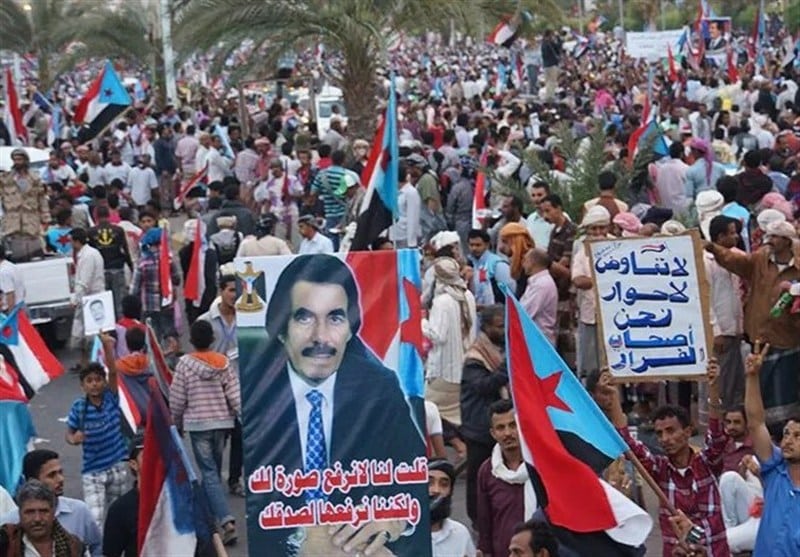
South Yemen’s formation; rectifying the 1994 failure.
Yemen witnessed geopolitical developments last week, during which the so-called Transitional Council forces, supported by the UAE, succeeded in taking control of the two provinces of Hadramaut and Al-Mahra, taking control of the entire Yemeni coastline in the northern Indian Ocean from Al-Mahra to Taiz, which is actually a prelude to the re-establishment of South Yemen.
This is why the leaders of South Yemen and North Yemen decided to merge in 1990, in line with international changes and economic problems after bloody wars between the two countries.
The North Yemeni army, supported by Saudi Arabia, and the South Yemeni army, supported by the Soviet Union, fought a long and bloody war during the 1970s and 1980s. Still, during the period of Ali Abdullah Saleh in the north and Ali Salem Al-Bayd in the south, the two sides decided to unite.
The northerners and southerners wrote a new constitution, and in May 1990, the union of Sanaa and Aden was signed, but this agreement lasted only 4 years. The southerners emphasized that the agreement’s provisions and the distribution of positions and assets were not respected, and they again set the instrument of separation.
The third war between the north and the south of Yemen began again in 1994, but this time the northern forces succeeded in defeating the south, and Aden came under the control of the forces of Ali Abdullah Saleh.
The differences between the two sides during the rule of Abdullah Saleh and Abd Rabbuh Mansur Hadi did not have the opportunity to emerge due to Saudi support for Sanaa, and the Sanaa government, relying on the support of Riyadh, was able to keep the south under control.
The 2015 Yemeni revolution and the expulsion of elements affiliated with Saudi Arabia from Sanaa caused the country to intervene directly militarily to pressure the revolutionaries and, at the same time, enter into a coalition with forces in southern Yemen under the name of the “Southern Movement”.
In recent years, the Southern Movement, with the support of Saudi Arabia and, after 2016, with the increased support of the UAE, succeeded in forming the Southern Transitional Council in 2019. The Southern Transitional Council, which was actually part of the coalition of forces opposing the revolutionary government in Sanaa, known as the Presidential Council, was also in conflict with the northern forces within this same council.