
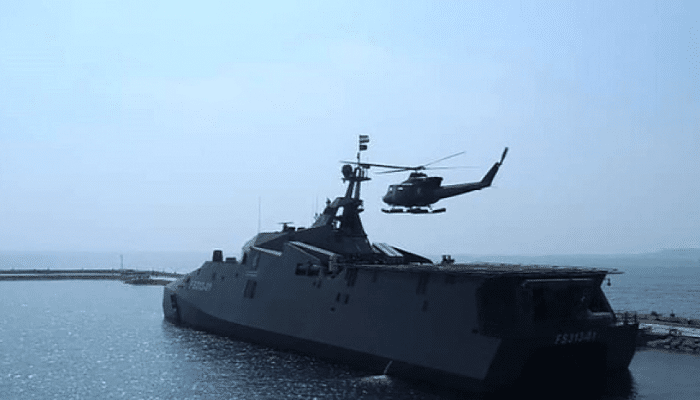
PNN – The Deputy Political Chief of the IRGC Navy said that Iran is receiving real-time data from the Strait of Hormuz from the air, the surface, and beneath the sea, and that the security of this region depends on Tehran’s decisions.
Mohammad Akbarzadeh, Deputy Political Chief of the Islamic Revolutionary Guard Corps Navy, said on Tuesday in response to military threats from some US officials that the Islamic Republic is not seeking war, but is fully prepared to confront the enemy, adding that “if a war is imposed on us, the response will be more decisive than in the past.”
He went on to say that Iran’s defensive readiness, particularly in the field of air defense, is at a very high level, noting that all senior commanders and top officials of the country, including Ghalibaf, Larijani, Pezeshkian, Pakpour, and Mousavi, have emphasized that if a war begins, there will not be even a one-millimeter retreat and Iran’s movement will be forward.
Referring to the fact that the management of the Strait of Hormuz has moved beyond the traditional model and has become fully intelligent, the Deputy Political Chief of the IRGC Navy said, “We are receiving data in real time beneath the sea, on the surface, and in the air,” and through full control determine which vessels and warships, under which flags, are allowed to pass and which are not.
If your country is placed at the disposal of the enemy, you will be considered hostile
Akbarzadeh said that Iran does not want the global economy to be harmed, but it is also not acceptable for the Americans and their supporters to benefit from a war they have initiated. He added that they must know that if their food security, energy supplies, and trade have so far been ensured through this route, today we can turn that very security into insecurity for them.
He also stated that neighboring countries have been told that they are considered friends, but that “if their airspace, land, or territorial waters are used against Iran, they will be regarded as hostile.” He said the response of these countries has been positive and that they have conveyed this concern to the United States and Israel.
The Deputy Political Chief of the IRGC Navy further stressed that in addition to what has been mentioned, there are other capabilities that will be revealed at the appropriate time.
$150 Oil, Iran’s Trump Card in the Confrontation With the United States
The message that “when Iran is involved, there is no such thing as a limited strike” has so far been conveyed by various officials in Tehran. In this context, the Strait of Hormuz is one of the key trump cards Iran can play, because this strait is the vital artery for 21 million barrels of oil per day, accounting for about 37 percent of the world’s seaborne oil trade. Any disruption there would deliver a major shock to the global oil market and cause prices to surge.
This scenario is frightening but conceivable, because if any problem arises for Persian Gulf oil, crude prices could reach $150 per barrel even in the most cautious scenarios, and gasoline prices in the United States could cross $4.5 per gallon.
This is a strategic reality, since having the operational capability to disrupt this waterway is not a difficult task for Iran. Tehran knows well that this 33-kilometer stretch is a lever capable of shaking the $25 trillion US economy, and Washington is aware that any strategic miscalculation against Iran would carry heavy consequences for the global economy. In such circumstances, this oil-rich region would burn in a fire ignited by the United States.