
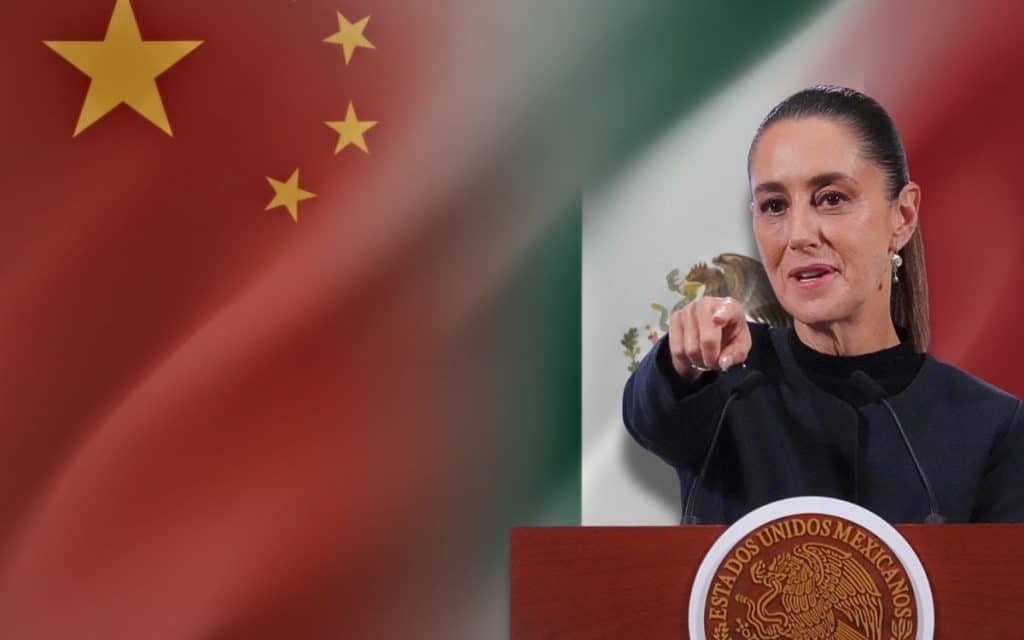
Dispute escalates between Mexico and China over new tariffs.
According to the Spanish section of the ART website, Mexican President Claudia Sheinbaum said in a press conference that Mexico will earn at least $30 billion annually thanks to the new tariffs: “We are negotiating with all countries, we do not want hostility with any country; these are simply decisions that have been made with the agreement of the different commercial and industrial sectors in our country, from small to large, to strengthen employment and development in Mexico. We are negotiating in all cases.”
She clarified that since her election campaign, she has emphasized the need for the country to import less and export more products and services to create jobs and strengthen the national industry.
Last week, the Mexican Congress approved the “General Tax on Imports and Exports Law,” proposed by Sheinbaum. The law imposes new tariffs on goods from countries with which Mexico does not have a free trade agreement.
China immediately protested Mexico’s new tariff law, which has been the hardest hit by the law; Chinese products account for 20.8 percent of Mexico’s imports, and its tariffs will be higher from now on.
China’s Ministry of Commerce said in a statement on Thursday that the tariff hike would cause “significant harm” to China and Mexico’s other trading partners. The ministry called on Mexico to “correct its wrong practices of unilateralism and protectionism as soon as possible.” The ministry said it was currently investigating trade barriers with Mexico, which began in September.
A Chinese government spokesman also responded to the Mexican government’s move, according to the Spanish version of Xinhua News Agency, stressing that China has always opposed “unilateral tariff increases” in all their forms and urging the Sheinbaum administration to exercise caution and correct “wrong practices” such as protectionism that create trade barriers.
Sheinbaum then pledged to provide more details about the reasons for the law, along with his economy minister.
Mexican Economy Minister Marcelo Ebrard explained that the main objective is to protect 350,000 jobs that were at risk in Mexico if bilateral trade with Asian countries was not changed.
He recalled, for example, that 250,000 jobs were lost in the footwear and textile industries between 2021 and 2024, as imports in these sectors increased by more than 20%, while steel purchases increased by 12.4%.
Regarding the strategic automotive market, Ebrard explained that Mexico is the fifth largest car manufacturer in the world, but between 2023 and 2024, car imports from Asian countries with which Mexico does not have a trade agreement increased by 34%, which is a worrying trend.
He added that overall, Mexico exports only $22.76 billion worth of products to Singapore, Indonesia, the Philippines, India, Thailand, Malaysia, Vietnam, South Korea, and China, but imports 10 times that amount, $227.80 billion.
“We cannot allow this upward trend to continue because it is unsustainable,” Ebrard said.
Mexico’s economy minister, like the president, stressed that the new tariffs were not designed to target any specific country. “We do not have a geopolitical agenda; what we are doing is imposing tariffs to protect an industry in Mexico, regardless of the country where it is produced,” he added.
According to the Central Bank of Mexico, China sold about $11.581 billion worth of goods to Mexico through July 2025. China is the second-largest exporter to Mexico after the United States, and it sold $130 billion in goods to the country last year (2024). (The United States sold $334 billion in goods to Mexico last year.)
According to the New York Times, the Mexican Congress’s move to impose tariffs of up to 50 percent on Chinese imports is seen as an attempt to align Mexico with the United States amid pressure from Washington.
According to Oscar Ocampo, director of economic development at the Mexican Competitiveness Institute (IMCO), although the move is intended to boost revenue, it should also be considered in the context of negotiations with the United States and Canada to revise the free trade agreement (TMEC).
He adds, “This plan is written in the style of US President Donald Trump. If you change the name of the country, it’s like a document issued by the White House.” This is, of course, not a problem, but currently, Mexico is complaining that the US is closing its market, while it is doing the same thing to countries with which it does not have a free trade agreement. Of course, unlike the US, Mexico still adheres to the principles of the World Trade Organization, and this is not an insignificant point.
Mexico shares more than three thousand kilometers of common border with the US, and since Trump took office, dozens of issues have been negotiated and discussed between the two countries, from immigration to the drug fentanyl, to investments, and … In this regard, while criticizing the closure of the US market, Mexico has also adopted similar policies against other countries to show that it stands with the US in the regional economic and trade struggle.