
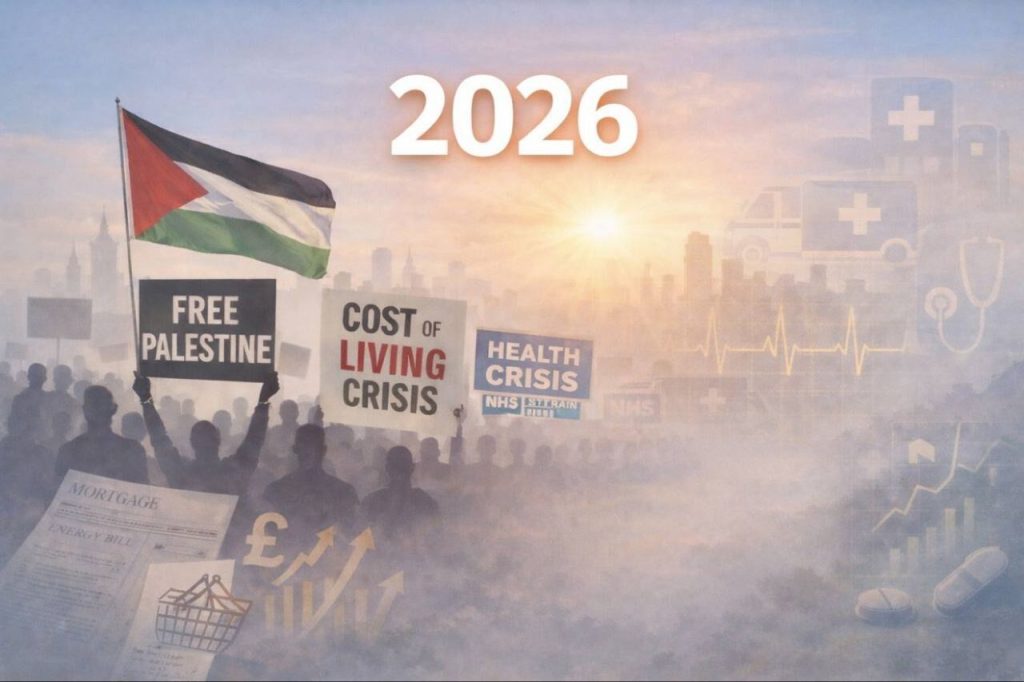
Early 2026: renewed hope for peace and crisis resolution.
People around the world are celebrating the arrival of the New Year according to their local customs.
In London, thousands of Britons and tourists from around the world gathered along the River Thames, near the London Eye in Westminster, to celebrate the final moments of 2025 and the arrival of the new year together.
As midnight approached, the paths leading to the south bank of the Thames became busier, with police and city services personnel stationed at various points to manage the crowds, control traffic routes, and ensure security for the event.
The New Year’s Eve celebration around the London Eye has been a fixture in the British capital since 2000, and is held every year, focusing on the banks of the Thames and London’s urban icons.
In the capitals and major cities of Europe, which had entered the New Year an hour earlier, people gathered in squares and next to iconic city buildings, and public celebrations were held with music, light, and fireworks programs.
In East Asia and the Pacific, major cities had recorded the entry into 2026 with similar rituals a little earlier, and the wave of the New Year continued from east to west, according to the local time of the countries.
But 2026 began while signs of continuing geopolitical competition, the shadow of wars and humanitarian crises, and at the same time, the efforts of global powers to redefine the rules of security, trade, and technology are prominent.
Among the controversial events of last year, military attacks on Iran and the country’s nuclear facilities, which are under the supervision of the International Atomic Energy Agency safeguards, became one of the darkest moments of the rules-based system.
The International Atomic Energy Agency warned at the same time about the consequences of such attacks for safety, security, and the safeguards system, but at the political level, the response of the Director General and European capitals was limited to expressing concern and distancing themselves from a direct role; an approach that, in the eyes of many, contributed to the erosion of the credibility of the non-proliferation order and double standards in dealing with aggression.
Meanwhile, the Ukrainian war remains one of the main axes of tension in East-West relations, and the Gaza war, with its continuing humanitarian crisis, has been another test of Western governments’ human rights slogans; a test that, each time, with the rise of field images and statistics, brings the gap between claims and actions to the forefront of public debate.
The Ukrainian war in 2025 was also a tense and eroding point, with both Russia and Ukraine facing heavy casualties and global political pressure, and negotiations for a ceasefire between the two countries did not yield results.
The global economy also experienced weak growth last year, remaining at around 2.8%, below the pre-pandemic average, and continued to fluctuate under the pressure of high debt, low investment, geopolitical tensions, and the trade war that US President Donald Trump had unleashed on the world.