
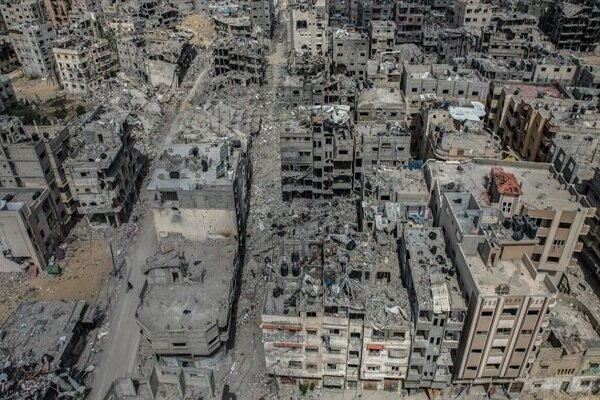
“Ecocide”, Israel’s crime against the Gaza Strip.
As the historic verdict of the International People’s Court for Palestine in Barcelona was announced, condemning Israel, the United States, several European countries, and other actors for genocide, ecocide, deliberate starvation, and systematic violations of international law against the Palestinian people, one of the most prominent experts present at the trial was Dr. Omar Neshabeh.
Omar Neshabeh, a criminologist and human rights researcher, holds a PhD in criminal justice and has spent decades researching structural violence, prison systems, and state accountability in the region. He has worked in academia, investigative journalism, and human rights activism, and was a member of the editorial board of the newspaper Al-Akhbar for many years. In court, he appeared as an expert witness for the prosecution, presenting detailed documentation of Israel’s destruction of Gaza’s environment and infrastructure; An analysis that played a significant role in concluding that Israel’s actions in Gaza constitute not only genocide but also ecocide. In this exclusive interview with Tehran Times, Dr. Neshabeh explains the findings, legal basis, and global implications of the anti-Zionist verdict. Read the full interview with him below;
Why was this “International People’s Court for Palestine” established at this juncture, and what gaps does it fill?
Since 2023, the Israelis have been committing genocide, ecocide, crimes against humanity, and war crimes against Palestinians, and of course, these are just the latest links in an 80-year chain of violations: occupation, apartheid, and indiscriminate killings that have continued since Israel’s creation in 1948. For all these decades, Israel has evaded accountability, creating a global climate of impunity; An atmosphere in which Israeli officials always escape the consequences of any punishment.
Today, these crimes have reached an unprecedented point. Everyone has witnessed the death of children from hunger, the bombing of hospitals, and the blatant violation of international law in the Gaza Strip. The International Criminal Court issued an arrest warrant for Netanyahu, but no country, not even the European states that are parties to the Rome Statute, executed it. The International Court of Justice ordered Israel to allow food in and stop the killing, but Tel Aviv ignored it three times.
When international mechanisms failed to stop the crime and hold Tel Aviv accountable, we felt the need for a popular and democratic mechanism. The People’s Court was created precisely for this purpose, so that ordinary people could present documents, record the facts, and issue a verdict, without the politics and influence of governments distorting it.
I made my position clear in court. I presented evidence that Tel Aviv was committing not only genocide but also ecocide in Gaza. I even coined the term “metacide,” which means the destruction of nature and every sign of human life in Gaza. This court was established to express global solidarity with the Palestinian people.
How does the court define the “right to resist” from a legal perspective and distinguish it from what Israel calls “terrorism”?
The right to resist occupation is an internationally recognized right. One of the main documents that legitimizes this right in all its forms is the UN Charter. Chapter VII of the Charter states that every member of the UN, including Lebanon and Palestine, has the right to self-defense and to struggle for freedom if occupied or attacked. No part of the Charter can limit this right. This right is also affirmed in UN resolutions, Resolutions that recognize the right of nations to resist colonialism and foreign domination. After World War II, the international community actively supported the right of nations to independence, and many countries overthrew colonialism through resistance. Therefore, the right to resist occupation is part of international law and not just a political opinion or position. The People’s Court also simply recalled this existing framework.
What exactly was the theme and main thrust of your statements in court, which revolved around patterns of violence and structural oppression?
I participated in the People’s Court for Palestine not as a judge but as an expert witness for the prosecution. In fact, I focused on an angle that is often overlooked: ecocide, or crimes against nature. This is because, without ecocide, genocide is not complete. If people are not killed or if some of them survive, they can return and rebuild their lives. So to “make” genocide effective, the perpetrators of the crime must also destroy the life-supporting environment. That is exactly what the Israeli regime has done in Gaza: destroying nature, polluting aquifers, poisoning the air, creating an unprecedented volume of rubble, and completely collapsing the sewage system. All of these crimes have been committed to make Gaza uninhabitable.