
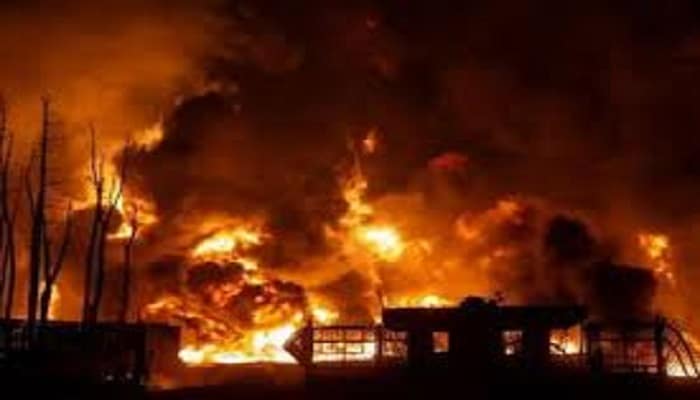
PNN – With 15 days having passed since the start of the US and Israeli attack on Iran, many media outlets are examining possible scenarios for the end of the war.
According to the report of Pakistan News Network, Axios has listed five scenarios for ending the war. The first scenario, according to the news agency, is a “negotiated ceasefire and nuclear agreement.” In recent days, US President Donald Trump spoke in an interview with Fox News about the possibility of resuming negotiations, but Iran has rejected such a possibility.
The second scenario was the Venezuela model for Iran, which did not come to fruition. Trump had repeatedly spoken during the war about the desirability of the Venezuela model for Iran and was willing to implement it in Iran, where the United States in January arrested President Nicolas Maduro and installed his vice president, Delcy Rodriguez. Regarding Iran, Trump also claimed that he should intervene in the selection of a new leader, but by his own admission, the selection of Ayatollah Mojtaba Khamenei disappointed him.
The third scenario, according to Axios, is civil war and the collapse of the regime and the fourth scenario is the use of ground special forces to destroy the enriched uranium stored in Iran. Axios writes that Washington and Tel Aviv have discussed sending Special Forces to Iran to access highly enriched uranium reserves.
Ultimately, Axios called the final scenario Trump would declare victory and retreat without achieving political success in Iran.
The war will stop soon.
According to the report of Event24, Amir Dabirimeh, head of the Qalam think tank and political expert, explaining his conceptual structure for ending the war, says: This structure includes the favorable scenarios of the aggressor (America and Israel) and the favorable scenarios of the Islamic Republic of Iran, and what will happen in the coming days and weeks will probably be a combination of these scenarios.
Dabiri-Mehr explains the current process in several stages. The first stage is “assessment,” which lasted about 10 days and during which the sides became aware of each other’s strategies, tactics, and capabilities; the second stage is “escalation of conflicts,” which is where we are now, and the sides are trying to focus on the opponent’s weaknesses and take advantage of their strengths based on the assessments made; and the third stage is “pause.”
According to him, the surrounding evidence shows that the war cannot continue in the medium or long term and will move towards a standstill.
The US and Israel’s preferred scenarios for ending the war
This political expert points to three scenarios desired by the enemy and writes that the first scenario is the collapse of the Islamic Republic, which is out of reach and now the likelihood of its realization has decreased.
The second scenario is Iran’s surrender in the war and a direct request for a ceasefire from Tehran, which he believes is out of reach, and the third scenario is the complete weakening of Iran’s military and law enforcement defense capabilities. More than five thousand attacks by the enemy have been focused on achieving this goal, and if successful, it could pave the way for scenarios of collapse or surrender, although this goal has not yet been fully realized.
Dabiri-Mehr describes the fourth scenario as “fundamentally weakening the country’s infrastructure and damaging residential areas,” and says that this scenario has been in effect since the oil and gasoline depots in Tehran were targeted and has greater operational capability than some other scenarios. He calls this trend worrying, noting: A heavy legal and moral responsibility lies with the aggressor, but in the international arena, sometimes “brute force” becomes decisive.
What are Iran’s preferred scenarios for ending the war?
In the section on the Islamic Republic of Iran’s preferred scenarios, Dabiri-Mehr proposes two paths. The first path is to continue the resistance until the US or Israel declare a ceasefire, which he considers a national victory and a symbol of the resistance’s success, and believes it can create a medium-term deterrent. The second path is to request a ceasefire through a mediator, which he believes is more likely to be realized than a direct surrender by Tehran.
The head of the Qalam think tank says: There are signs of efforts at mediation, and the role of Russia and China, with their veto power in the Security Council and greater weight in the international system, in facilitating a ceasefire solution is significant.
America is an actor in Israel’s scenarios
Dabiri-Mehr also points to the difference in priorities and approaches between Israel and the United States, and believes that this war has a distinct “directing” and “acting” element; meaning that Israel plays the role of director and the United States plays the role of actor, and the Americans feel that the costs of this conflict have fallen partly on their shoulders. He says that although there are differences between Washington and Tel Aviv, overall this event can be considered an American-Israeli war against the Islamic Republic of Iran.