
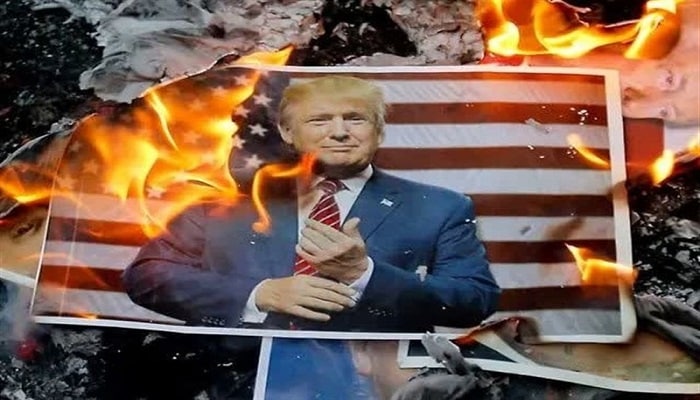
PNN – A European think tank has proposed 8 pressure points for Europe to help Trump get out of the war.
According to the report of Pakistan News Network, the European Council on Foreign Relations (ECFR) think tank has argued in a strategic analysis titled “The Art of the Escape” that, although European leaders do not have direct control over America’s empty policies, a correct understanding of the pressures Donald Trump is under could give them leverage to stop the war in Iran. The analysis, which takes a realistic look at the White House’s calculations, emphasizes that Trump is trapped in a crisis from which none of his usual tools – neither aggressive rhetoric, nor threats of escalation, nor deceptive promises of an imminent agreement – can save him.
According to the think tank, Trump never sought a war of attrition in the Middle East. Referring to his history of using force during his presidency, the authors of the analysis emphasize that what drives Trump is the desire to dominate narratives, achieve quick victories, and then shout about “victory.” But in Iran, things went against this pattern. Tehran neither surrendered nor backed down, but closed the Strait of Hormuz. According to the ECFR, oil prices jumped to more than $100 a barrel, gasoline prices in the US rose by about a third to $4 a gallon, and the US president’s approval rating fell to 36%. In response, Trump has resorted to the only method he knows how: empty rhetoric, threats of escalation, and hints that a deal might save him.
8 Pressure Points: Europe’s Roadmap to Influence the White House
An analysis by the European Council on Foreign Relations shows that Trump is currently facing a mix of domestic pressures, some of which are far more important to him than others. Trump is not so concerned about legal challenges, strategic incoherence or the anger of allies, the think tank says. But what really worries him are four factors: the price of gas, the performance of the stock market, his approval ratings among his base, and concerns among Republican elites about whether he can still portray himself as a man who ends crises rather than one who creates them.
In its report, the think tank identified eight specific pressure points and provided European leaders with practical solutions for each:
First: The price of gasoline. According to the ECFR, US politics is notoriously sensitive to the price of gasoline, and this could greatly strain Trump’s voter base. The think tank advises Europeans to link any public intervention on Iran to the burden of households bearing the brunt of rising energy prices. European leaders should make it clear, repeatedly, that de-escalation will lower prices and escalation will raise them.
Second: General inflation. The think tank points to a warning from the Organization for Economic Co-operation and Development (OECD) that continued fighting could push US inflation to 4.2 percent. Reducing inflation was a central promise of Trump’s election campaign. Europe, working with the International Energy Agency, G7 finance ministers and central banks, could make the economic costs of continuing the war so stark that they are impossible to ignore, and present a ceasefire as a pro-growth, anti-inflation option.
Third: The stock and bond markets. According to ECFR analysts, Trump deeply cares about the performance of the markets and considers them his political record. Europeans should emphasize that opening the Strait of Hormuz and ending tensions with Iran is the fastest way to stabilize the markets.
Fourth: The split in the Republican and “America First” base. The think tank warns that Trump’s political coalition is fractured, and younger conservatives and “America First” voices have warned of another war in the Middle East. Europeans should reinforce the line that a ceasefire can restore order without dragging the United States into another attrition war.
Fifth: The midterm elections. According to the ECFR, American independent voters strongly oppose war, especially the deployment of ground troops. This situation will be bad news for Republicans in the midterm elections. Europe could take advantage of this by conditioning any support for protecting shipping or reopening the Strait of Hormuz on an end to the war and the absence of ground troops.
Sixth: Opponents of war within the US government. The European Council on Foreign Relations’ analysis shows that domestic opponents of war can pressure Trump by offering options for escalating or de-escalating tensions. The Europeans can give these officials tools: a specific European package for de-escalation, a naval mission for freedom of navigation, and a diplomatic initiative after the ceasefire.
Seventh: The lack of cooperation from allies. The think tank writes, referring to Trump’s behavior: Despite expressing contempt for allies, he has repeatedly asked them for help because he needs their assets and political support. Europeans should avoid giving him a “group photo” of the coalition. They should offer their support for naval stabilization and diplomacy, not for expanding the war.
Eighth: Friction with Congress. According to the ECFR, Congress could cut off funding and support, as well as point out the risk of a heavy defeat for Republicans in the midterm elections. Europe should use its diplomatic networks in Congress, especially among institutional Republicans, to emphasize that continuing the war will harm both the economy and transatlantic relations.
Three practical strategies: How Europe can exploit the pressures
The authors of the analysis emphasize that Europeans need to know which pressures are most important to the Trump administration. According to the ECFR, gasoline prices are in first place, followed by general inflation. Domestic pressures from the administration and Congress are less important on their own, but they can reinforce the widespread sense that the war is no longer in Trump’s interest. The refusal of allies to legitimize the escalation is also important, as it takes both credit and burden-sharing away from Trump.
The think tank, accepting the risk that Europeans may overestimate their influence and imagine that they can engineer US policy from the outside, emphasizes that this is not the case. Trump himself is the ultimate decision-maker and may still choose to escalate tensions if he thinks a show of military power benefits his image. But Europe can have a strategy to deter this decision, even if it cannot control or predict Trump.
This strategy, according to the ECFR, should be based on three axes that are within European control: first, Europeans should maintain public pressure on the economic consequences of the war and show that a ceasefire is the quickest way to reduce prices and calm markets. second, they should withhold the endorsement and support of allies that Trump is looking to further escalate tensions, while making it clear that they strongly support the diplomacy and maritime stabilization mission tied to the ceasefire. third, they should create an “escape route” that is consistent with Trump’s narcissism: not “withdrawal,” but “agreement”; not “surrender,” but “opening Hormuz”; not “accepting constraints,” but “restoring order.”